1999issue C061-5
Nested Euro cycle timing as one checkable procedure
A historical Euro workflow treated a four-year cycle as the long structure, used a 20-week double stochastic to locate weekly lows, and confirmed entries only after a setup bar plus a point trigger. Editorial reading: nested timing is then a single procedure, not a chart narrative.
- A four-year cycle was treated as the dominant long structure in synthetic Euro history, with a 40-week cycle assigned on the weekly horizon.
- Half-cycle stochastic inputs were used to target 48-month dollar-mark tops and 40-week Euro lows, rather than matching oscillator length to the full cycle.
- Rule-based entry required a double-stochastic turn up from below 10 and a point move above the setup bar before a four-year or weekly low was confirmed.
- Editorial reading: the long cycle, the half-length oscillator and the two-step trigger are one checkable procedure, not three separate chart comments.
A nested timing case
This archive case records a historical workflow on synthetic Euro history that stacked three pieces: a long dominant cycle, a half-length oscillator and a two-step confirmation rule. The lengths, lines and triggers below are the recorded procedure. Comments that go beyond that record are labelled as editorial.
Two horizons on one series
A four-year cycle in synthetic Euro history was treated as the dominant long-horizon structure. Five such cycles were identified from 1981 onward, and the latest low was placed in August 1997. On the weekly horizon the same series was assigned a 40-week dominant cycle. The archive applied Dominant cycle detection on both horizons of one series.
A half-length oscillator
On the weekly horizon a 20-week double stochastic was used to locate those lows, and a dual exponential moving-average overlay was used to mark the weekly trend. The half-cycle stochastic construction used a 24-period input to target 48-month tops on dollar-mark and a 20-week input to target 40-week Euro lows.
Two-step confirmation
Mechanical confirmation of four-year ECU lows used a double-stochastic turn up from below a buy line of 10 plus a 600-point move above the setup bar. Five such signals from 1981 each marked a four-year low.
Weekly Euro buy confirmation required the 20-week double stochastic to drop below 10, turn up to paint a setup bar, then exceed that bar's high by 30 points so daily high-low differences across cash sources would not fire the entry. Rule-based entry was the confirmation step in that record.
A nested count after the long low
A 10-week oscillator dip and rise from below 10 was used to count three completed 20-week cycles after the last four-year low. The series was then 17 weeks into a fourth cycle that a straight weekly count still needed three weeks to finish.
What the trigger was said to add
The setup-bar-plus-trigger combination was reported to raise signal accuracy by up to 15% versus the setup bar alone, and historically to identify cycle extremes with 70% or greater accuracy. After a confirmed 40-week low the first measured objective was 1.1150 within six weeks, with a Friday close above that level treated as a cue to test 1.1550 to 1.1630.
Weekly synthetic euro after the 1997 four-year low
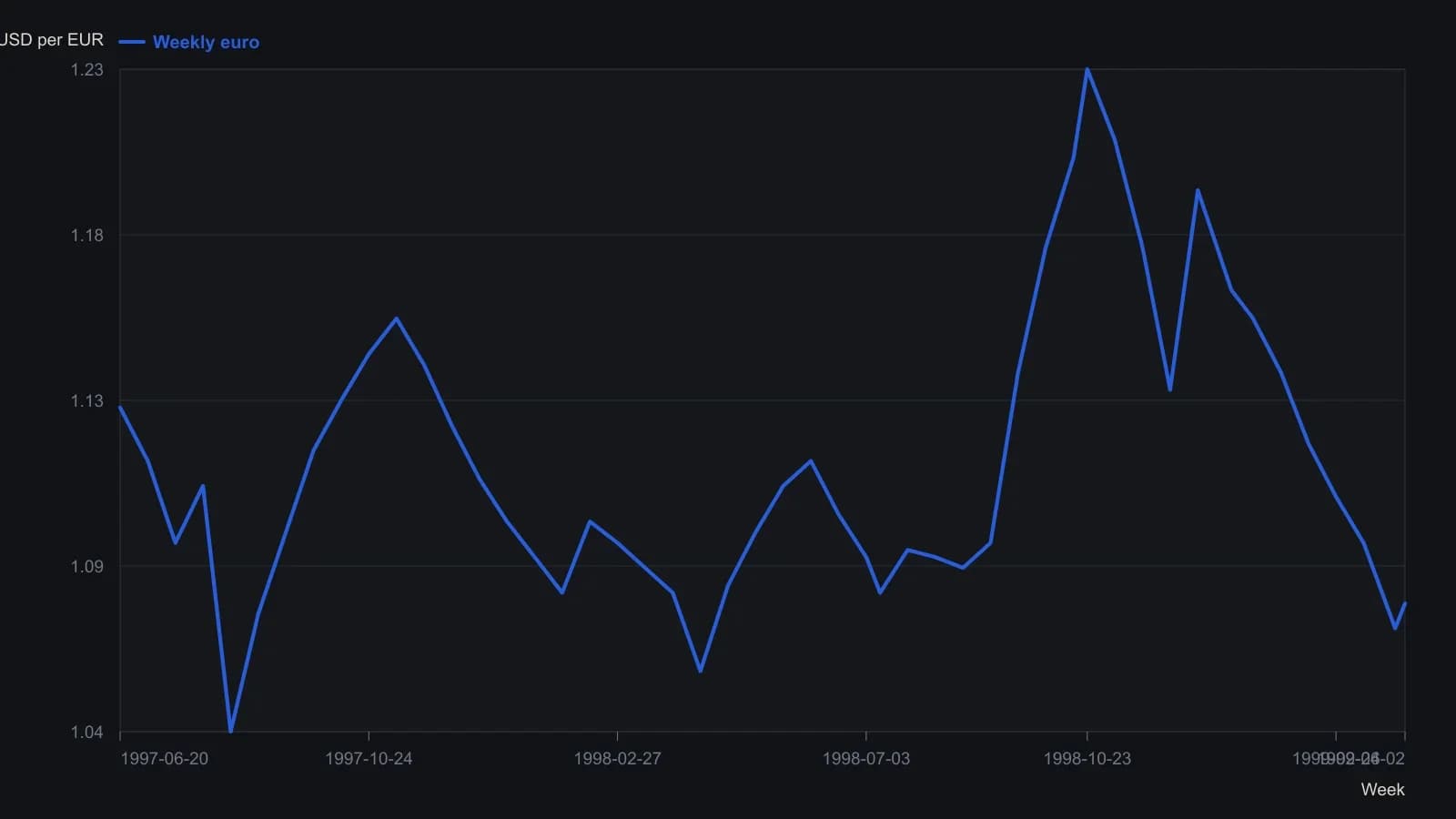
Bars before 4 January 1999 are Bridge Channel EuroCalc synthetic euro, spliced to interbank prices after the launch. Digitised weekly levels are approximate to about half a US cent. The companion 10-week double stochastic used a buy line of 10; a buy needed a 30-point break of the setup bar.
All readings on this track · 31 readings
- 1982Cycle phase windows for chart signal filters
- 1987Constructing a cycle-scaled trend oscillator
- 1987Constructing a dominant-cycle grid from marked lows
- 1988Cycle lead from staggered exponential averages
- 1988Auditing the forty-month stock-price cycle
- 1989When long-wave dominant cycles cannot be disproved
- 1991Half-cycle average plot shift versus cycle attenuation
- 1991Half-cycle average contact as an amplitude-ratio test
- 1993Building a restoring-pull indicator from cycle frequency and volume
- 1995Regime filters for a dominant long wave
- 1995A cycle-tuned lead filter from bounded oscillators
- 1998Testable cycle rules instead of fear and greed
- 1999Nested Euro cycle timing as one checkable procedure
- 2002Constructing an instantaneous trendline from a dominant cycle
- 2002Half-cycle center of gravity oscillator from moving-average balance
- 2004Testing a locked forty-week cycle with a hold-or-sit-out rule
- 2005Nested timing bands for dominant-cycle confirmation
- 2005Dominant-cycle baselines versus policy-news narratives
- 2006Pairing a dominant-cycle horizon with trend and oscillators
- 2006A dominant-cycle split into a trend filter and residual Relative Strength Index
- 2007Construct a momentum difference from the dominant cycle
- 2007Naive dominant-cycle rules fail without crowd tests
- 2012Constructing a dominant-cycle forecast as a timing window
- 2012Open-parameter construction of dominant-cycle baselines
- 2013Using a second-term election to check a predeclared dominant-cycle forecast
- 2014Constructing a dominant-cycle forecast baseline
- 2014Quotient transform as an early-onset trend filter
- 2014Construct a trough-to-trough cycle map with the Detrended Price Oscillator
- 2015Dominant-cycle alignment before an earnings catalyst
- 2017Causal reverse exponential average for cycle and trend
- 2020Constructing a cycle-plus-trend oscillator from a one-wavelength chord