1997issue C041-8
Calendar seasonality as a testable trading procedure
Archive notes define seasonality as calendar-tied recurrence and turn that definition into an open-to-close date study. The same notes then ask whether a lagging trend rule can be applied to a forward-shifted-seasonal-series instead of raw prices.
- Seasonality is defined here as calendar-tied recurrence, including anniversary dates, not as every cycle or weather pattern.
- An intraday-date-study tallies same-date open-to-close outcomes over a lookback-window, then uses hit rate and average change to go long, short, or sit out.
- End-of-day evaluation applies a lagging moving-average crossover to a forward-shifted-seasonal-series and is expected to help only where seasonal trends are meaningful.
- Simple seasonal procedures are templates to elaborate with risk control and later mix with other rule types, not finished mechanical-trading-system designs.
What seasonality means here
Seasonality is defined here as calendar-tied recurrence. Anniversary dates are included. Other cycles and weather patterns are not treated as seasonality in this workflow.
That narrow definition keeps the study on the calendar, so a given date can be compared with prior occurrences of the same date.
An open-to-close date study
An intraday-date-study tallies same-calendar-date open-to-close outcomes over a multi-year lookback-window. Hit rate and average change then decide whether to go long, short, or sit out.
A ten-year window is the worked example for counting those prior occurrences before an open-to-close order is placed. The daily stance is therefore one of three actions: trade long, trade short, or sit out.
A lagging rule on a shifted seasonal path
End-of-day evaluation asks whether a lagging moving-average crossover can be applied to a forward-shifted-seasonal-series instead of raw prices. A forward-shifted-seasonal-series is a constructed seasonal path advanced a few days so a trend rule can fire without its usual lag.
That construction is expected to work only to the extent the market being traded has meaningful seasonal trends.
The same study on today, later, or earlier
A helper function takes displacement and lookback-window as inputs. Displacement is a date offset that looks at today, a future date, or a past date when the seasonal series is built. The same date study can therefore be pointed at more than one calendar location without changing its logic.
S&P 500 seasonal running-sum, Nov 1995–Nov 1996
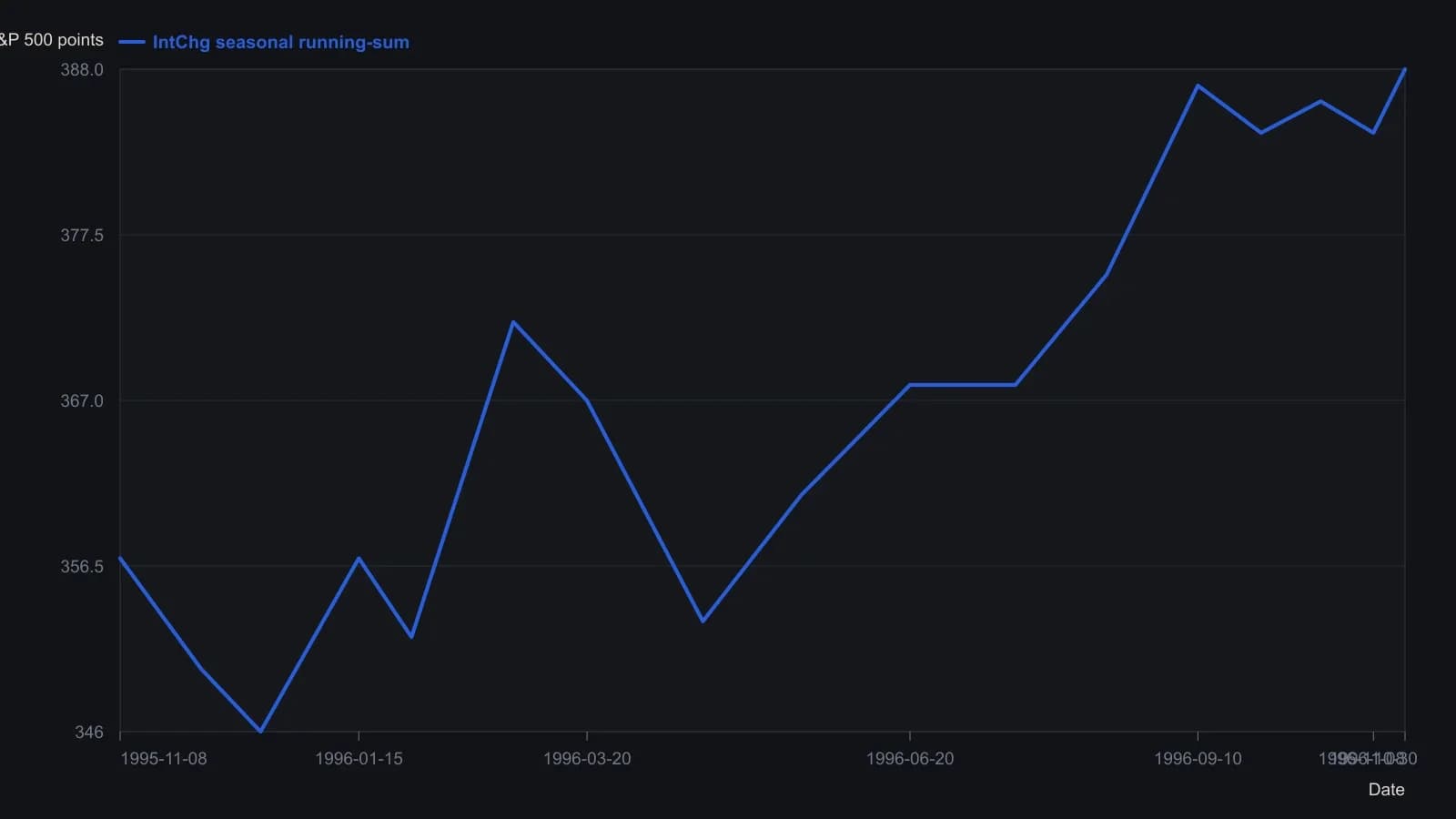
The pane plots IntChg and its 5-bar average (source code fixes Disp=8, Wind=3, MaPer=5). The two traces overlap at magazine resolution for most of the year, so only the visible seasonal level is digitized. The printout tags the pair at 388.04 and 386.85 on 11/08/96.
Templates, not finished systems
Simple seasonal procedures can be elaborated with risk control, stops, re-entry, and filters before they are treated as finished systems. Seasonal rules are framed as later templates for a genetic search that would combine them with other rule types. The next study is reserved for nonseasonal recurrent cycles.
All readings on this track · 41 readings
- 1989Evaluating venue volume as a speculation-breadth signal
- 1991A thirty-name price-weighted average as a seasonal regime classroom
- 1991Ranked half-year rate changes as an equity signal filter
- 1991Demographic wave as a market-regime overlay
- 1994Seasonal range regimes as a futures context overlay
- 1996Evaluating presidential party terms as equity regimes
- 1996A dominant cycle is a baseline, not a reprint
- 1996Seasonality and presidential election cycle regimes
- 1997Stacking calendar regimes around election years
- 1997Calendar seasonality as a testable trading procedure
- 1997Lunar phase delay as a testable seasonal regime
- 1998Seasonal system construction without curve-fitting
- 1999Crowd life cycle as a market regime map
- 2001Regime-dependent cycle timing after four-year and seasonal lows
- 2002A 2002 case study in regime-first seasonal selection
- 2002Seasonal windows and dominant-cycle rules
- 2002Fifty-four-year wholesale cycle as an inflation-deflation regime map
- 2004The championship conference rule as a yearly regime case study
- 2004Election-year seasonality as trade regime context
- 2006Two-ten inversion as an intermarket regime filter
- 2006Midterm-to-presidential seasonal holding window
- 2008Two-layer equity regimes from seasonality and price history
- 2008Seasonal futures as a regime filter, not a calendar rule
- 2008Retesting seasonal rules when regimes change
- 2010Corn and wheat staggered calendars as dollar-neutral seasonal spreads
- 2011Name the S&P 500 trend regime before using weekly and monthly seasonality
- 2012Seasonal windows that wait for confirmation
- 2013Pair-sleeve rotation as a two-state sector regime-switch
- 2013Lunar phase as a seasonal overlay on implied volatility
- 2013Soybean seasonal highs in a five-year carryover regime
- 2014Year-end tax-loss selling as a seasonal regime
- 2017Calendar-window overlays that mute mechanical signals without rewriting the system
- 2017A four-year cycle and volume case study of a secular bear
- 2017Treat the valuation climate as climate and implied-volatility extremes as weather
- 2019Seasonal depth versus tracking for futures position sizing
- 2019Stacking cycle forecasts with seasonal regimes
- 2019Hit-rate gates for seasonal regime evaluation
- 2019July to October as a seasonal window, not a reason to own the name
- 2020A recession-regime checklist from valuation stretch and the yield curve
- 2020Treat a seasonal idea as a stay-or-sit holding procedure
- 2020A single position as a sleeve on a seasonal regime map