2004issue C041-2
The championship conference rule as a yearly regime case study
This case study restates a once-a-year football-conference timing myth as one event-based-seasonal-procedure. It counts exception-years on two stock-index proxies and asks, as an editorial test, whether decade-conference-cluster stories only restate long bull and bear yearly-index-regime stretches.
- The championship-conference-rule maps a National Football Conference winner to an up-year label and an American Football Conference winner to a down-year label.
- A scan from the first championship in 1967 through 37 contests counted 10 exception-years on a broad large-capitalization index and 9 on an industrial-average proxy.
- An original-conference-recode assigns a winner to an earlier conference affiliation and is offered by some supporters as a way to raise the historical match rate.
- Editorial reading: a decade-conference-cluster can name the same long bull or bear stretch already visible in yearly-index-regime labels, rather than add a separate seasonal clock.
A conference label for a full year
A widely circulated yearly timing story labels the stock market an up year after a National Football Conference champion and a down year after an American Football Conference champion.
That story is grouped with other calendar and holiday market traditions. It is framed as an entertaining timing myth rather than a causal account of yearly returns.
In the terms used here, the championship-conference-rule is a once-a-year seasonal signal that maps the winning team's football conference onto an up-year or down-year label for stocks.
Restate the label as one procedure
Editorial framing: convert the myth into one event-based-seasonal-procedure. That procedure treats the championship outcome as the sole trigger for entering, standing aside, or expecting a yearly market bias.
After a National-conference title the procedure assigns an up yearly-index-regime. After an American-conference title it assigns a down yearly-index-regime. The restatement makes entry, hold, and abstention rules testable as a single yearly routine. It is not a trade recommendation.
A yearly-index-regime is only a coarse classification of a full calendar year as an up year or a down year in a stock-index proxy.
Count exception-years on two proxies
A historical scan from the first championship in 1967 through 37 contests found no more than 10 years in which the conference-based yearly pattern failed.
That scan counted 10 exception-years when a broad large-capitalization stock index was the proxy and 9 exception-years when an industrial-average proxy was used.
An exception-year is a calendar year in which the conference label did not match the yearly direction of the chosen equity-index proxy. The two proxies did not produce the same exception count.
Original-conference-recode changes the input
Some supporters recode winners by a team's original conference assignment rather than the conference it belonged to when it won, arguing that this recoding increases the historical match rate.
An original-conference-recode is that variant. Editorial reading: the recode edits the conference input that feeds the same event-based-seasonal-procedure. It does not introduce a separate market mechanism.
Matches and misses around the turn of the decade
In 2003 a National-conference champion coincided with a strong up year in both index proxies, while American-conference champions in 2001 and 2002 coincided with down years in those proxies.
The championship-conference-rule did not fit 2000, a down year after a National-conference winner, or 1998 and 1999, strong up years after consecutive American-conference winners.
Those three years are exception-years under the rule as stated, even though the nearby years lined up with the conference label on the same proxies.
Decade-conference-clusters and long regimes
National-conference teams took the title eight times in the 1990s and seven times in the 1980s, while American-conference teams took seven of the ten titles played in the 1970s, a decade described as a long equity bear period.
A decade-conference-cluster is a multi-year stretch in which one conference dominates the title game and is later narrated as lining up with a long bull or bear stock regime.
Editorial test: ask whether a decade-conference-cluster only restates a long bull or bear regime that yearly-index-regime labels already show. The 1970s pairing is the clear archive example, with American-conference titles concentrated in a decade already described as a long equity bear period. National-conference teams took most titles in the 1980s and 1990s. The editorial question is whether those later clusters do the same work, naming a multi-year market regime in conference language, or whether they add a separate seasonal claim.
Super Bowl conference winners by decade, 1970s–1990s
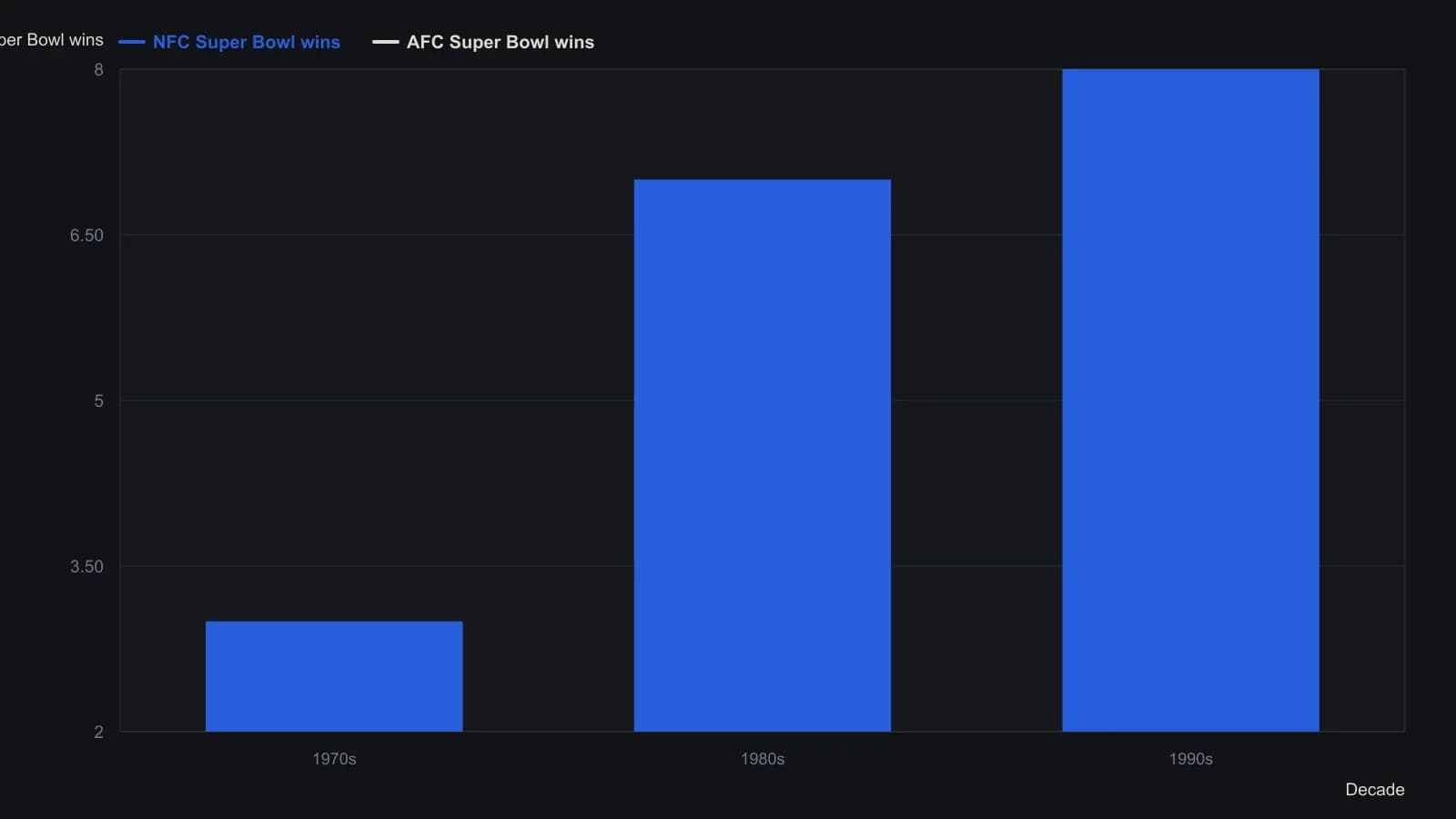
The 1970s NFC total is the remainder after the stated AFC tally of seven of ten Super Bowls that decade. Original-conference recodes are not applied.
How the mid-January 2004 field would have been labelled
As of mid-January 2004, four remaining contenders split evenly between the two conferences, and quoted betting odds favored the American-conference side, which the story would treat as a down-year setup.
Editorial limit: that snapshot shows how the championship-conference-rule would have labelled the still-open field at the time. It is historical workflow, not a present-day forecast and not a claim about later returns.
All readings on this track · 41 readings
- 1989Evaluating venue volume as a speculation-breadth signal
- 1991A thirty-name price-weighted average as a seasonal regime classroom
- 1991Ranked half-year rate changes as an equity signal filter
- 1991Demographic wave as a market-regime overlay
- 1994Seasonal range regimes as a futures context overlay
- 1996Evaluating presidential party terms as equity regimes
- 1996A dominant cycle is a baseline, not a reprint
- 1996Seasonality and presidential election cycle regimes
- 1997Stacking calendar regimes around election years
- 1997Calendar seasonality as a testable trading procedure
- 1997Lunar phase delay as a testable seasonal regime
- 1998Seasonal system construction without curve-fitting
- 1999Crowd life cycle as a market regime map
- 2001Regime-dependent cycle timing after four-year and seasonal lows
- 2002A 2002 case study in regime-first seasonal selection
- 2002Seasonal windows and dominant-cycle rules
- 2002Fifty-four-year wholesale cycle as an inflation-deflation regime map
- 2004The championship conference rule as a yearly regime case study
- 2004Election-year seasonality as trade regime context
- 2006Two-ten inversion as an intermarket regime filter
- 2006Midterm-to-presidential seasonal holding window
- 2008Two-layer equity regimes from seasonality and price history
- 2008Seasonal futures as a regime filter, not a calendar rule
- 2008Retesting seasonal rules when regimes change
- 2010Corn and wheat staggered calendars as dollar-neutral seasonal spreads
- 2011Name the S&P 500 trend regime before using weekly and monthly seasonality
- 2012Seasonal windows that wait for confirmation
- 2013Pair-sleeve rotation as a two-state sector regime-switch
- 2013Lunar phase as a seasonal overlay on implied volatility
- 2013Soybean seasonal highs in a five-year carryover regime
- 2014Year-end tax-loss selling as a seasonal regime
- 2017Calendar-window overlays that mute mechanical signals without rewriting the system
- 2017A four-year cycle and volume case study of a secular bear
- 2017Treat the valuation climate as climate and implied-volatility extremes as weather
- 2019Seasonal depth versus tracking for futures position sizing
- 2019Stacking cycle forecasts with seasonal regimes
- 2019Hit-rate gates for seasonal regime evaluation
- 2019July to October as a seasonal window, not a reason to own the name
- 2020A recession-regime checklist from valuation stretch and the yield curve
- 2020Treat a seasonal idea as a stay-or-sit holding procedure
- 2020A single position as a sleeve on a seasonal regime map