1993issue C051-11
Constructing stochastic, RSI and CCI inputs for forecasts
A forecast model assigns input weights by comparing each output with a supplied training-pattern target. This archive note follows how stochastic, RSI and CCI series were built, scaled and stacked so those columns could be used as model inputs rather than as a chart worksheet.
- If the error count does not fall, columns may be complete as an analyst worksheet and still unusable as model inputs, because weights update only against a supplied training-pattern.
- Currency-pair, Eurorate and gold columns tested against Deutschemark per US dollar were highly correlated and showed little lag, so raw prices were treated as low-value inputs and separately trained outputs were stacked into a primary model.
- Encoding RSI or CCI as the arithmetic gap to a volatility band can invert importance, because that gap shrinks as the oscillator approaches the band while the model treats larger numbers as more significant.
- Construction is described as training on one indicator first and then adding columns, with accepted training tolerances widened early and narrowed in later stages.
What a learner can actually weight
TradersWeek editorial reading: treat stochastic, RSI and CCI construction as the first forecast-design decision. A time-series learner can weight only the scale, cycle length and independence you encode. It cannot apply the rule sheet a discretionary reader would draw on the same chart.
A forecast model assigns input weights by comparing each produced output with a supplied training-pattern target. The training-pattern is the known result paired with that input row. If the error count does not fall, the columns may be complete as an analyst worksheet and still unusable as model inputs.
Training-error histogram when the network cannot learn
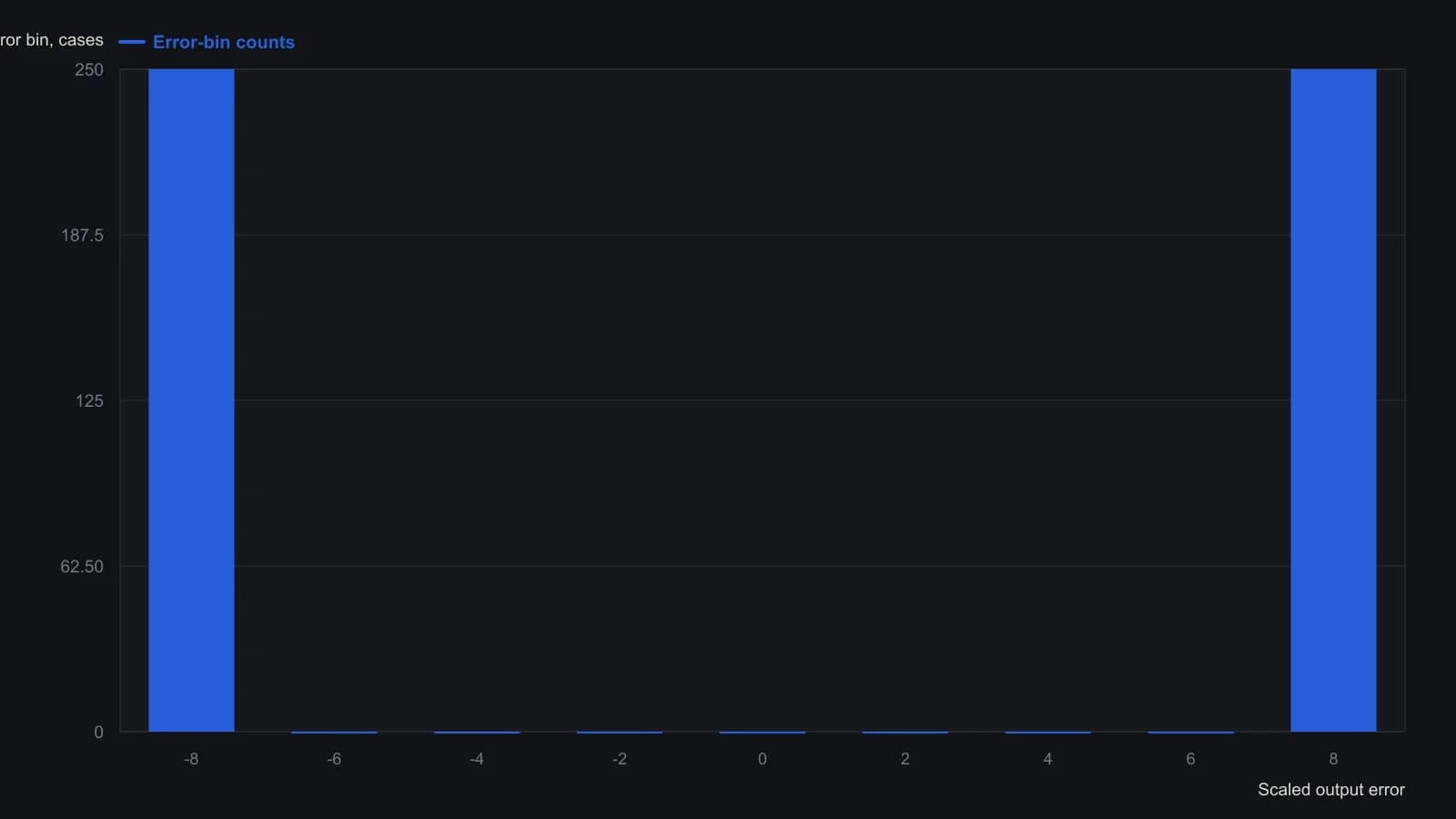
The source does not print a y-axis title. Vertical ticks are 0, 50, 100, 150, 200 and 250; both extreme bars reach the top tick. Intermediate labeled bins show no visible mass on the scan.
When columns move together
Currency-pair, Eurorate and gold columns tested against Deutschemark per US dollar were highly correlated and showed little lag. That input correlation left little independent information, so raw prices alone were treated as low-value forecast inputs. Outputs from separately trained models were then fed into a primary model.
Fixed and cycle-linked stochastic construction
A stochastic oscillator is a bounded oscillator from ordered prices over a stated lookback and smoothing window. A cotton stochastic construction uses an eight-period lookback and three-period smoothing and still shows a varying lag.
A companion construction multiplies that fixed period by a sinewave so oscillator length tracks a selected dominant cycle. That offset is a variable-length displacement: the period lengthens or shortens as the selected dominant cycle expands or contracts.
Band encodings for RSI and CCI
A relative strength index is a momentum oscillator over a stated lookback. A commodity channel index is a deviation oscillator over a stated lookback. Encoding either series as the arithmetic gap to a volatility band can invert importance, because the model treats larger numbers as more significant while that gap shrinks as the oscillator approaches the band. A band touch is required to outrank a mid-band reading. The volatility band is an envelope around the oscillator used as that reference level.
Weekly Deutschemark constructions place a 14-period RSI and a 23-period CCI each against a volatility band. Separate bull-trend and bear-trend volatility columns, plus inverse and four-period-displaced smoothed RSI encodings, are listed as alternative input tests.
Checks, row counts and staged construction
When in-sample error looks resolved but held-out rows fail, the model may have memorized pairs. Multiplying a training-pattern column by minus one, reducing hidden units, or randomizing chronological rows is presented as a check against that shortcut. Row randomization reorders chronological training examples so a trending series cannot be generalized from presentation order alone.
A market-forecasting guideline is fifteen example rows per input column, so four columns imply sixty rows. The model sees one row at a time, so any prior-week price must be written into that same row.
Construction is described as training on one indicator first and then adding columns, rather than loading every available series at once. Accepted training tolerances are widened early and narrowed in later stages.
All readings on this track · 39 readings
- 1982Three gates on a 1982 pork-belly short
- 1982Scale-free Commodity Channel Index construction
- 1986Constructing a commodity channel index and a regression price channel
- 1987Constructing scaled OHLC matrices for study overlays
- 1987Constructing the commodity channel, average directional, and relative strength indexes on a shared cycle scale
- 1992Eleven-bar commodity channel index from typical price and mean deviation
- 1992Evaluating Commodity Channel Index breakout versus range rules
- 1992Evaluating breakout and CCI rules as complete mechanical procedures
- 1993Constructing stochastic, RSI and CCI inputs for forecasts
- 1993Nested centered channels with a commodity channel index confirmation gate
- 1993Listed-option timing as three separable clocks
- 1994Constructing an eleven-period commodity channel index
- 1994Confirming Elliott wave turns with channels and the commodity channel index
- 1995Commodity Channel Index band rules lag zero-line timing
- 1995Building the commodity channel index from typical price
- 1995Staged reversal rules with commodity channel index and average channels
- 1995Commodity channel index construction from typical price to a smoothed zero line
- 2001Reader tests for unfinished lookback oscillators
- 2002Constructing the commodity channel index from typical price
- 2003Breadth-filtered commodity channel index entry and exit rules
- 2003Constructing the Commodity Channel Index from typical price and scaled deviation
- 2003A shallow, poorly participated advance is an unconfirmed trend
- 2003CCI and RSI parameter defaults as scaling conventions
- 2003A cost and capital audit of a Commodity Channel Index trade engine
- 2003Commodity channel index peak divergence as an exit after twin patterns
- 2004Constructing the Commodity Channel Index from typical price
- 2004Constructing the Commodity Channel Index from typical price and mean deviation
- 2006Building custom indicators from the Commodity Channel Index, a least squares moving average and a rule-based entry
- 2012Confirming breakouts and retracements with CCI, ADX, and averages
- 2012Stacking oscillator lookbacks into a heatmap mosaic
- 2013Constructing a consensus and volatility-normalized value oscillator
- 2013Walk-forward system evaluation with a commodity channel index and chandelier exits
- 2014Dual detrended oscillators and dual Bollinger Band channels
- 2014RSI, CCI, and moving-average trend-filter construction
- 2014Dual RSI, a moving average, and CCI as a confirmation stack
- 2017Constructing dual-average cross and channel-index filters
- 2018Treat CAM as a classification layer before confirmation becomes an entry
- 2018Four-state slope labels gated by a moving average and a commodity channel index
- 2018Deviation-Scaled Moving Average construction from a two-bar difference