2017issue C0348
Golden-cross swing entry with a trailing-stop exit
A documented 50-period and 200-period simple moving-average crossover is read as a swing-trading entry on a 90-day daily chart. The archive workflow allows a later fill, holds while the averages stay uncrossed in an uptrend, and closes on a pre-committed trailing stop.
- The documented golden-cross trigger is a 50-period simple moving average crossing above a 200-period simple moving average on a daily candlestick chart.
- After the crossover appears, entry may occur at any later time and is not required on the exact crossover bar.
- The swing stays open while both averages remain uncrossed in an uptrend, then exits on a trailing stop of two points or more or on a trail at the 50-period average.
- Chart-selection notes favor a wide, clean range and instruments priced roughly 20 to 70, and the write-up pairs the cross with other breakout conditions rather than using it alone.
The documented golden-cross trigger
The documented entry trigger is a 50-period simple moving average crossing above a 200-period simple moving average. That daily-chart condition is the golden-cross in this case. The write-up frames the moving-average-crossover as a join of a shorter 50-period momentum line and a longer 200-period trend line.
The worked example is read on a 90-day daily candlestick chart, with the illustrated cross dated 20 October 2016. After that crossover appears, the procedure allows entry at any later time rather than requiring a fill on the exact crossover bar.
Spirit AeroSystems (SPR) 90-day daily closes with 50- and 200-day SMAs
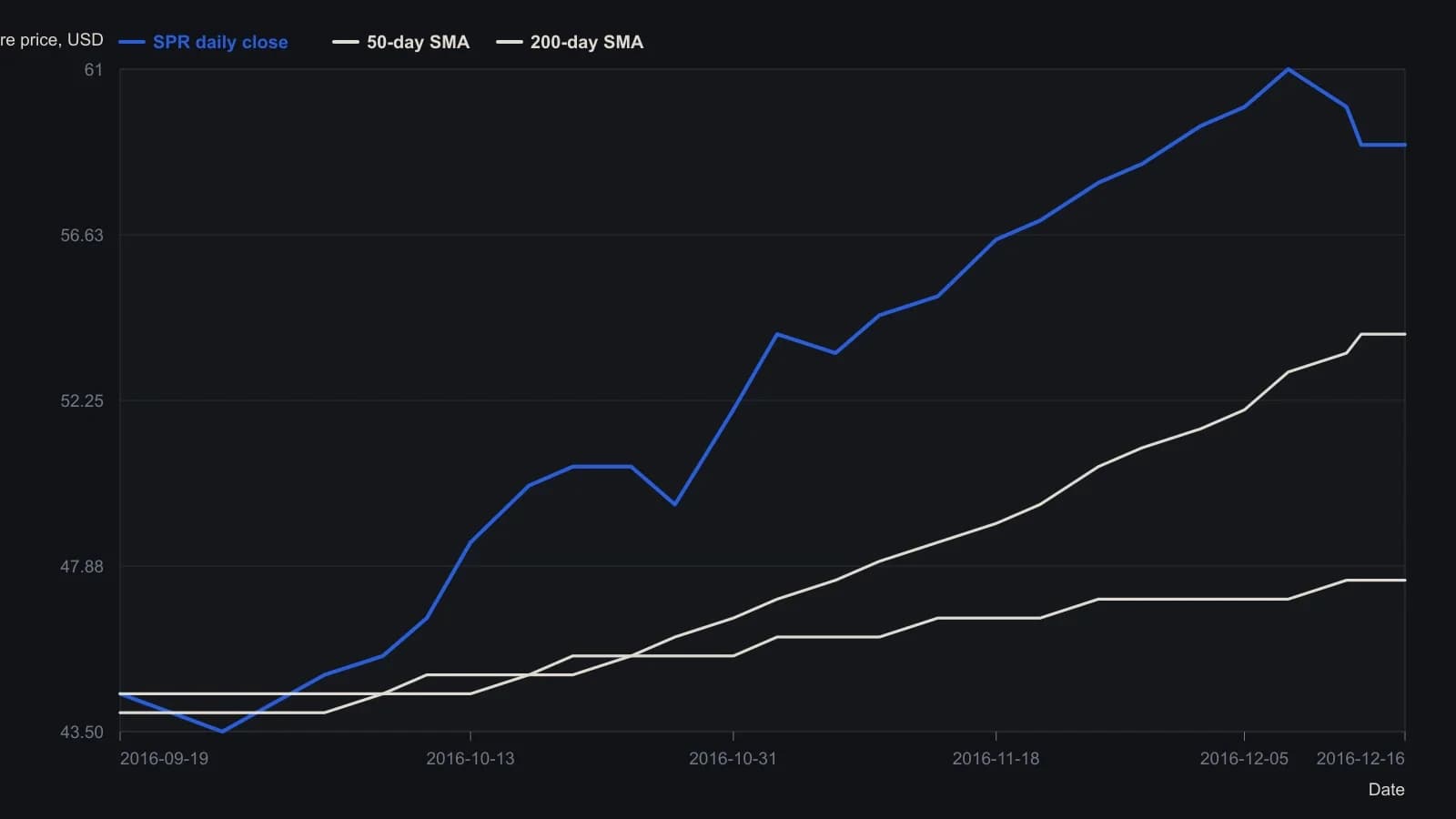
Closes are approximate readings from the candlesticks at roughly twice-weekly spacing; dollar halves are as fine as the raster and $1 price axis will support. The two-point trailing stop is the author’s pre-committed exit, not a level fitted after the fact.
Hold rule and trailing-stop exits
The hold rule keeps the swing open while both averages remain uncrossed in an uptrend.
One specified exit is a trailing-stop of two points or more. The example marks that exit on 13 December 2016 at 59 per share. An alternative longer-hold exit trails at the 50-period average and is marked at 54 on the same example chart.
Chart-range-filter and breakout-confirmation
Chart-selection notes favor a wide, clean range. On the 90-day example that span is about 20 points from 43 to 61. The same notes favor instruments priced roughly 20 to 70 rather than names under 10. In this procedure those notes are the chart-range-filter: a selection rule that prefers a wide, orderly price span over a narrow or choppy chart before a crossover setup is considered.
The write-up says the pattern should be paired with other breakout conditions rather than used alone. That pairing is the breakout-confirmation: an extra price-pattern or volume condition used so a moving-average-crossover is not treated as a standalone entry.
All readings on this track · 35 readings
- 2001Swing trading with trailing stops and fixed loss exits
- 2003Linear regression swing alerts and trailing stops
- 2005Range-width gates for swing entries at base edges
- 2006Beyond setups: a six-factor trading process
- 2007Angle of ascent, chart scale, and style-fit
- 2010Stacking a short-horizon oscillator with a moving average and swing hold rules
- 2010A weekly contest long treated as one swing procedure
- 2011Four-color volume-price states for long-only swing actions
- 2012Classify momentum, velocity, or volatility before the swing signal
- 2013Swing rules as a portable entry and exit procedure
- 2013Constructing paired percent-b and stochastic swing oscillators
- 2013Give the fast band line and the slow stochastic complementary jobs
- 2013Smoothed percent-b divergences for numbered swing-wave rules
- 2013Portable swing rules for candle turns and a 1-2-3 wave count
- 2013A three-average swing and breakout case study
- 2013Constructing swing trades with a fifty-day average and a five-bar exponential average
- 2014From aliasing and dilation to a roofed stochastic swing
- 2014Channel width and trend-filter lookback as separate swing-trading choices
- 2016Constructing volume-confirmed multiday breakout swings
- 2017Constructing swing signals from a volume-weighted average cross
- 2017Golden-cross swing entry with a trailing-stop exit
- 2017One swing procedure: group leadership first, then a volume-price leave
- 2017Four-day green-candle breakout entry as one swing procedure
- 2017Swing pivots need a 100-period crossover and a breakout candle
- 2017Supply and demand zones as bounded swing maps
- 2018Three-bar volume-confirmed swing breakout
- 2018Tight stops first on swing breakouts with a range filter
- 2018Constructing trend and swing rules from horizon to crossover
- 2019Decade-level breakouts as one closed swing procedure
- 2019Inverse-pair swing trading with a shared buy-stop
- 2019Week-range next-day breakout on bitcoin pairs
- 2019Ranking strength before confirming a multi-timeframe breakout
- 2019Forty-five-degree multi-week swing breakout as a closed procedure
- 2020A dual pending-stop pair as one bitcoin swing construction
- 2020High-low activator, directional oscillator, and momentum swing agreement