1984issue C051-13
Pairing tradeoffs with pre-trade checklists
Refuse an isolated hunch. Write competing reasons into one tradeoff ledger, cancel items of similar judged weight, then run a veto checklist so entry, exit, and sitting out stay the same testable procedure.
- Multiple-criteria procedures compare several alternatives on several attributes in one view so reward-seeking and risk-limiting conditions can be handled together.
- Tradeoff analysis records reasons for and against a measure across several review sessions, cancels items of similar judged weight, and decides only after further review adds nothing material.
- A checklist process drops each alternative that fails a rule, market-state, or execution screen until one action remains or none is acceptable; screens may be combined rather than applied one at a time.
- Additive weighting may rank remaining options only after constraints and weighting curves are applied, and only when an alternative's value does not depend on interaction between criteria.
One procedure, not a hunch
Editorial reading: a desk should refuse an isolated hunch. Competing reasons belong in one written view. A veto checklist then keeps entry, exit, and sitting out inside the same testable procedure.
The archive describes a multiple-criteria workflow. Several alternatives are compared on several attributes in one view so reward-seeking and risk-limiting conditions can be handled together. The inputs are rule readings, market state, and execution constraints. The horizon is the system holding period.
Write the tradeoff first
Tradeoff analysis is a written procedure that places opposing reasons in one view. It records reasons for and against a measure across several review sessions. Items of similar judged weight cancel. A signal is issued only after further review adds nothing material.
The aim is to make entry, exit, and abstention rules testable as one procedure. Editorial reading: the written view is a reviewable record, not a private impression of why a measure is favored or opposed.
Then run the veto checklist
A checklist process is a pre-trade sequence of screens. It drops any alternative that fails a rule, market-state, or execution test until one action remains or none is acceptable. Sequential elimination compares alternatives against successive screens and drops each failure. Screens may be combined rather than applied one at a time.
The checklist outputs a signal over the system holding period so entry, exit, and sitting out stay one procedure. Editorial reading: an alternative that fails a screen is not eligible, whether the contemplated action is to enter, to leave, or to stand aside.
Constraints before any score
A constraint is a gate an alternative must pass before it may be scored. It is stated as a required trait or as a disqualifying trait. A conjunctive screen is an and-gate: a viable alternative must meet every listed condition. A disjunctive screen is an or-gate: a viable alternative must meet at least one listed condition.
Additive weighting can apply positive or negative constraints that an alternative must meet to stay eligible. Editorial reading: a score does not restore an alternative that failed a gate.
Product-price weighting curve
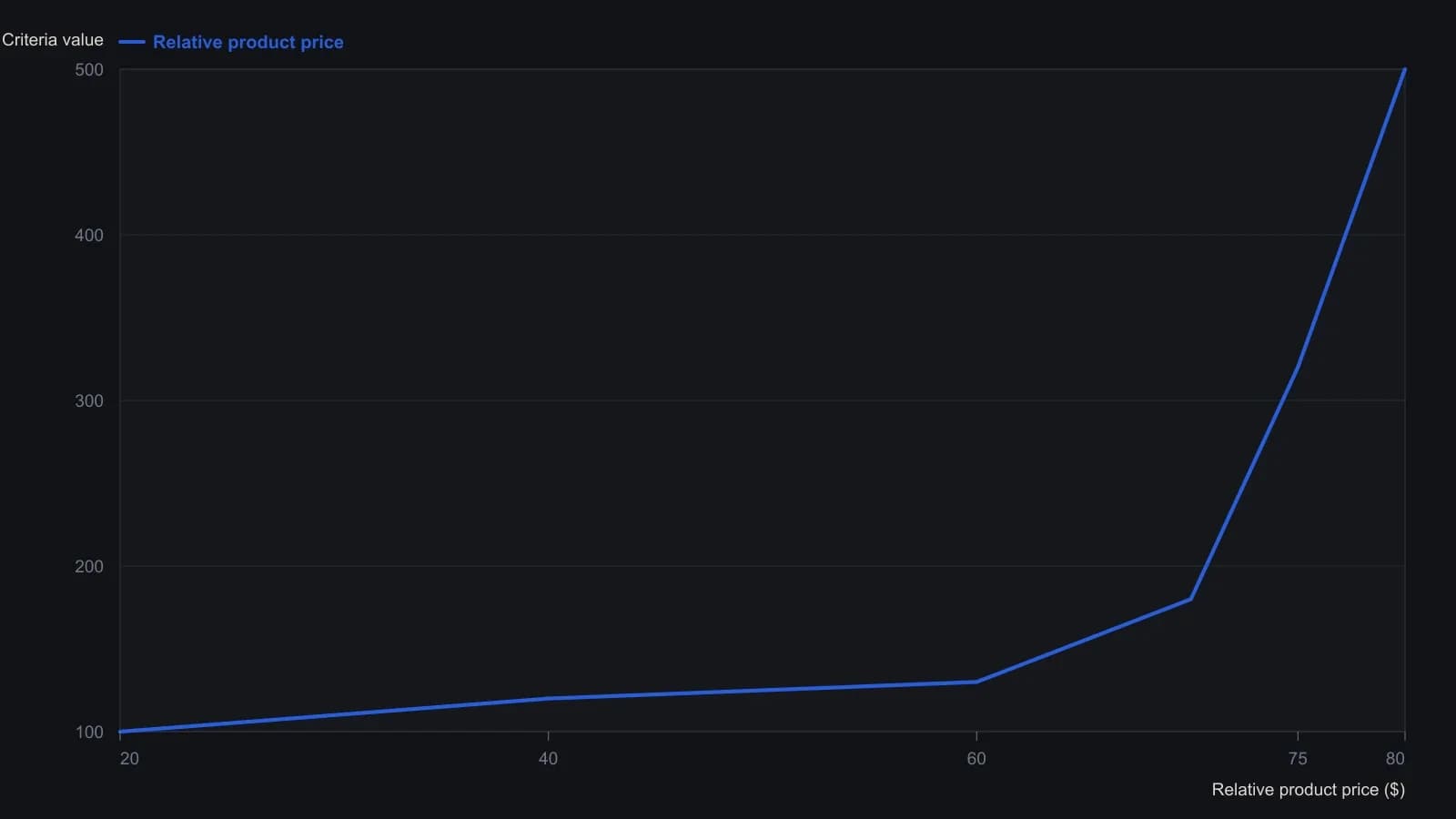
Figure 1 puts criteria value 100–500 on the top axis and relative product price down the side. No data table is printed. The $50 and $60 pair follows the article’s 125/130 comparison; remaining points are digitized and should not be treated as exact.
When a weighted sum is valid
Additive weighting gives each chosen criterion a relative weight, converts observations into comparable values, applies any hard constraints, and ranks remaining alternatives by the resulting sum. Each chosen criterion is assigned a weight from 0 through 1. Those weights must sum to 1 or 100 percent.
A weighting curve turns a raw observation into a comparable value. If the implied equivalences do not match the decision maker's judgment, the curves are redrawn before any sum is taken.
Additive weighting is not valid when an alternative's value depends on interaction between criteria. After observations are transformed and constraints and relationships are applied, the alternative with the highest sum is treated as most desirable, provided the inputs are treated as known with certainty.
A worked scoring routine can collect a short list of courses of action, rate each on several factors using a 0-to-10 importance scale, normalize the factor weights, and rank the options.
Certainty is not given
Selecting or refining a trading method is framed as raising at least one return measure while lowering several risk measures. Those quantities are not known with certainty. The harder versions of the procedure require a computer.
Editorial reading: the tradeoff and the checklist still operate when the quantities are uncertain. The weighted sum is only a ranking aid after the gates pass, and only when the inputs are treated as known with certainty.