1995issue C111-12
Why historically tested rules fail without a decision process
The archive describes a sequence from observed market behavior to bar-by-bar historical testing and then to small live trading that is abandoned if results do not match. Editorial: TradersWeek treats that sequence as the method itself, because a historically tidy setup still fails when the operator, the regime, or the path from fill to stop sits outside the same procedure.
- The described research sequence is observation of a recurring market behavior, bar-by-bar historical testing of how a trader would act, then live trading that starts small and is abandoned if results do not match the test.
- Identical written rules can produce different live outcomes across traders, and a method that does not fit temperament and money-management habits is unlikely to be followed.
- A 10-day historical-volatility reading near 50% of a 100-day reading is treated as a complacent regime that often precedes a sharp, frequently one-directional move.
- A method is treated as tradable only when the operator can explain why it should work. A historically tidy but conceptually opaque rule set is rejected even if testing looks perfect.
Treat the method as the whole procedure
The archive presents research as a sequence, not as a search for a lone trigger. A recurring market behavior is observed first. That behavior is then tested bar by bar as a record of how a trader would act. Live trading starts small and is abandoned if results do not match the test.
Editorial: TradersWeek reads this as a critique of isolated setups. Entry language is not a method until testing, abstention, sizing, stops, operator fit, and an explainable reason for acting belong to the same procedure.
Historical testing is described as a walk through the bars
Intraday testing is described as walking through as much as 10 years of 10-minute or 15-minute bars, rather than judging ideas only from closing prices. The walk is meant to reconstruct decisions, including the choice to stand aside.
Trailing stops placed immediately after a fill are said to produce more live stop-outs than the same idea showed in historical testing. Editorial: TradersWeek treats that gap as a reason to keep fills, stops, and live handling inside the same testable process, not as a later repair once a setup looks tidy.
The same written rules are not the same live method
Identical written rules can produce different live outcomes across traders. A method that does not fit the operator's temperament and money-management habits is unlikely to be followed.
In this framing, a trading-psychology-process is a repeatable procedure that turns market observations into entries, exits, and abstentions only when the operator can explain the logic, follow money-management constraints, and accept that the same written rules will produce different live results across traders.
Opening range and the news reversal
An opening-range-breakout is a short-horizon signal that uses the prior day's range and the current opening gap or early range as the trigger for entering, exiting, or standing aside after a news-driven or volatility-driven open.
A news-reversal procedure waits for a clearly bullish or bearish report, requires a gap beyond the prior day's range, then enters against the gap if price prints one tick back through the prior high after an upside gap or one tick through the prior low after a downside gap.
Range contraction and expansion, and shifts between high and low volatility, are presented as recurring market structures. Those structures are treated as conceptually valid even when specific 1980s opening-range distances no longer apply because volatility itself has changed.
Volatility contraction as regime context
Historical-volatility is a regime comparison of a short-window volatility reading against a longer-window baseline, used to mark contraction that often precedes a larger, often one-sided move.
A 10-day historical-volatility reading near 50% of a 100-day reading is treated as a low-volatility, complacent regime that often precedes a sharp, frequently one-directional move as short-term volatility reverts toward the longer baseline. Combining a 10-day versus 100-day comparison with a 6-day versus 100-day comparison is described as producing fewer but more precise contraction signals.
Editorial: TradersWeek reads that comparison as context for a single decision, not as a substitute for entry, exit, and abstention rules.
July 1995 copper: 100-, 10- and 6-day historical volatility
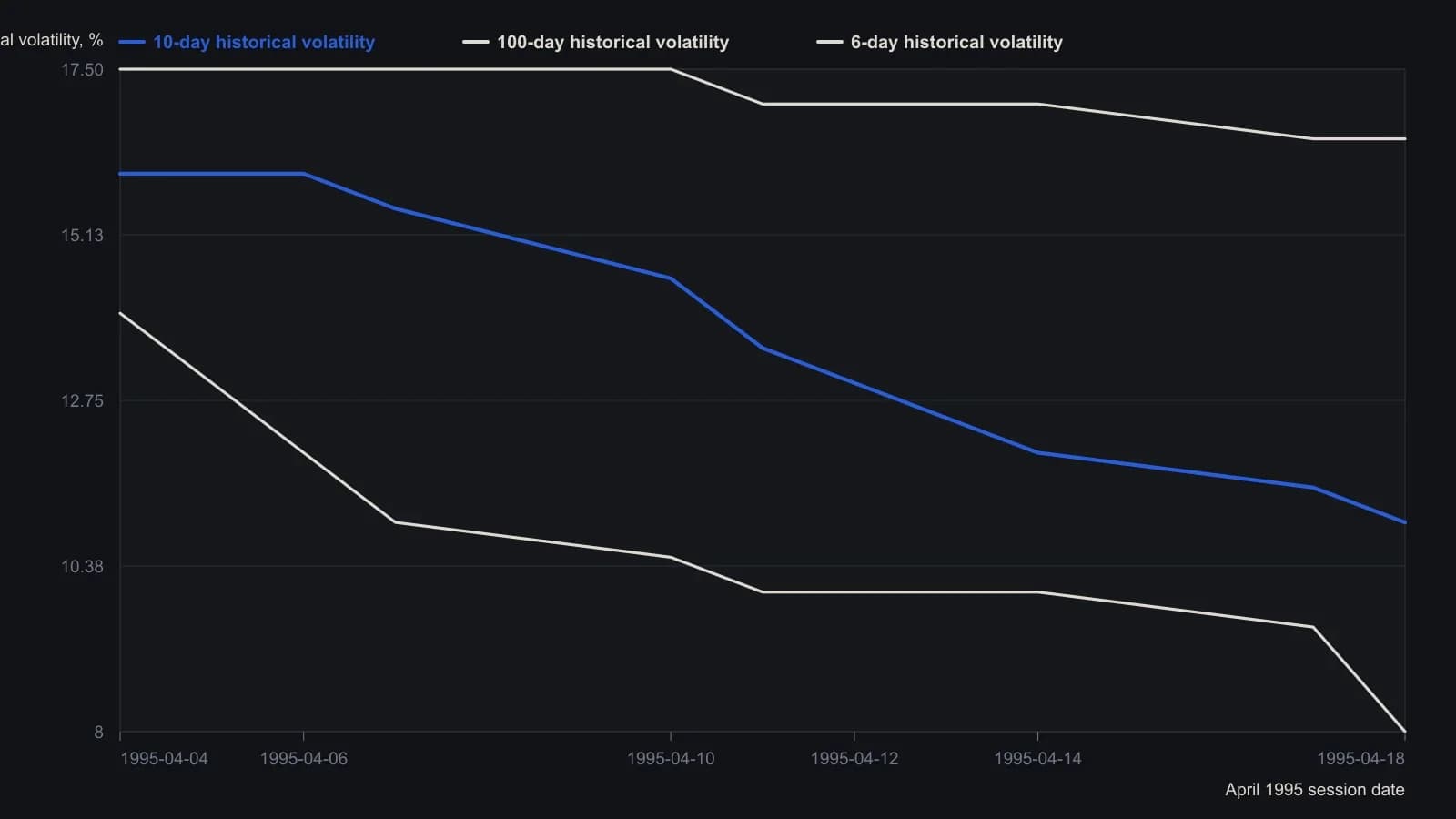
The source scale is labeled only at 10 and 15 percent, so plotted readings are approximate to the nearest half point. Connors treats a 10-day or 6-day reading at about half the 100-day reading as the signal; April 18 is the signal date named for the companion copper price chart.
A rule set is rejected if it cannot be explained
A method is treated as tradable only when the operator can explain why it should work. A historically tidy but conceptually opaque rule set is rejected even if testing looks perfect.
Editorial: TradersWeek takes that filter as the last test of the procedure. If the operator cannot say why the action should exist, the historical walk has not produced a method, only a pattern that will not be followed the same way from one trader to the next.
All readings on this track · 25 readings
- 1988Early entry as the session switch for an opening-range breakout
- 1989Evaluating inside-day filters on opening-range breakouts
- 1989Opening-range breakout after a narrow-range-four session
- 1989A joint contraction setup as the arming switch for an opening-range breakout
- 1989Next-session opening-range rules after a bear hook
- 1989Same-session exits from multi-day open-close codes
- 1989A close-to-close sequence is a bias label, not a trigger
- 1989Inside-day contraction as a same-session open-to-close rule
- 1990Evaluating five-day soybean open-to-close rules
- 1990Hourly breakouts gated by absolute tick volume
- 1993Premarket setup selection and opening-range rules
- 1994First-hour opening-range construction as a refusal problem
- 1995Why historically tested rules fail without a decision process
- 2001The opening range as a measuring stick for a ladder breakout
- 2001Evaluating an opening reaction as one timed stop procedure
- 2003Swing trading, opening-range checks, and the decision to stand aside
- 2006Monitor each opening-range setup as its own regime
- 2006Midday breakout rules from the opening range
- 2007Opening-range breakout as one session procedure
- 2007Evaluating same-day opening range entry rules
- 2008Overnight auction regimes and the intraday hold-or-exit choice
- 2010Construct a market-state-first range-breakout system as one procedure
- 2013Opening-hour stop as a session filter
- 2017Overnight volume as a construction step for the opening-range breakout
- 2017Night-volume gate for opening range breakouts