1989issue C041-4
Opening-range breakout after a narrow-range-four session
Historical tests compared same-session opening-range breakouts with and without a prior narrow-range-four filter, keeping the offset and the close-of-day exit unchanged. In 15 of 16 comparisons the filtered group had a higher share of winning trades.
- An opening-range breakout is a same-session entry at a predetermined distance above or below that day's opening price, usually taken on a stop.
- A narrow-range-four day is a session whose range is smaller than each of the prior three daily ranges and is used here only as a prior-day filter.
- Historical tests kept the offset and the same-day close fixed across four offset variants per market, then compared filtered sessions with an unfiltered control group.
- In 15 of 16 comparisons the filtered group had a higher share of winning trades, but the report treated the work as a principle check, not a finished trading system.
What the same-session procedure tests
An opening-range breakout is defined as an entry at a predetermined distance above or below that day's opening price. The usual execution is a stop, so the procedure tests whether price expands away from that session's open.
A breakout system pairs that entry with an exit and any abstention filter so the whole procedure can be evaluated together. In this evaluation the exit is a same-session exit: the position is closed on the close of the day the breakout is taken, so the test measures follow-through from that session's open only.
The narrow-range-four filter
A narrow-range-four session is defined as a daily range that is smaller than each of the prior three daily ranges. Here it is a prior-day condition on the next session's opening-range test, not a change to the offset or the exit.
The historical tests entered on a stop at a stated offset from the open, exited on that same day's close, and ran four offset variants per market. Those tests compared opening-range breakout sessions that followed a narrow-range-four day with an unfiltered control group.
What the comparisons showed
In 15 of 16 comparisons, opening-range breakout sessions that followed a narrow-range-four day showed a higher share of winning trades than the unfiltered control group.
The pairing of a narrow-range-four day with a subsequent move off the next open was reported to appear about once every eight to ten market days.
Across the reported tests, the share of profitable trades never exceeded 70 percent, and all but two tests reached at least 60 percent.
The one comparison that did not favor the filtered group was a cattle buy 50 points above the open, reported as 63 percent after a narrow-range-four day versus 65 percent on any day.
How contraction-expansion was treated
The evaluation treated a narrow, directionless session as often preceding next-day expansion, while noting that a trend move can also occur without that prior contraction.
Win share of same-session opening-range breakouts after an NR 4
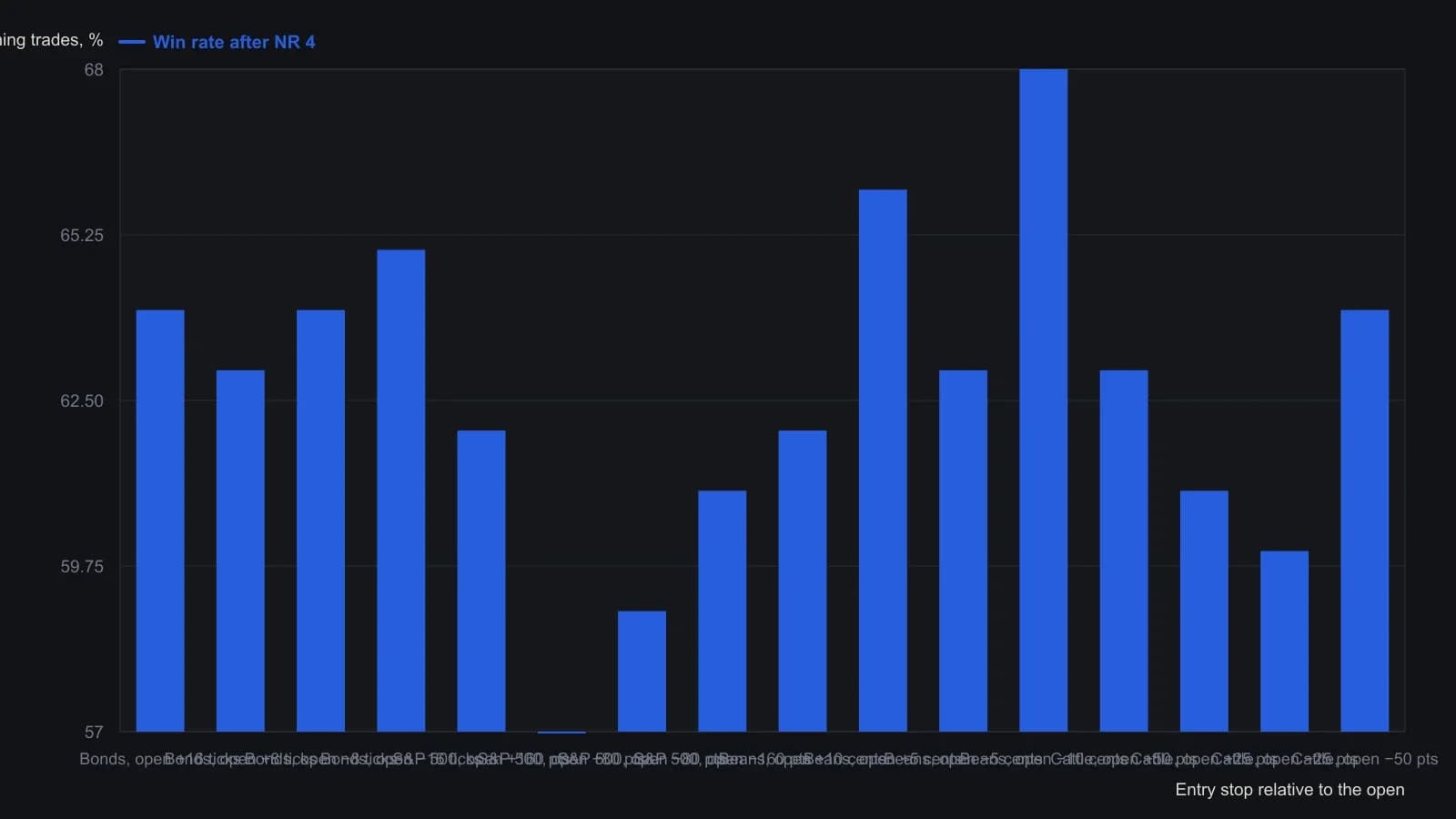
Each trade is a stop at the listed offset from that day’s open, exited on the same session’s close. Sample windows differ by market. Commission and slippage are not deducted; Crabel warns they would cut gross profits sharply. The unmatched any-day control percentages are not in this table.
What the tests were not
The report warned that adding commission and slippage reduced gross profits sharply and framed the tests as a check on a market principle, not as a finished trading system.
All readings on this track · 25 readings
- 1988Early entry as the session switch for an opening-range breakout
- 1989Evaluating inside-day filters on opening-range breakouts
- 1989Opening-range breakout after a narrow-range-four session
- 1989A joint contraction setup as the arming switch for an opening-range breakout
- 1989Next-session opening-range rules after a bear hook
- 1989Same-session exits from multi-day open-close codes
- 1989A close-to-close sequence is a bias label, not a trigger
- 1989Inside-day contraction as a same-session open-to-close rule
- 1990Evaluating five-day soybean open-to-close rules
- 1990Hourly breakouts gated by absolute tick volume
- 1993Premarket setup selection and opening-range rules
- 1994First-hour opening-range construction as a refusal problem
- 1995Why historically tested rules fail without a decision process
- 2001The opening range as a measuring stick for a ladder breakout
- 2001Evaluating an opening reaction as one timed stop procedure
- 2003Swing trading, opening-range checks, and the decision to stand aside
- 2006Monitor each opening-range setup as its own regime
- 2006Midday breakout rules from the opening range
- 2007Opening-range breakout as one session procedure
- 2007Evaluating same-day opening range entry rules
- 2008Overnight auction regimes and the intraday hold-or-exit choice
- 2010Construct a market-state-first range-breakout system as one procedure
- 2013Opening-hour stop as a session filter
- 2017Overnight volume as a construction step for the opening-range breakout
- 2017Night-volume gate for opening range breakouts