1989issue C021-5
Evaluating inside-day filters on opening-range breakouts
Score a prior-session inside day as a context filter by leaving the stretch, the first-stop entry, and the same-session close unchanged. Only the eligibility rule should move: whether that identical opening-range breakout is allowed to count.
- Keep the stretch, the first filled stop, and the same-session close fixed so the only changing rule is whether a prior inside day is required.
- An inside day is a session whose high is below the prior high and whose low is above the prior low, used here as a context filter on an unchanged breakout.
- The historical comparison judged the filtered rule against the same opening-range breakout taken on any day and did not improve after an inside day in every market and direction.
- In-session integrity is a live check on the open breakout and should not be mixed into the prior-session filter score.
The breakout rule that stays fixed
The opening-range procedure arms a buy stop a stretch above the opening-range high and a sell stop the same stretch below the opening-range low, and the first stop filled becomes the position. That is a same-session, rule-based entry and a breakout system.
The position is closed on the close of the day the stretch is hit, with no stop after entry. That same-session exit is how a context filter is scored on one-session outcomes.
The inside day is the only moving part
An inside day is a session whose high is below the prior high and whose low is above the prior low, so the whole range sits inside the previous session. In this design it is a context filter: a prior-session condition that decides whether the same breakout rule is eligible to fire.
The tested hypothesis was that inside days precede trend-day behavior and therefore more successful opening-range breakouts.
The illustrated sequence is an inside day, then a next-session open, then a stretch hit above or below that open, then an exit on that same session's close.
Judge the filter against the unfiltered twin
Treasury bonds, the S&P 500, soybeans, and cattle were each run at four stretch offsets, with exit on that session's close, no stop after entry, and both sides counted if both stretches traded.
The inside-day version was judged against the same opening-range breakout taken on any day, ignoring the prior session's pattern.
What the sixteen comparisons showed
Of sixteen entry-point comparisons, four showed a lower share of profitable same-direction trades after an inside day. The comparisons that did not improve after an inside day were S&P 500 stretches below the open and cattle stretches above the open.
Among nine charted inside days, several following sessions opened within one tick of an extreme and then expanded range.
Inside-day opening-range breakouts: percent profitable
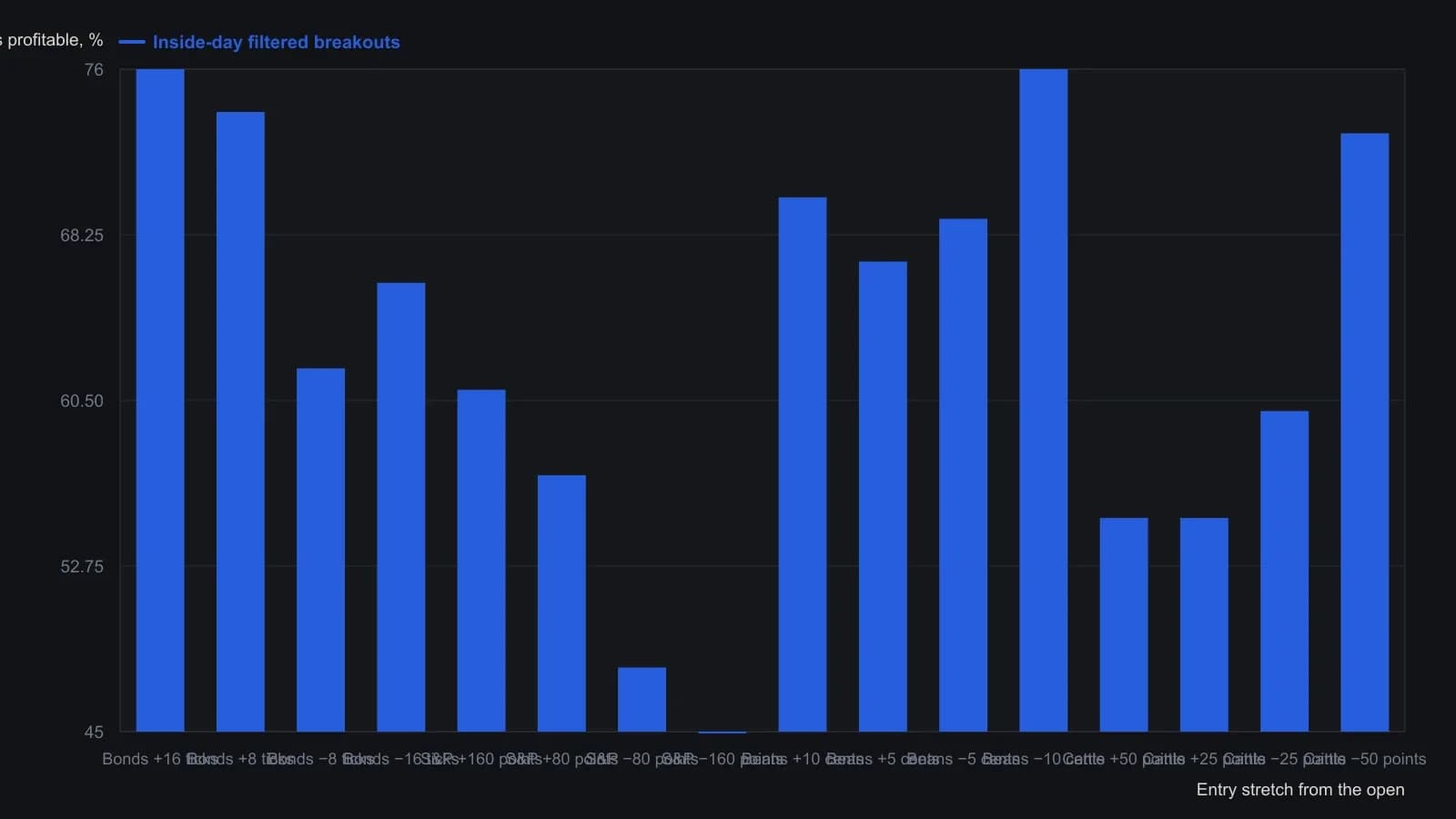
No protective stop was used after the first stretch filled. If price tagged both the upside and downside stretch, both a buy and a sell could be booked. The author later notes that a bond night session reduced trend and volatility relative to this sample.
Keep live integrity off the filter score
While the breakout is open, the procedure looks for no accelerating move against the position, a held prior half-hour extreme, and a new high or low at least every hour in the breakout direction.
All readings on this track · 25 readings
- 1988Early entry as the session switch for an opening-range breakout
- 1989Evaluating inside-day filters on opening-range breakouts
- 1989Opening-range breakout after a narrow-range-four session
- 1989A joint contraction setup as the arming switch for an opening-range breakout
- 1989Next-session opening-range rules after a bear hook
- 1989Same-session exits from multi-day open-close codes
- 1989A close-to-close sequence is a bias label, not a trigger
- 1989Inside-day contraction as a same-session open-to-close rule
- 1990Evaluating five-day soybean open-to-close rules
- 1990Hourly breakouts gated by absolute tick volume
- 1993Premarket setup selection and opening-range rules
- 1994First-hour opening-range construction as a refusal problem
- 1995Why historically tested rules fail without a decision process
- 2001The opening range as a measuring stick for a ladder breakout
- 2001Evaluating an opening reaction as one timed stop procedure
- 2003Swing trading, opening-range checks, and the decision to stand aside
- 2006Monitor each opening-range setup as its own regime
- 2006Midday breakout rules from the opening range
- 2007Opening-range breakout as one session procedure
- 2007Evaluating same-day opening range entry rules
- 2008Overnight auction regimes and the intraday hold-or-exit choice
- 2010Construct a market-state-first range-breakout system as one procedure
- 2013Opening-hour stop as a session filter
- 2017Overnight volume as a construction step for the opening-range breakout
- 2017Night-volume gate for opening range breakouts