1989issue C051-4
A joint contraction setup as the arming switch for an opening-range breakout
A case study required both an inside day and a four-day narrowing range before taking an opening-range stretch breakout. The same paired-stop entry was then compared after that joint setup, after each contraction pattern alone, and after days with no pattern filter.
- An opening-range breakout places a buy stop the stretch above the opening-range high and a sell stop the same stretch below the opening-range low, and the first stop filled is the position.
- The joint contraction setup is a session that is both an inside day and a four-day narrowing range: the day's range is narrower than each of the prior three daily ranges and sits entirely inside the previous day's range.
- The case study compared that joint filter with an inside day alone, a four-day narrowing range alone, and no pattern filter on the same opening-range breakout.
- The study read the comparison rankings as consistent with a contraction-then-expansion relationship, in which a narrow, directionless day is associated with trending action the next day.
The paired-stop opening-range breakout
The opening range is the price span printed in the first 30 seconds to 5 minutes of the session. The stretch is the 10-day average of the distance from each day's open to the nearer of that day's high or low.
The procedure places a buy stop the stretch above the opening-range high and a sell stop the same stretch below the opening-range low. Under the first-stop-filled rule, the first of those paired stops to trade becomes the position.
The joint contraction setup
The joint contraction setup requires the current daily range to be narrower than each of the prior three daily ranges and to sit entirely inside the previous day's range. That is one session that satisfies both the inside-day condition and the four-day-narrowing-range condition.
The working assumption was that two contraction patterns that were each useful separately would give a clearer opening-range-breakout indication when required together.
How the case study compared the filters
The case study compared the same opening-range breakout after the joint setup, after an inside day alone, after a four-day narrowing range alone, and after days with no pattern filter.
In 15 of 16 tests, the joint setup showed a higher success probability on the following opening-range breakout than the same breakout taken without a pattern filter. In 8 of 16 opening-range breakouts after the joint setup, that setup had a higher success probability than any of the three comparison groups.
The study read those rankings as consistent with a contraction-then-expansion relationship: a narrow, directionless day is associated with trending action the next day.
ORB win rates after the joint ID/NR 4 filter versus weaker filters
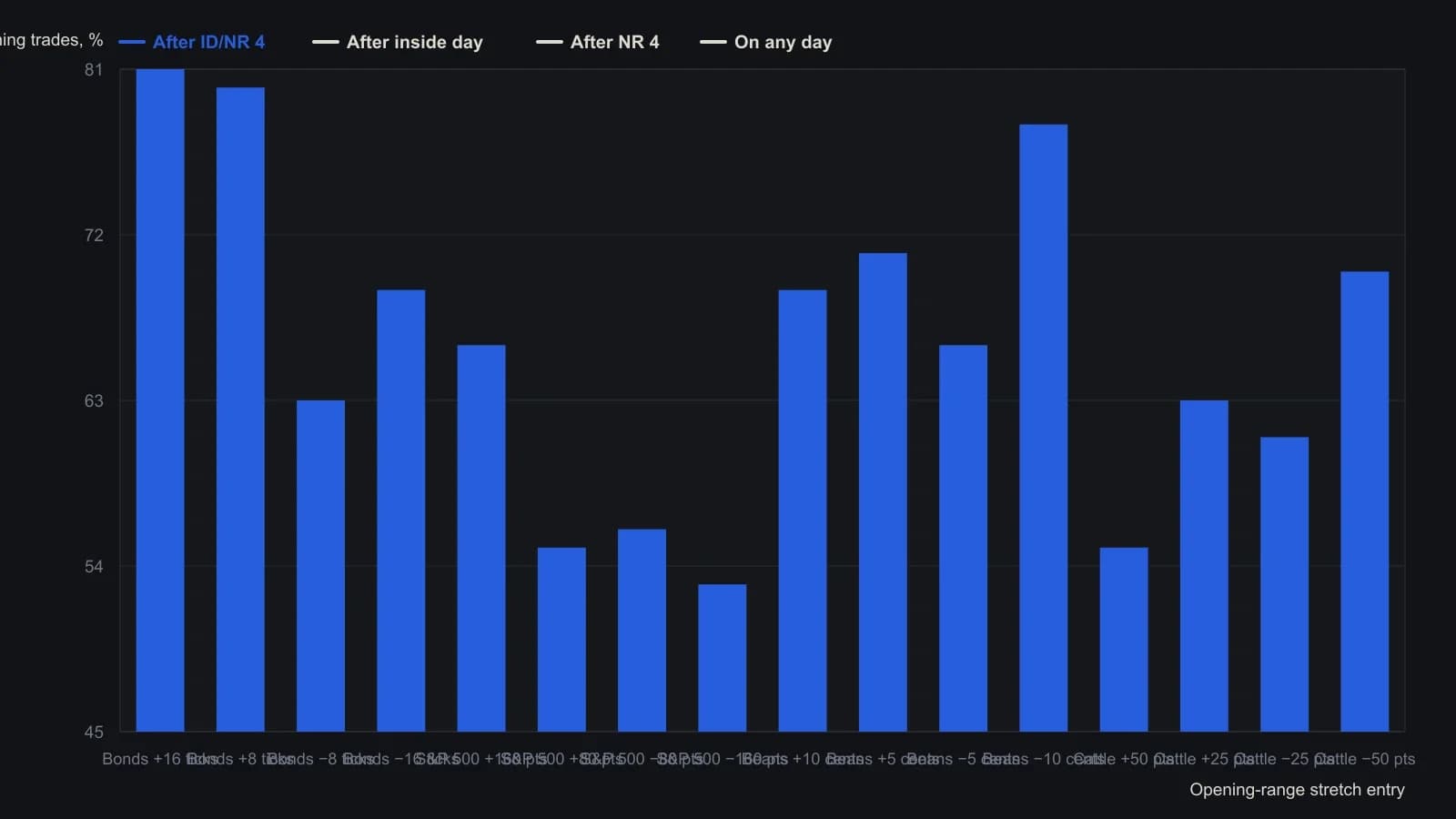
Sample windows differ by market: T-bonds 1978–86, S&P 500 1982–88, soybeans and cattle 1970–88. Bars are win frequency only; trade count and expectancy sit in the companion ID/NR 4 results table.
All readings on this track · 25 readings
- 1988Early entry as the session switch for an opening-range breakout
- 1989Evaluating inside-day filters on opening-range breakouts
- 1989Opening-range breakout after a narrow-range-four session
- 1989A joint contraction setup as the arming switch for an opening-range breakout
- 1989Next-session opening-range rules after a bear hook
- 1989Same-session exits from multi-day open-close codes
- 1989A close-to-close sequence is a bias label, not a trigger
- 1989Inside-day contraction as a same-session open-to-close rule
- 1990Evaluating five-day soybean open-to-close rules
- 1990Hourly breakouts gated by absolute tick volume
- 1993Premarket setup selection and opening-range rules
- 1994First-hour opening-range construction as a refusal problem
- 1995Why historically tested rules fail without a decision process
- 2001The opening range as a measuring stick for a ladder breakout
- 2001Evaluating an opening reaction as one timed stop procedure
- 2003Swing trading, opening-range checks, and the decision to stand aside
- 2006Monitor each opening-range setup as its own regime
- 2006Midday breakout rules from the opening range
- 2007Opening-range breakout as one session procedure
- 2007Evaluating same-day opening range entry rules
- 2008Overnight auction regimes and the intraday hold-or-exit choice
- 2010Construct a market-state-first range-breakout system as one procedure
- 2013Opening-hour stop as a session filter
- 2017Overnight volume as a construction step for the opening-range breakout
- 2017Night-volume gate for opening range breakouts