2017issue C0648-56
Overnight volume as a construction step for the opening-range breakout
The archive workflow treats overnight-session volume as a leading input for whether a later day-session opening-range is large enough to trade. The session-clock then builds the first-hour range, arms stop-entry orders only inside an implementation-cost-window, and applies same-session-flatten.
- Overnight-session volume is a leading input for whether a later day-session range is large enough to trade.
- Day-session volume is described as correlated with the preceding overnight-session volume, and day-session range is described as correlated with day-session volume.
- The session-clock separates overnight accumulation, first-hour opening-range construction, the implementation-cost-window, and same-session-flatten.
- Independent platform ports keep the same three-layer construction: night-volume filter, first-hour range, and time-bounded breakout entries.
A size filter, not a direction call
The construction treats overnight-session volume as a leading input for whether a later day-session range is large enough to trade. Day-session volume is described as correlated with the preceding overnight-session volume, and day-session range is described as correlated with day-session volume.
Overnight volume versus the five-day average on E-mini S&P
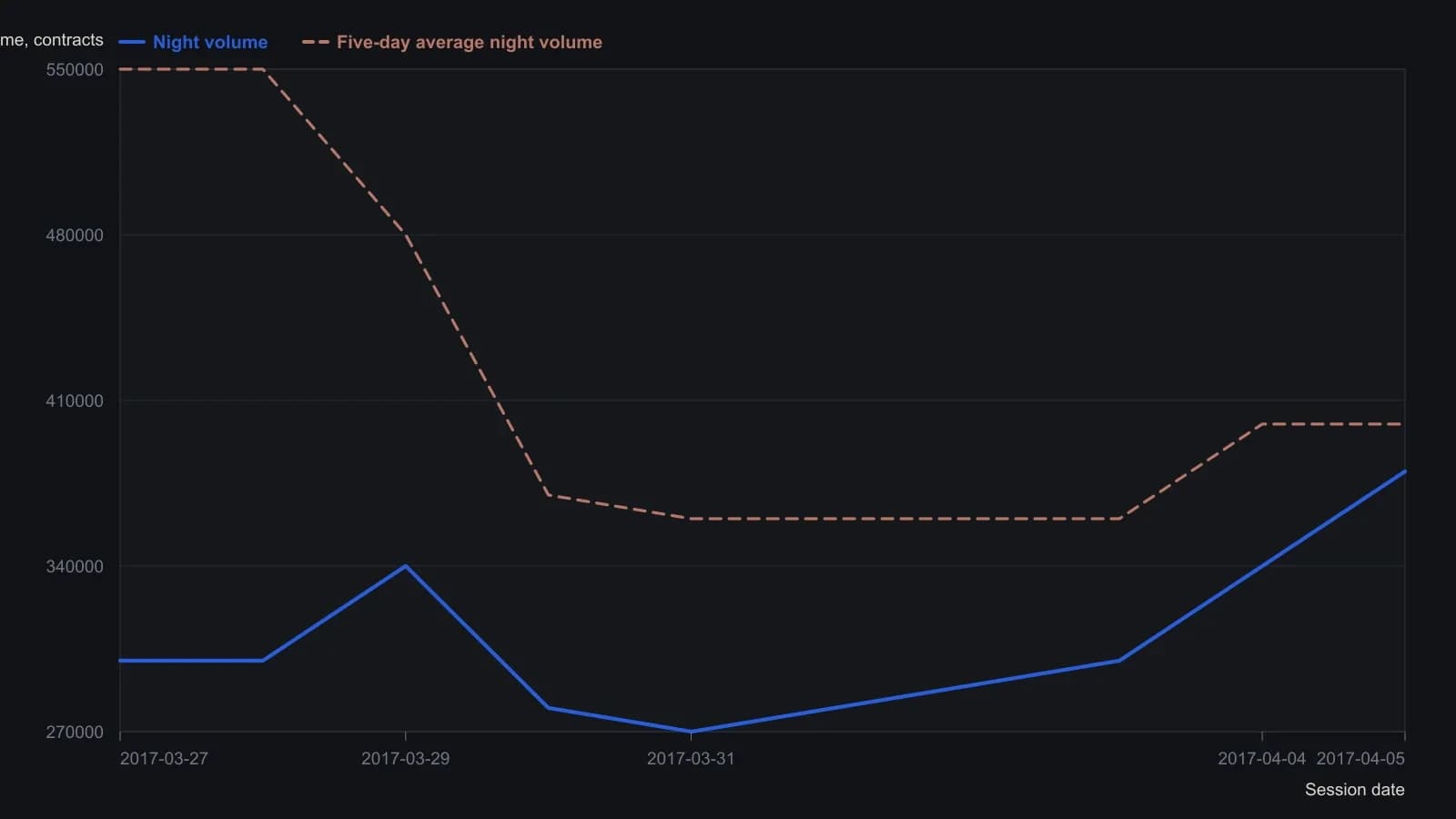
NeuroShell's port uses 15-minute bars and a five-session average of overnight volume, with clock times shifted to Eastern. The published figure does not deduct slippage or commissions. Values are read to the nearest 10,000 from a 100,000-unit grid.
How overnight volume is accumulated
Overnight volume is accumulated only while the session-clock sits inside a wrap-aware night window. The completed overnight-session total is then compared with the overnight-volume-average multiplied by the volume-ratio-threshold. Default session construction uses a night window from 0000 to 0830 and a first-hour opening-range from 0830 to 0930.
Opening-range stop-entry
The opening-range high and low are built only during the first-hour window. After that window ends, those extremes become the stop-entry prices.
When a new order may be armed
A new long or short is armed only when overnight volume exceeds its overnight-volume-average, the session-clock is after the range window and before a no-entry cutoff, and there is no open position. The implementation-cost-window is that limited interval after the opening-range during which new entries are allowed. One platform implementation sets the no-entry cutoff at 1400 and applies same-session-flatten so that all positions are forced flat at the session close.
The same three layers across ports
Independent platform ports keep the same three-layer construction: night-volume filter, first-hour range, and time-bounded breakout entries.
All readings on this track · 25 readings
- 1988Early entry as the session switch for an opening-range breakout
- 1989Evaluating inside-day filters on opening-range breakouts
- 1989Opening-range breakout after a narrow-range-four session
- 1989A joint contraction setup as the arming switch for an opening-range breakout
- 1989Next-session opening-range rules after a bear hook
- 1989Same-session exits from multi-day open-close codes
- 1989A close-to-close sequence is a bias label, not a trigger
- 1989Inside-day contraction as a same-session open-to-close rule
- 1990Evaluating five-day soybean open-to-close rules
- 1990Hourly breakouts gated by absolute tick volume
- 1993Premarket setup selection and opening-range rules
- 1994First-hour opening-range construction as a refusal problem
- 1995Why historically tested rules fail without a decision process
- 2001The opening range as a measuring stick for a ladder breakout
- 2001Evaluating an opening reaction as one timed stop procedure
- 2003Swing trading, opening-range checks, and the decision to stand aside
- 2006Monitor each opening-range setup as its own regime
- 2006Midday breakout rules from the opening range
- 2007Opening-range breakout as one session procedure
- 2007Evaluating same-day opening range entry rules
- 2008Overnight auction regimes and the intraday hold-or-exit choice
- 2010Construct a market-state-first range-breakout system as one procedure
- 2013Opening-hour stop as a session filter
- 2017Overnight volume as a construction step for the opening-range breakout
- 2017Night-volume gate for opening range breakouts