1994issue C071-4
First-hour opening-range construction as a refusal problem
Construction converts a day-trading method into a fully specified mechanical-trading-system for S&P 500 futures. The first-hour-extremes, offset breakout orders, anticipated-range reverses, range-width-filter, stand-aside-day, and protective stops have to sit in one script.
- Construction means turning a day-trading method into a complete mechanical-trading-system for S&P 500 futures, covering entries, reverses, stops, and no-trade days.
- First-hour-extremes stamp the opening range, but an opening-range-breakout fires only after price clears a stated offset beyond those extremes.
- A range-width-filter and a stand-aside-day drop or forbid new entries when the opening range is already wide, while open risk stays with stops.
- Anticipated-range levels, timed-reversal, and sell-and-reverse belong in the same procedure as the protective stop layers.
Construction means writing the full script
The construction task is to convert a day-trading method into a fully specified mechanical procedure for S&P 500 futures. A mechanical-trading-system is a complete script for entries, reverses, stops, and no-trade days that can be followed or backtested without new discretion.
The system is framed as trend-following while adding rules meant to drop many trades during nontrending sessions. Those refusal rules are not a later overlay. They are part of the same procedure as the first-hour map.
Stamp the first-hour-extremes
The directional premise is that the session high or low is estimated to form in the first hour about 60 percent of the time, so a later breach of that extreme is treated as the day’s direction. A breakout-system is the directional procedure that treats a cleared extreme as the session bias and states the matching reverse and exit.
First-hour-extremes are the session high and low stamped at 9:30 a.m. Eastern Time. They exclude any gap from the prior close and serve as that day’s opening range.
Offset breakouts reverse instead of flattening
An opening-range-breakout is a signal that fires only after price clears a stated offset beyond the first-hour high or low. Buy and sell orders sit 20 points beyond those extremes. Positions may be held overnight.
A hit on the opposite side is a sell-and-reverse. The current side closes and the opposite side opens at the same trigger, rather than going flat.
Anticipated-range levels carry timed-reversal
An anticipated-range is a projected session extreme formed by adding or subtracting a recent average daily range from the opposite first-hour extreme. Those levels equal the opposite first-hour extreme plus or minus the 10-day average daily range.
A 20-point approach plus a 15-minute hold governs whether to reverse. That hold is the timed-reversal: a reverse allowed only after price has held a stated interval at or through an anticipated-range level.
After that reverse, a further 140-point adverse move allows one more reverse, after which a protective stop ends new activity for the rest of the session. Both anticipated-range ends may trigger on the same day, except that a reverse appearing with less than 45 minutes left in the session is treated as a special case.
Daily RSI ratio of Swiss franc to Deutschemark
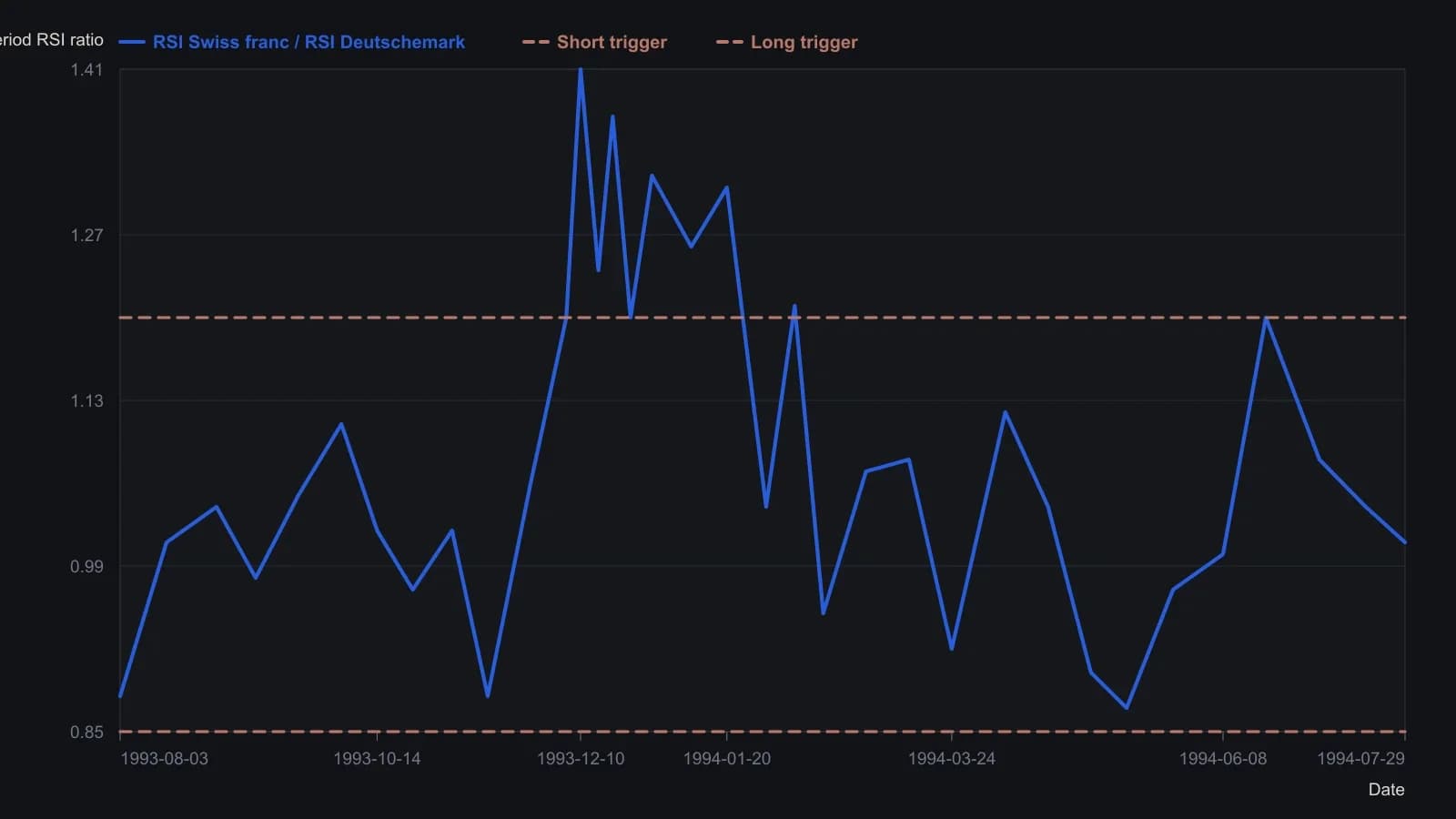
Each RSI is 14 periods, plotted in MetaStock as RSI(14)/P after the Deutschemark RSI is restored from the indicator buffer. A long on the spread is long Swiss franc and short Deutschemark. Curve readings are approximate; the two trigger levels are the constants in the tester rules.
Width filters and stand-aside days refuse new entries
If the first-hour range is within 50 points of the 10-day average range, first-hour breakout entries are disabled and only anticipated-range rules apply. That is the range-width-filter: it cancels first-hour breakout entries when the opening range is already nearly as wide as the recent average daily range.
If the first-hour range exceeds that average, new entries are skipped while open risk is left to stops. That session is a stand-aside-day: it forbids new entries while an existing position remains subject only to stops.
Protective stops close the procedure
Protective layers include a 300-point money-management stop, a trailing stop that arms after 220 points of open profit and is placed 49 percent from the position extreme, and a $1,500 stop when both the first-hour and 10-day ranges are large. Those stops belong in the same mechanical-trading-system as the entries, reverses, and no-trade days.
All readings on this track · 25 readings
- 1988Early entry as the session switch for an opening-range breakout
- 1989Evaluating inside-day filters on opening-range breakouts
- 1989Opening-range breakout after a narrow-range-four session
- 1989A joint contraction setup as the arming switch for an opening-range breakout
- 1989Next-session opening-range rules after a bear hook
- 1989Same-session exits from multi-day open-close codes
- 1989A close-to-close sequence is a bias label, not a trigger
- 1989Inside-day contraction as a same-session open-to-close rule
- 1990Evaluating five-day soybean open-to-close rules
- 1990Hourly breakouts gated by absolute tick volume
- 1993Premarket setup selection and opening-range rules
- 1994First-hour opening-range construction as a refusal problem
- 1995Why historically tested rules fail without a decision process
- 2001The opening range as a measuring stick for a ladder breakout
- 2001Evaluating an opening reaction as one timed stop procedure
- 2003Swing trading, opening-range checks, and the decision to stand aside
- 2006Monitor each opening-range setup as its own regime
- 2006Midday breakout rules from the opening range
- 2007Opening-range breakout as one session procedure
- 2007Evaluating same-day opening range entry rules
- 2008Overnight auction regimes and the intraday hold-or-exit choice
- 2010Construct a market-state-first range-breakout system as one procedure
- 2013Opening-hour stop as a session filter
- 2017Overnight volume as a construction step for the opening-range breakout
- 2017Night-volume gate for opening range breakouts