2001issue C031-3
The opening range as a measuring stick for a ladder breakout
After a fixed settle window, the opening range is recorded and stacked into equal range units above and below that range. Only the first tagged unit is treated as a valid opening-range breakout, and each further unit becomes the next trailing stop.
- Delay every entry through a fixed settle window, then record the opening high, low and volume before any projected level is used.
- Stack that high-low difference as equal range units above and below the opening range, and treat only the first tagged unit as a valid opening-range breakout.
- Place the first stop-loss at the opening-range extreme, then move it to the prior projected unit each time price tags the next unit.
- The documented rule set has no separate exit: the position ends when a stop is hit or when it is flattened at the close.
A delayed reading, not an immediate trade
This case study follows a documented breakout system that withholds entry until a settle window has produced an opening range. From that range the procedure stacks range units into projected levels and allows only one opening-range breakout: the first unit tagged in the direction of the emerging move.
After a defined post-open waiting interval, the procedure records the session high, low and volume, then builds successive upside and downside price levels by repeatedly adding or subtracting the opening high-low difference.
What the settle window records
The settle window is the fixed interval after the session open during which no trade is placed, so the opening high, low and volume can be recorded. That reading is the opening range used as the base for later price projections.
The waiting interval used for the original market is 45 minutes after the open, with a stated option to shorten it to 30 or 35 minutes when the calendar period is treated as falling on a house cusp.
For New York listings, the high-low reading is to be completed before 10:25, and 10:30 is treated as a change in activity tied to a house transition. The wait is expected to differ in other cities.
How the projected ladder is built
A range unit is the difference between the opening high and low, stacked repeatedly above the high or below the low. A projected level is a price obtained by adding or subtracting one or more of those units, and it can later serve as a potential support, resistance or stop location.
Eight projected units are tabulated in each direction even though observed prices were said rarely to reach the fifth, so the ladder would still be available if the session became unusually volatile.
Reaching the first projected unit is presented as a sign that a strong directional move may be starting, even though the observer reported that prices rarely tag that first level in either direction.
First-unit entry and the moving stop
Once price tags a projected unit, that level can serve as the entry. That first-unit reach is the opening-range breakout. The stop-loss is first placed at the opening-range extreme and is then moved to the prior unit each time a further unit is reached.
The breakout system is the full procedure that combines the settle window, the projected ladder, the first-unit entry and the later stop moves into one testable rule set.
Two December 2000 illustrations
In the 11 December 2000 Intel illustration, the measured opening range was 35.25 high and 34.3125 low. A long was placed at the first upside unit, and stops were advanced from 35.25 to 36.186 and then to 37.125.
In the 18 December 2000 Cisco illustration, the opening range was 50.125 high and 48.75 low. A short was placed at the first downside unit, stops were trailed through 48.75, 47.375, 46 and 44.625, and the position was covered at the close.
What ends the position
The documented rule set has no independent exit other than a stop being hit or flattening at the close. Overnight holding is mentioned when a trend remains intact, but the US illustrations were closed before the close because they were treated as day trades.
INTC opening-range ladder, 11 December 2000
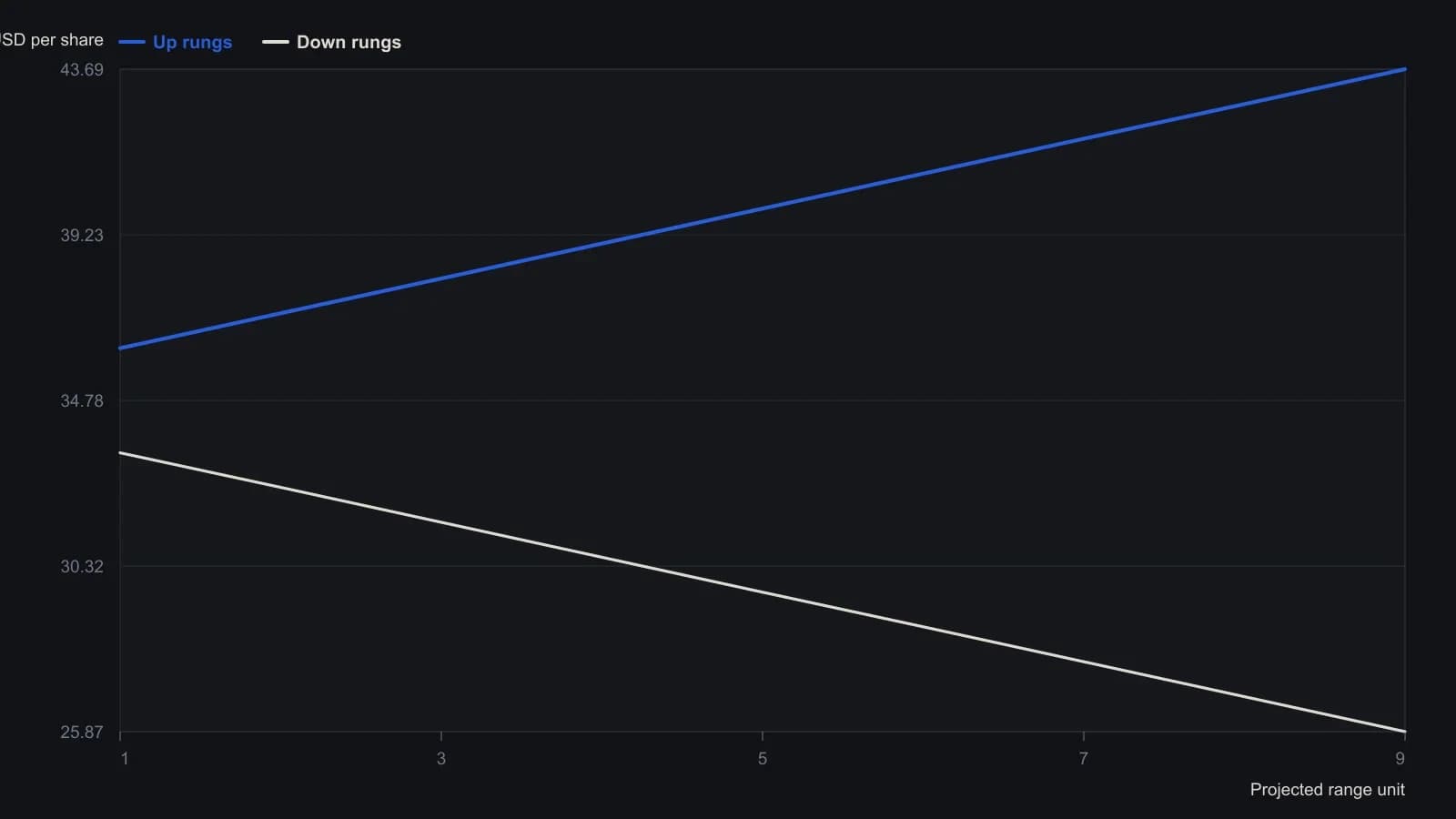
Sathe still projects eight or nine rungs even though the article says price rarely reaches the fifth. The New York reading used a 10:25 a.m. cutoff so the sun would not be changing houses.
All readings on this track · 25 readings
- 1988Early entry as the session switch for an opening-range breakout
- 1989Evaluating inside-day filters on opening-range breakouts
- 1989Opening-range breakout after a narrow-range-four session
- 1989A joint contraction setup as the arming switch for an opening-range breakout
- 1989Next-session opening-range rules after a bear hook
- 1989Same-session exits from multi-day open-close codes
- 1989A close-to-close sequence is a bias label, not a trigger
- 1989Inside-day contraction as a same-session open-to-close rule
- 1990Evaluating five-day soybean open-to-close rules
- 1990Hourly breakouts gated by absolute tick volume
- 1993Premarket setup selection and opening-range rules
- 1994First-hour opening-range construction as a refusal problem
- 1995Why historically tested rules fail without a decision process
- 2001The opening range as a measuring stick for a ladder breakout
- 2001Evaluating an opening reaction as one timed stop procedure
- 2003Swing trading, opening-range checks, and the decision to stand aside
- 2006Monitor each opening-range setup as its own regime
- 2006Midday breakout rules from the opening range
- 2007Opening-range breakout as one session procedure
- 2007Evaluating same-day opening range entry rules
- 2008Overnight auction regimes and the intraday hold-or-exit choice
- 2010Construct a market-state-first range-breakout system as one procedure
- 2013Opening-hour stop as a session filter
- 2017Overnight volume as a construction step for the opening-range breakout
- 2017Night-volume gate for opening range breakouts