1990issue C061-6
Evaluating five-day soybean open-to-close rules
A soybean sample from 1970 through 1988 tested every combination of four successive closes plus a higher or lower open on the following session. Entry was the fifth session's open and the exit was that same session's close. The identical sequences were then compared in Treasury bonds and split by the prior day's range.
- Four successive closes plus the next open were locked as one five-day sequence, with entry at that open and an exit at the same session close.
- Buy or sell for each sequence was assigned only by which side produced a positive gross-profit total, so every tabulated sequence appeared on its selected side.
- Eight of the 32 sequences showed significantly different directional biases in soybeans than in Treasury bonds, including sequences 3, 4, 15, and 17, which reversed buy versus sell orientation.
- A range split on sequence 30 changed the percent-profitable reading, and small one-day range differences were presented as more useful development steps than the unfiltered five-day templates.
A locked open-to-close procedure
A soybean sample from 1970 through 1988 was used to test every combination of four successive closes plus a higher or lower open on the following session, producing 32 five-day sequences. A five-day sequence is those four relative closes plus the next open, with that open as both the last symbol and the entry.
Entry was taken at the fifth session's open and the position was closed at that same session's close, so the holding period was a single open-to-close interval. Pattern recognition coded the ordered up and down closes, then the following open, as a forecast of that session's open-to-close direction. Opening range breakout used the trade day's open as the executable entry print that starts the same-session test. Rule-based entry joined the sequence, the open, and a same-day close exit into one complete buy or sell procedure.
How a sequence was judged
Buy versus sell for each sequence was assigned only by which side produced a positive gross-profit total, so every tabulated sequence was shown on its selected side. A sequence was to be judged from percent profitable trades, the average-win-to-average-loss ratio, and gross profit together, not from any one of those readings alone.
A cross-market check
The same sequences were repeated in Treasury bonds to see whether buy and sell orientation stays put. Eight of the 32 sequences showed significantly different directional biases in soybeans than in Treasury bonds, including sequences 3, 4, 15, and 17, which reversed buy versus sell orientation across the two markets.
In the soybean table the largest gross-profit totals clustered on short sequences, with no long sequence above a ten-thousand-dollar gross-profit mark, while the bond comparison was described as more even on that measure.
Soybean open-to-close gross profit by five-day pattern
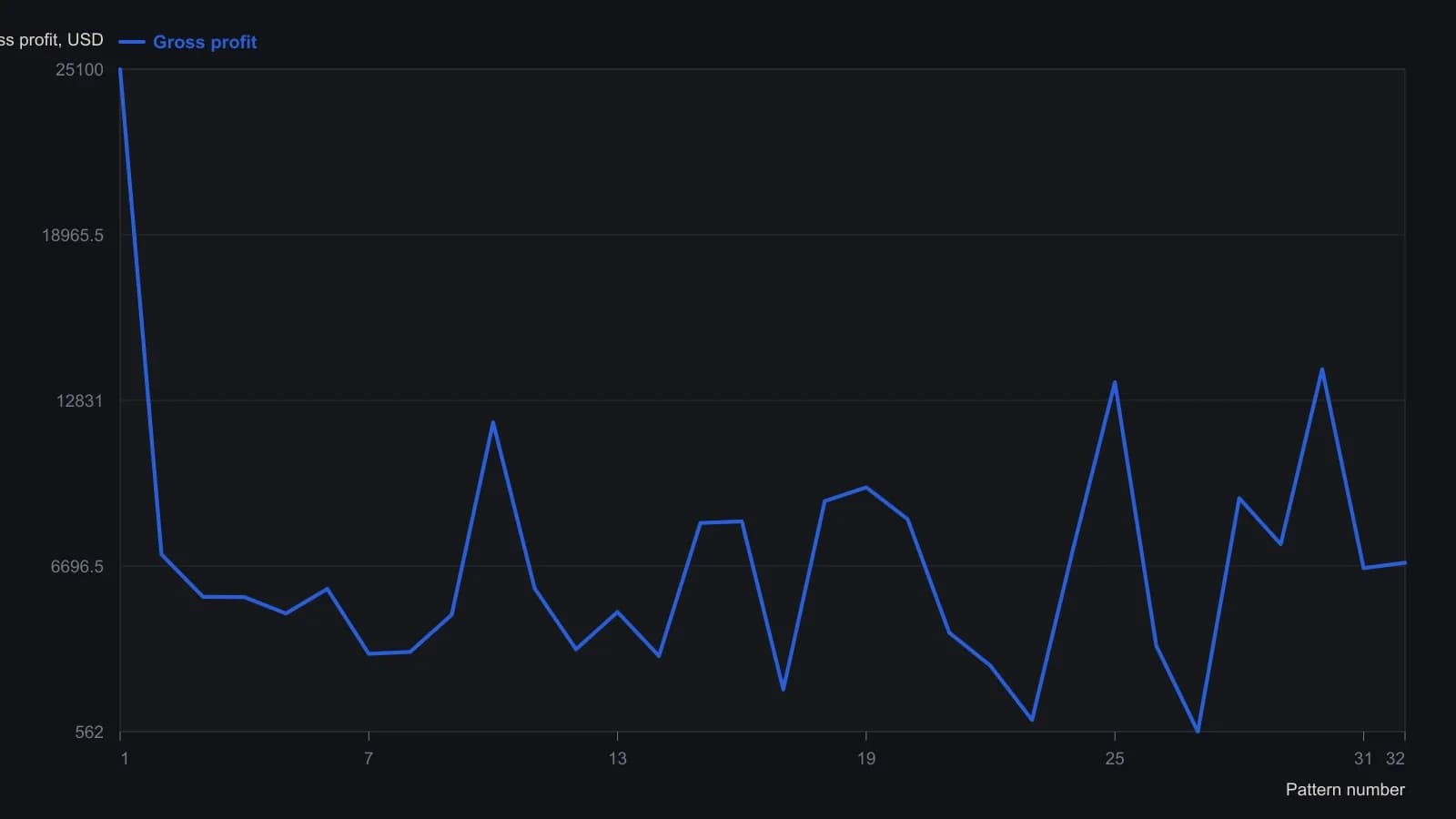
Trade direction was assigned solely by which side produced a positive gross profit, so every bar is above zero by construction. Some rules are below 50 percent winners and live on the size of the average win.
A range split on sequence 30
Sequence 30 was specified as three lower closes, then a higher close, then a lower open, with a sale at that open. A range split keeps only an expanding or only a narrowing range on the day before entry.
Restricting sequence 30 to an expanding day-4 range versus day 3 kept 63 of 94 cases and lowered the percent-profitable reading to 51 percent, while a narrowing day-4 range kept 30 cases and raised that reading to 67 percent.
A starting template
Small changes to the base sequences, especially one-day range differences used to mark momentum, were presented as more useful development steps than the unfiltered five-day templates alone. The five-day sequences were treated as a starting template for later rule work rather than as finished high-profit procedures, and this style of development was described as less promising in soybeans than in other markets.
All readings on this track · 25 readings
- 1988Early entry as the session switch for an opening-range breakout
- 1989Evaluating inside-day filters on opening-range breakouts
- 1989Opening-range breakout after a narrow-range-four session
- 1989A joint contraction setup as the arming switch for an opening-range breakout
- 1989Next-session opening-range rules after a bear hook
- 1989Same-session exits from multi-day open-close codes
- 1989A close-to-close sequence is a bias label, not a trigger
- 1989Inside-day contraction as a same-session open-to-close rule
- 1990Evaluating five-day soybean open-to-close rules
- 1990Hourly breakouts gated by absolute tick volume
- 1993Premarket setup selection and opening-range rules
- 1994First-hour opening-range construction as a refusal problem
- 1995Why historically tested rules fail without a decision process
- 2001The opening range as a measuring stick for a ladder breakout
- 2001Evaluating an opening reaction as one timed stop procedure
- 2003Swing trading, opening-range checks, and the decision to stand aside
- 2006Monitor each opening-range setup as its own regime
- 2006Midday breakout rules from the opening range
- 2007Opening-range breakout as one session procedure
- 2007Evaluating same-day opening range entry rules
- 2008Overnight auction regimes and the intraday hold-or-exit choice
- 2010Construct a market-state-first range-breakout system as one procedure
- 2013Opening-hour stop as a session filter
- 2017Overnight volume as a construction step for the opening-range breakout
- 2017Night-volume gate for opening range breakouts