2006issue C061-4
Monitor each opening-range setup as its own regime
Overnight gap and first-hour direction define four mutually exclusive mechanical setups. A running-summary for each setup, not a blended lifetime average, is what decides whether to keep the signal, reverse it, or sit out.
- A position is considered only after the first-hour window closes, then held for the rest of the cash session.
- Overnight session and first-hour direction are classified independently, producing four mutually exclusive rule-based setups.
- Effectiveness is judged by contrasting tradable and nontradable days inside the same session window, so a broad rally is not mistaken for rule edge.
- Each setup gets its own running-summary. A regime-break can argue for pausing or reversing even when the lifetime average still looks favorable.
Wait for the first-hour window
The case study specifies a mechanical entry that is not taken at the cash open. A position is considered only after the first-hour window closes. If a named setup qualifies, the position is held over the remainder of the cash session, from the 10:30 print through the 16:00 close.
Classify overnight session and first-hour direction separately
Overnight state is defined solely by the open versus the prior close. An open above the prior close is a rising overnight session. An open below the prior close is a falling overnight session. That classification is independent of first-hour direction.
First-hour state is defined solely by the 10:30 print versus that day’s open. A 10:30 print above the open is a rising opening hour. A 10:30 print below the open is a falling opening hour.
Trade four setups, not one blend
Those two binary classifications produce four mutually exclusive rule-based setups: up/up, up/down, down/up, and down/down. Each can be tabulated and traded separately rather than as one blended system.
Entry fires only when a named combination of overnight session and first-hour direction is present. Otherwise the system abstains. The case tabulates the four combinations separately and does not treat their averages as equal.
QQQQ short gain by overnight and first-hour setup
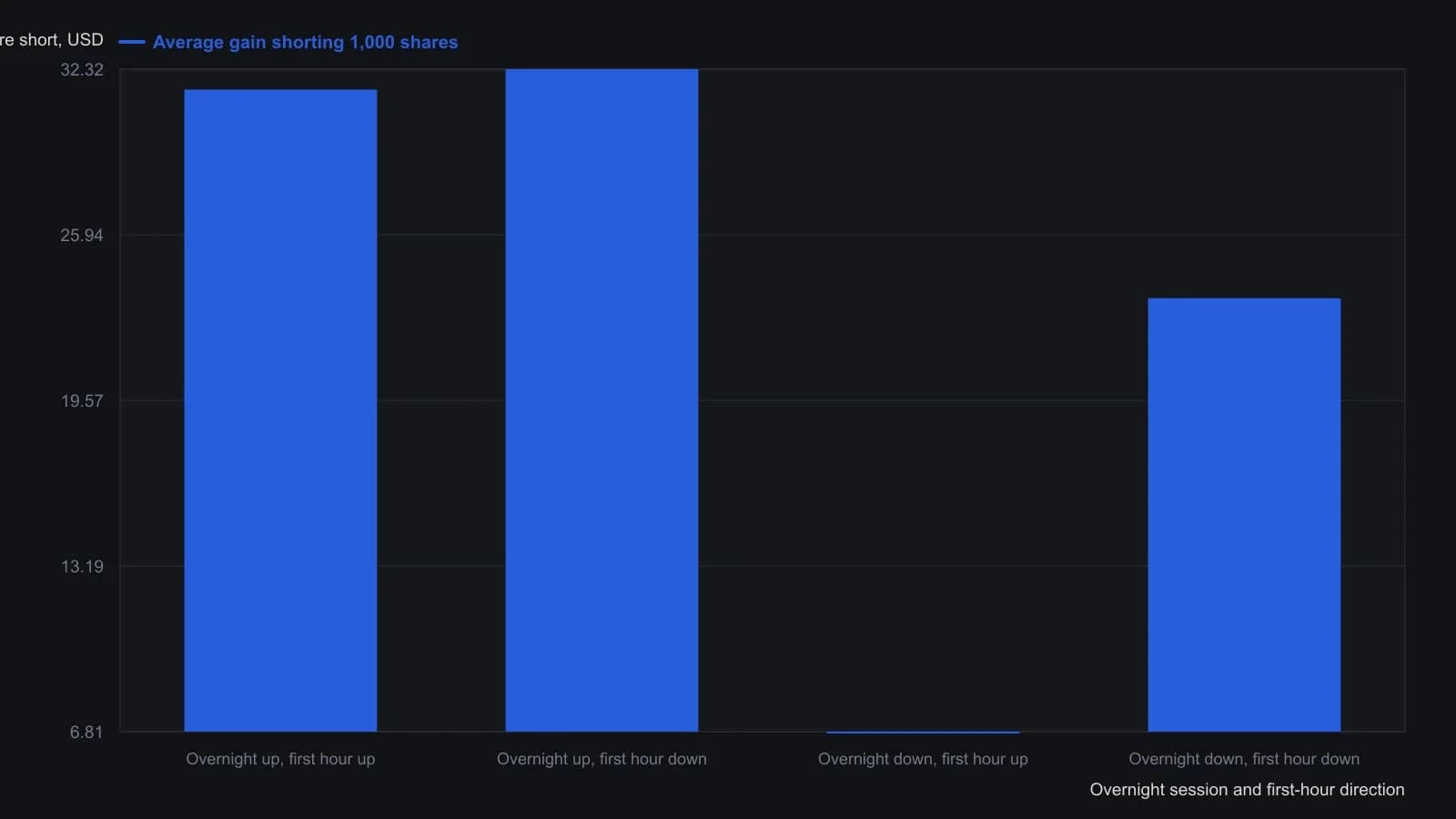
Results are for the 10:30–16:00 ET window only on QQQQ. Trade counts are 143 (up/up), 136 (up/down), 118 (down/up) and 98 (down/down) across 514 sessions.
Judge the rule inside the same window
The study insists that system effectiveness be judged inside the same window from 10:30 to 16:00 by contrasting days that qualify as a tradable play with days that do not. A broad market rally is not to be mistaken for rule edge.
The case notes that an always-long rule held through a later rally would have looked successful. It uses that backdrop to argue that a short-biased opening-range system must be scored against the prevailing trend, not given credit for it.
Read each running-summary for a regime-break
The prescribed monitoring method is a separate cumulative plot for each of the four setups. Each plot is read as range, breakout, or breakdown. No mechanical combination is assumed to keep working through every market regime.
Even a short setup the case treated as favorable on average still showed a completed triple-bottom and a sequence of higher lows on its running-summary. The case treats that structure as a reason to question continued shorting even while the lifetime average remains favorable.
All readings on this track · 25 readings
- 1988Early entry as the session switch for an opening-range breakout
- 1989Evaluating inside-day filters on opening-range breakouts
- 1989Opening-range breakout after a narrow-range-four session
- 1989A joint contraction setup as the arming switch for an opening-range breakout
- 1989Next-session opening-range rules after a bear hook
- 1989Same-session exits from multi-day open-close codes
- 1989A close-to-close sequence is a bias label, not a trigger
- 1989Inside-day contraction as a same-session open-to-close rule
- 1990Evaluating five-day soybean open-to-close rules
- 1990Hourly breakouts gated by absolute tick volume
- 1993Premarket setup selection and opening-range rules
- 1994First-hour opening-range construction as a refusal problem
- 1995Why historically tested rules fail without a decision process
- 2001The opening range as a measuring stick for a ladder breakout
- 2001Evaluating an opening reaction as one timed stop procedure
- 2003Swing trading, opening-range checks, and the decision to stand aside
- 2006Monitor each opening-range setup as its own regime
- 2006Midday breakout rules from the opening range
- 2007Opening-range breakout as one session procedure
- 2007Evaluating same-day opening range entry rules
- 2008Overnight auction regimes and the intraday hold-or-exit choice
- 2010Construct a market-state-first range-breakout system as one procedure
- 2013Opening-hour stop as a session filter
- 2017Overnight volume as a construction step for the opening-range breakout
- 2017Night-volume gate for opening range breakouts