1989issue C101-4
A close-to-close sequence is a bias label, not a trigger
The archive treated two- through five-day close-to-close sequences as directional-bias scores and compared a close-to-close hold with later opening-range entries and a fixed-tick stop. Editorial reading: withhold the order until the next open confirms or cancels that label and the stop is specified before the fill.
- Editorial lesson: treat a close-to-close sequence as a directional-bias label, not as a trigger.
- Opening-range confirmation waits for the next session and takes the trade only if that open is on the bias side of the prior close sequence.
- A fixed-tick stop is specified before the position is held, and the abstention rule is to stand aside when the next open fails to confirm.
- The archive framed the catalog as a daily bias map and a starting point for further rule research, not as a finished signal.
Close-to-close sequences were catalogued as bias scores
The archive enumerated close-to-close sequences of two through five successive session closes on Treasury-bond futures. Each close was marked only as higher or lower than the close immediately before that day.
The base test entered on the last close of the sequence and exited on the next session close. That base test used no stop.
One named sequence was two lower closes followed by two higher closes, each compared with the immediately preceding close. The short was taken on that last, higher close.
The tabulated percent profitable column was treated as a directional-bias score. Larger bias readings were used only as a cue to keep developing the sequence as a rule rather than as a finished signal.
Holding from one close to the next close was described as weaker in bias and larger in risk than an open-to-close hold. The write-up took that comparison as evidence that the directional edge faded as the hold lengthened.
The next open could confirm the short, with a stop set first
After a selected close-to-close sequence, one opening-range variation waited for the next session, sold only if that open was higher, and exited on the same day's close. That is opening-range confirmation: the trade is taken only if the next open is on the bias side of the prior close sequence.
A more selective opening-range variation also required a wide-range last day on the final bar of the close-to-close sequence before selling a higher following open.
A stop-loss variation of that higher-open sale placed a seven-tick stop above the open. That fixed-tick stop set the loss distance before the position was held.
The default was a daily bias map
The catalog was framed as a daily bias map. The default was not to trade against the indicated side unless other information clearly overrode it. The sequences were offered as a base for further rule research.
Ten-year gross profit by bond close-to-close sequence
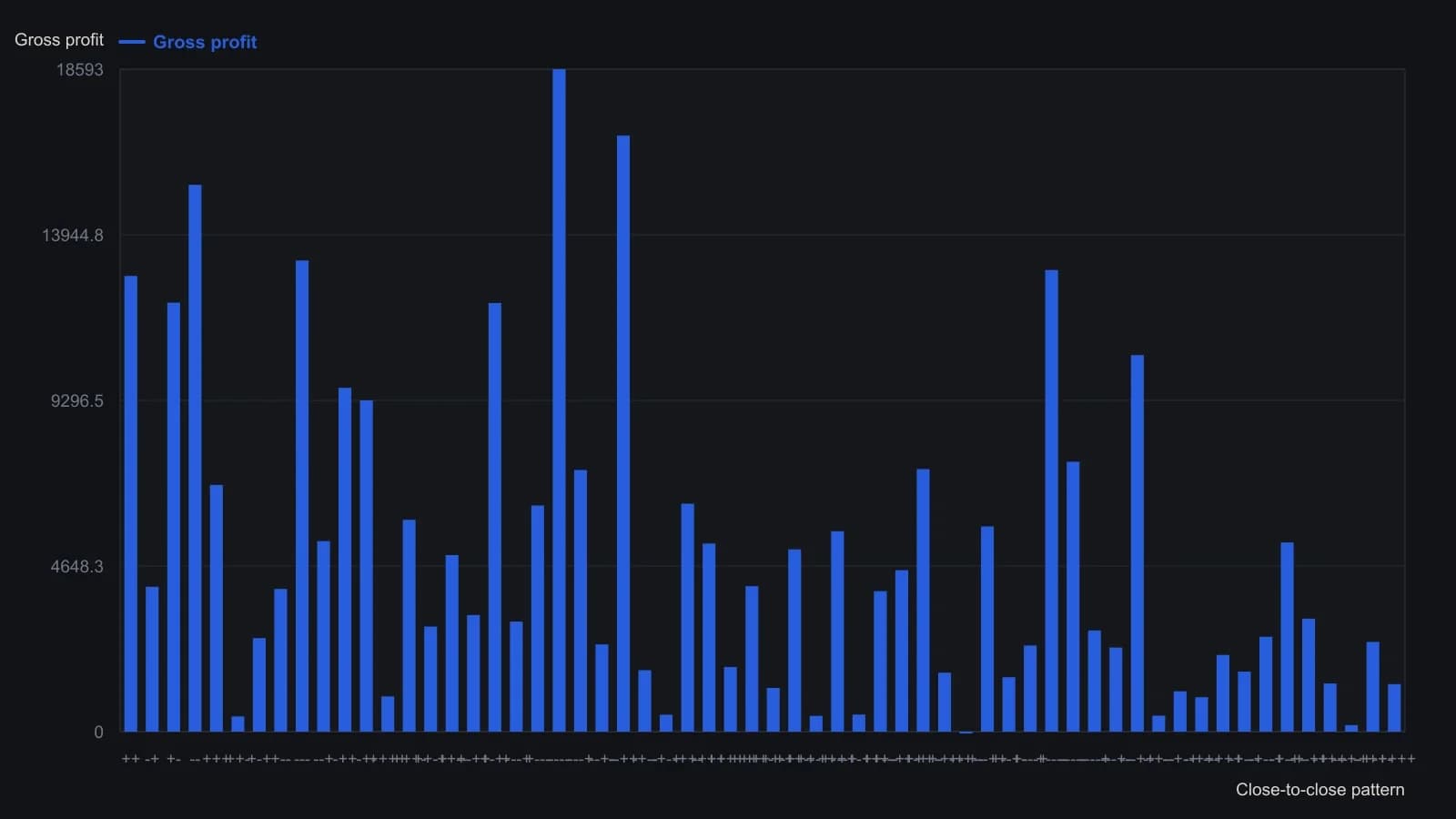
Gross totals are as printed; commissions and slippage are not stated. Two-day labels rest on roughly 500–560 trades; five-day labels on about 50–80, so the tallest bars are not equally sampled. B or S is the side the study took after the close run.
All readings on this track · 25 readings
- 1988Early entry as the session switch for an opening-range breakout
- 1989Evaluating inside-day filters on opening-range breakouts
- 1989Opening-range breakout after a narrow-range-four session
- 1989A joint contraction setup as the arming switch for an opening-range breakout
- 1989Next-session opening-range rules after a bear hook
- 1989Same-session exits from multi-day open-close codes
- 1989A close-to-close sequence is a bias label, not a trigger
- 1989Inside-day contraction as a same-session open-to-close rule
- 1990Evaluating five-day soybean open-to-close rules
- 1990Hourly breakouts gated by absolute tick volume
- 1993Premarket setup selection and opening-range rules
- 1994First-hour opening-range construction as a refusal problem
- 1995Why historically tested rules fail without a decision process
- 2001The opening range as a measuring stick for a ladder breakout
- 2001Evaluating an opening reaction as one timed stop procedure
- 2003Swing trading, opening-range checks, and the decision to stand aside
- 2006Monitor each opening-range setup as its own regime
- 2006Midday breakout rules from the opening range
- 2007Opening-range breakout as one session procedure
- 2007Evaluating same-day opening range entry rules
- 2008Overnight auction regimes and the intraday hold-or-exit choice
- 2010Construct a market-state-first range-breakout system as one procedure
- 2013Opening-hour stop as a session filter
- 2017Overnight volume as a construction step for the opening-range breakout
- 2017Night-volume gate for opening range breakouts