2001issue C051-4
Evaluating an opening reaction as one timed stop procedure
The procedure waits through the opening range, then seeks an opening reaction only after an extreme-zone stochastic cross. Evaluation holds the first stop still, scores a short holding window, and only later compares a trailing stop.
- The opening range is a high-volume formation window, not a trading interval. An opening reaction is sought only from 9:45 a.m. ET.
- A 14-period stochastic oscillator on one-minute bars can trigger only on an extreme-zone cross of the faster line through the slower line. A cross between those zones is skipped.
- The limit entry is anchored to the crossover-bar close and needs the next bar to confirm direction. The initial stop is left unchanged for five minutes.
- A strong opening-day trend can produce a false countertrend stochastic signal. A one-minute wide-range bar is not used as a stop.
The opening range is a formation window
After the session opens, one-minute bars are watched through about 15 minutes of high-volume, choppy trading. That opening range is treated as a formation window rather than a trading interval.
Only at 9:45 a.m. ET does the procedure start seeking an opening reaction against the prices printed in that first window.
Entry waits for an extreme-zone cross
A 14-period stochastic oscillator on those one-minute bars is used to identify a short-term swing extreme after the opening-range window. The oscillator treats 80 as overbought and 20 as oversold.
Entry requires the faster %K line to cross the slower %D line inside those extreme zones. A cross between 20 and 80 is skipped.
The intended entry is a limit order placed slightly beyond the close of the crossover bar, so the following bar must confirm direction.
The initial stop is left still
The initial stop is a violation of the most recent high or low just before entry. That stop is not moved for five minutes. A breakeven stop is then used if the trade is already profitable.
A one-minute wide-range bar is not used as a stop level, because short-interval prints can be unreliable.
The holding window locates the exit horizon
For evaluation, trades were left to run without trailing stops. Outcomes were grouped from entry in five-minute increments through 20 minutes, and that interval collection was used to locate an exit horizon inside the holding window of about 15 to 20 minutes.
Later risk control includes a trailing stop or another stochastic recross to exit a trade moving the wrong way. A very strong opening-day trend is treated as a condition that can generate a false countertrend stochastic signal.
QQQ opening-reaction P&L by holding window
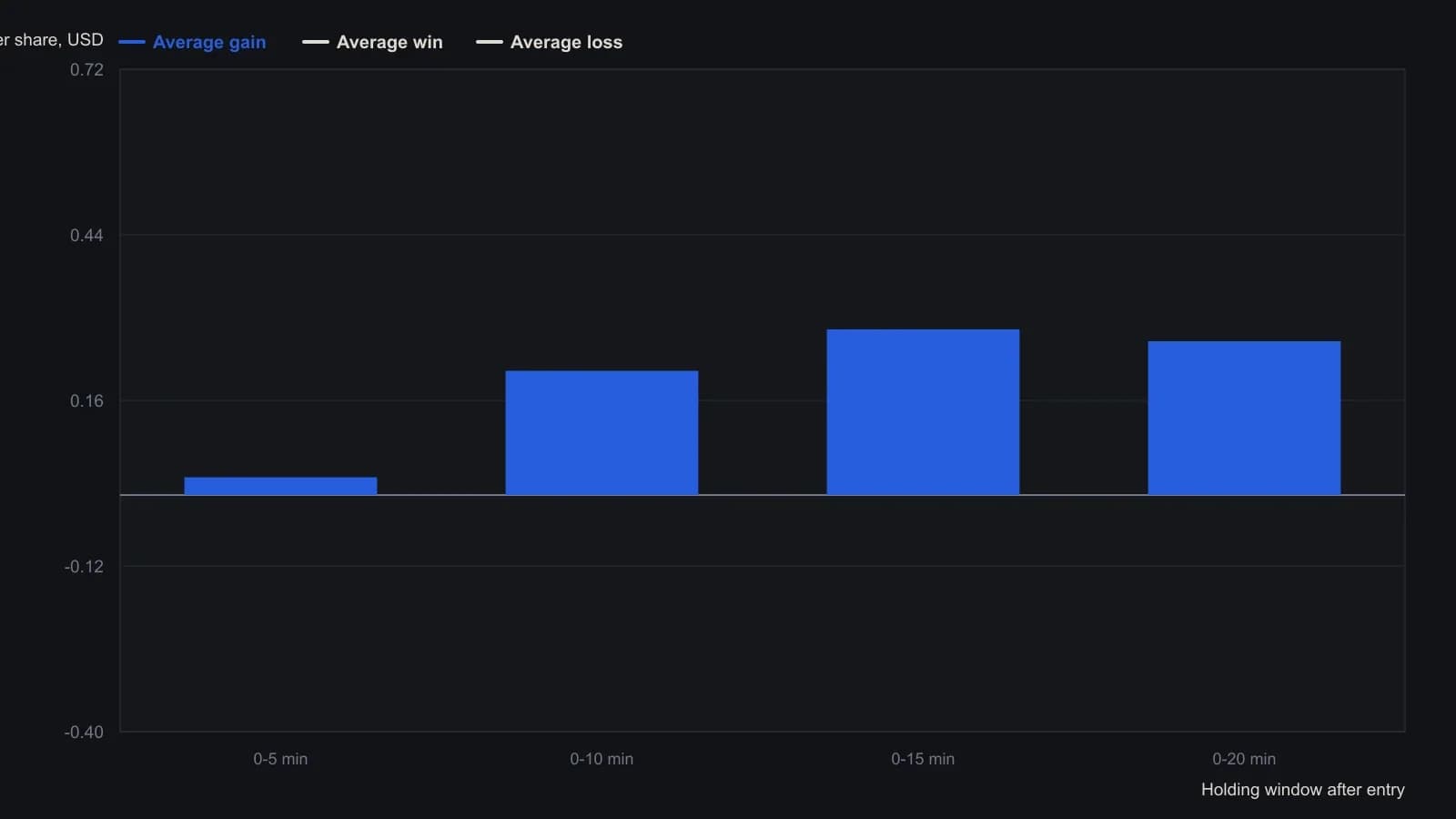
Thirty extreme-zone 1-minute stochastic-cross entries over 42 sessions. The first stop stayed fixed for five minutes; tracking stopped at 20 minutes after average gains began to shrink.
All readings on this track · 25 readings
- 1988Early entry as the session switch for an opening-range breakout
- 1989Evaluating inside-day filters on opening-range breakouts
- 1989Opening-range breakout after a narrow-range-four session
- 1989A joint contraction setup as the arming switch for an opening-range breakout
- 1989Next-session opening-range rules after a bear hook
- 1989Same-session exits from multi-day open-close codes
- 1989A close-to-close sequence is a bias label, not a trigger
- 1989Inside-day contraction as a same-session open-to-close rule
- 1990Evaluating five-day soybean open-to-close rules
- 1990Hourly breakouts gated by absolute tick volume
- 1993Premarket setup selection and opening-range rules
- 1994First-hour opening-range construction as a refusal problem
- 1995Why historically tested rules fail without a decision process
- 2001The opening range as a measuring stick for a ladder breakout
- 2001Evaluating an opening reaction as one timed stop procedure
- 2003Swing trading, opening-range checks, and the decision to stand aside
- 2006Monitor each opening-range setup as its own regime
- 2006Midday breakout rules from the opening range
- 2007Opening-range breakout as one session procedure
- 2007Evaluating same-day opening range entry rules
- 2008Overnight auction regimes and the intraday hold-or-exit choice
- 2010Construct a market-state-first range-breakout system as one procedure
- 2013Opening-hour stop as a session filter
- 2017Overnight volume as a construction step for the opening-range breakout
- 2017Night-volume gate for opening range breakouts