1989issue C091-6
Same-session exits from multi-day open-close codes
A plus-minus code of prior closes plus today's open is one rule-based entry. Encode the open-to-close sequence, decide at the day-session open whether to enter, wait for an opening-range breakout, or stand aside, and lock the same-session exit before any historical test begins.
- Each tabulated open-to-close sequence entered on the open shown by the last sign and used a same-session exit on that day's close, with no stops in the baseline procedure.
- In the plus-minus code, earlier signs mark an up or down close versus the prior close, and the final sign marks that day's open and the trade entry.
- Illustration charts should use the day-session open, not a night-session print, because the study is specified for day-session opens.
- The sequences are a research starting point for mechanical system work, not a method applied rigidly trade by trade.
One procedure from code to close
Editorial: treat a string of prior closes plus today's open as one complete procedure. Encode the open-to-close sequence, decide at the open whether to take a rule-based entry, wait for an opening-range breakout, or stand aside, and lock the same-session exit before any historical test begins.
A historical enumeration covered every two-, three-, four-, and five-day open-to-close sequence on T-bond futures from 1978 through 1987.
How the plus-minus code is read
In the plus-minus code, each plus or minus marks an up or down close versus the prior close, except the final sign, which marks that day's open and the trade entry.
Every tabulated sequence entered on the open shown by the last sign and exited on that day's close, and the tests used no stops.
Worked buy setups
The three-minus sequence means two lower closes and then a lower open. The illustrated long is taken on the third day's open and closed out on the third day's close.
One listed buy setup is three higher days, one lower day, and a lower open, framed as a defined upswing with a one-day counter move and a lower-open entry.
June 1988 Eurodollar, November 1987–March 1988
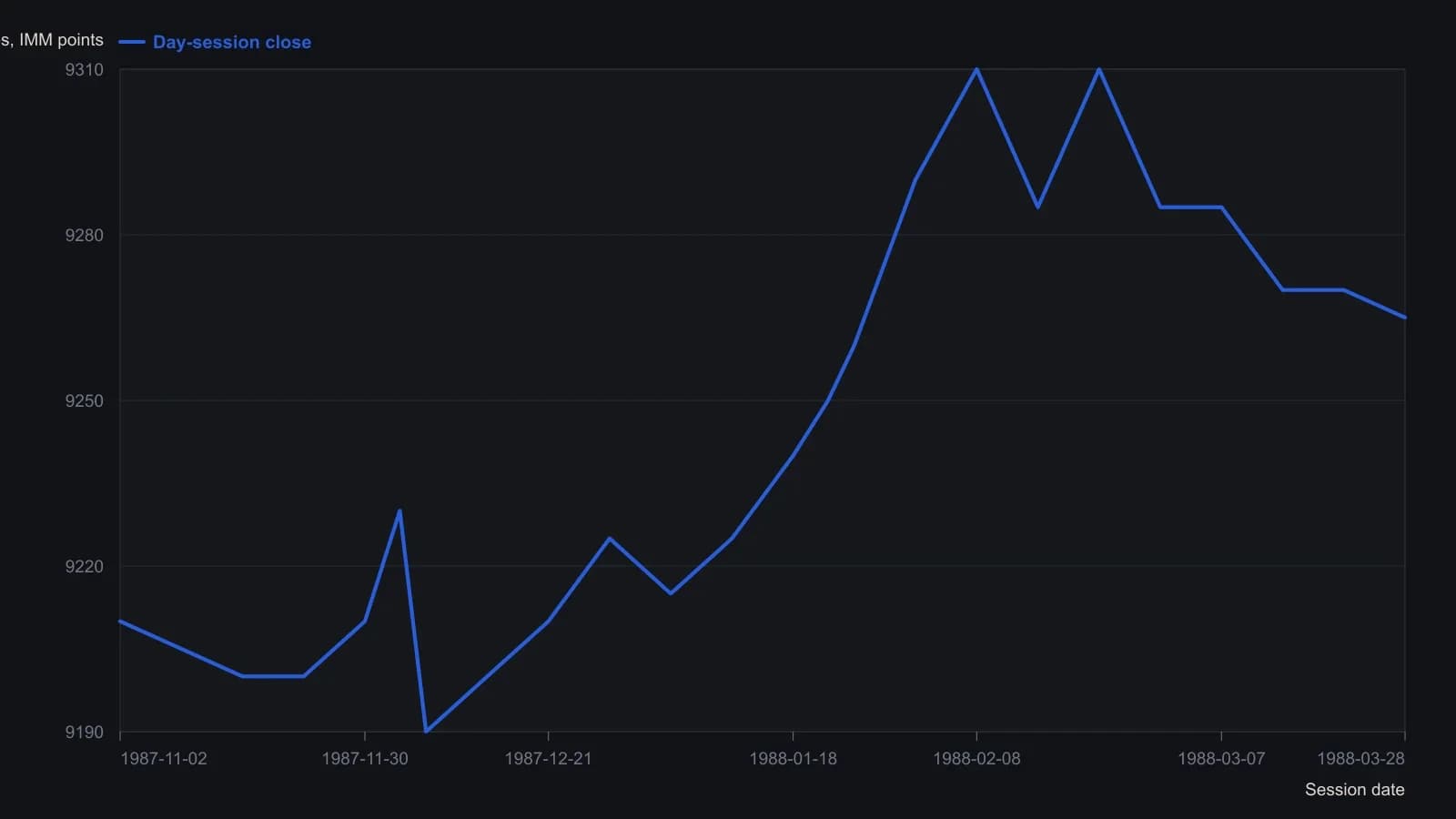
Quotes follow the chart’s four-digit IMM-style scale (9260 equals 92.60). Points are sampled near the marked weekly dates; individual bar highs and lows were not traced. The October 1987 fragment on the left drops through the indicator pane and was not read. The source tests used no stops.
Breakout stops, session choice, and overlays
A suggested early-session tactic is to rest entry stops just beyond the open in the direction of the opening-range-breakout bias.
Illustration charts should use day-session opens, because the study is specified for day-session opens rather than night-session opens.
Expanding or contracting daily ranges relative to prior days can be added to the basic close-and-open sequences as a further filter.
Suggested context overlays include support and resistance, angles, and trendlines, plus watching price action around the open before committing.
The sequences are presented as a research starting point for mechanical system work, not as a method applied rigidly trade by trade.
All readings on this track · 25 readings
- 1988Early entry as the session switch for an opening-range breakout
- 1989Evaluating inside-day filters on opening-range breakouts
- 1989Opening-range breakout after a narrow-range-four session
- 1989A joint contraction setup as the arming switch for an opening-range breakout
- 1989Next-session opening-range rules after a bear hook
- 1989Same-session exits from multi-day open-close codes
- 1989A close-to-close sequence is a bias label, not a trigger
- 1989Inside-day contraction as a same-session open-to-close rule
- 1990Evaluating five-day soybean open-to-close rules
- 1990Hourly breakouts gated by absolute tick volume
- 1993Premarket setup selection and opening-range rules
- 1994First-hour opening-range construction as a refusal problem
- 1995Why historically tested rules fail without a decision process
- 2001The opening range as a measuring stick for a ladder breakout
- 2001Evaluating an opening reaction as one timed stop procedure
- 2003Swing trading, opening-range checks, and the decision to stand aside
- 2006Monitor each opening-range setup as its own regime
- 2006Midday breakout rules from the opening range
- 2007Opening-range breakout as one session procedure
- 2007Evaluating same-day opening range entry rules
- 2008Overnight auction regimes and the intraday hold-or-exit choice
- 2010Construct a market-state-first range-breakout system as one procedure
- 2013Opening-hour stop as a session filter
- 2017Overnight volume as a construction step for the opening-range breakout
- 2017Night-volume gate for opening range breakouts