2013issue C0752
Walk-forward system evaluation with a commodity channel index and chandelier exits
Walk-forward evaluation fits parameter values on an in-sample window and then applies those same values to a later out-of-sample window. The editorial aim is to judge a mean-excursion reading and a volatility-scaled stop as one procedure after fitting ends.
- Walk-forward evaluation fits parameter values on an in-sample window and then applies those same values to a later out-of-sample window that was not used for fitting.
- The commodity channel index reports how far price has moved away from its mean, and a chandelier exit is a stop whose distance is a multiple of average true range measured from the highest high or the close.
- Optimization shapes system rules so they fit the historical sample as closely as possible, which is why already chosen values are held fixed on the later window.
- Editorial reading: the protocol should decide whether that signal and that stop still belong together after parameters leave the fitting window.
Evaluation as one procedure
Walk-forward evaluation fits parameter values on an in-sample window and then applies those same values to a later out-of-sample window. The in-sample window is the historical window used to fit or select parameter values. The out-of-sample window is the later window used only to apply already chosen parameter values.
Editorial interpretation: treat that sequence as one procedure. The protocol should decide whether a mean-excursion signal and a volatility-scaled stop still belong together after the parameters leave the fitting window.
How walk-forward evaluation works
Walk-forward analysis is a staged evaluation that fits parameter values on an earlier sample and then holds those values fixed on a later sample that was not used for fitting.
Backtesting is a two-stage check that develops a strategy on historical observations and then applies the same rules to later observations to see whether the behavior stays consistent.
Optimization shapes system rules so they fit the historical sample under study as closely as possible. Because that practice matches the sample as closely as possible, walk-forward evaluation keeps the later window free of a second fitting step.
Seasonally adjusted U.S. unemployment, 2003–2013
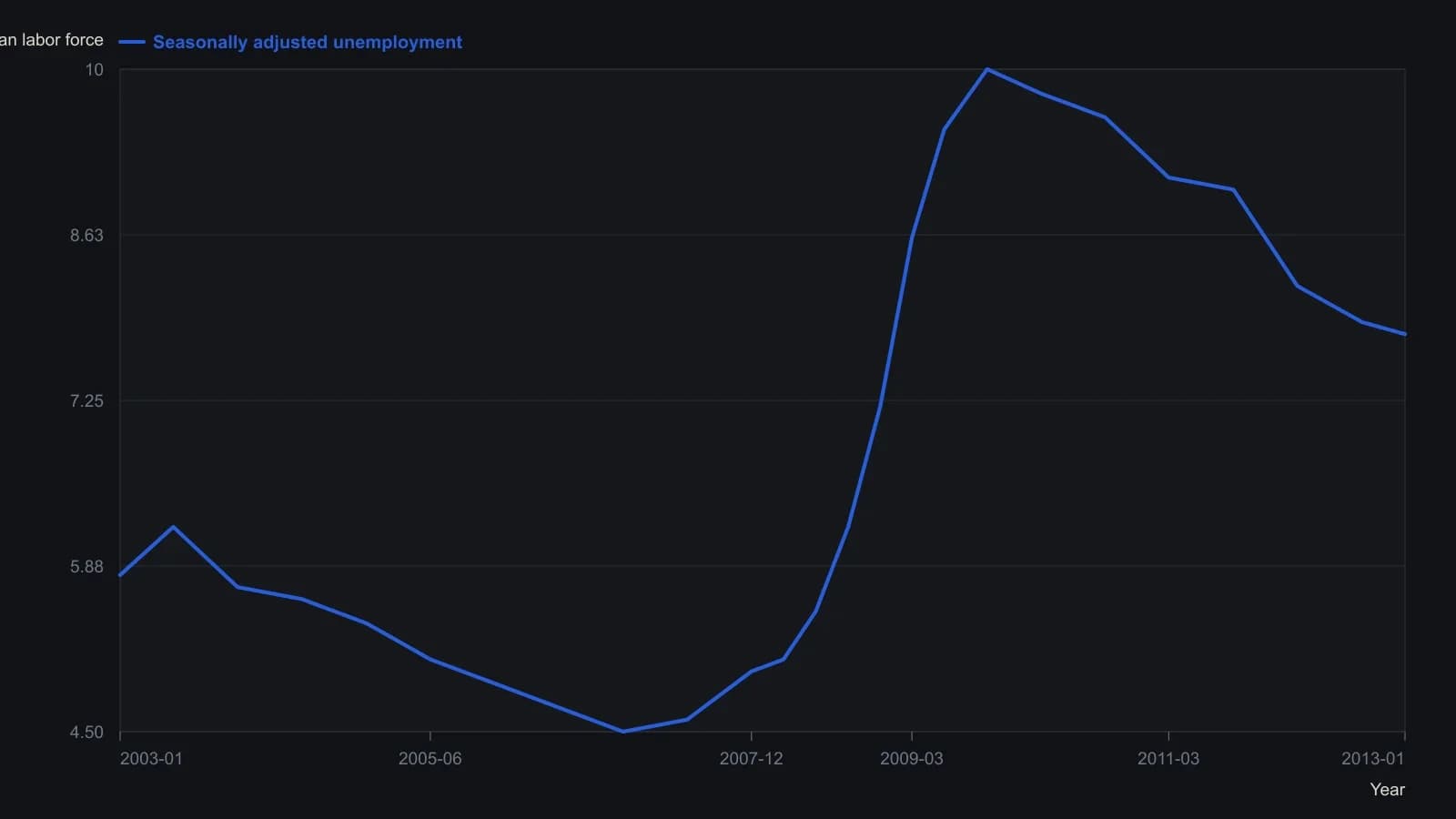
Interior readings are approximate digitizations of the screenshot, kept to one decimal to match the labeled last value. The empty lower pane is not a series and was ignored.
The commodity channel index as a fixed reading
The commodity channel index is a price-momentum reading that measures how far the current price has traveled from its mean over a stated lookback. It reports how far price has moved away from its mean.
A discretionary approach interprets indicator signals with personal judgment rather than a fixed procedure. Discretionary judgment means interpreting an indicator signal by personal decision rather than by a fixed, testable rule set.
Editorial interpretation: writing the reading as a fixed rule lets it enter the walk-forward procedure with the rest of the system, instead of remaining a matter of discretion.
The chandelier exit as a fixed stop
A chandelier exit is a volatility-scaled stop placed from the peak high or the last close, using a chosen multiple of average true range to bound remaining exposure. The distance is a multiple of average true range, measured from either the highest high or the close.
Average true range is a volatility measure used to set chandelier stop distance from a high or a close. A stop-loss is a risk action that closes a trade to prevent additional decline in value.
Editorial interpretation: the chosen multiple and the choice of high or close stay with the already chosen parameter values when the later window begins.
Judging the pair after fitting ends
After the in-sample window, the later sample is used only to apply already chosen parameter values. Those values are held fixed.
Editorial interpretation: the later window is where the designer learns whether the commodity channel index rule and the chandelier exit still belong together as one procedure, not whether each piece can be reshaped on its own.
All readings on this track · 39 readings
- 1982Three gates on a 1982 pork-belly short
- 1982Scale-free Commodity Channel Index construction
- 1986Constructing a commodity channel index and a regression price channel
- 1987Constructing scaled OHLC matrices for study overlays
- 1987Constructing the commodity channel, average directional, and relative strength indexes on a shared cycle scale
- 1992Eleven-bar commodity channel index from typical price and mean deviation
- 1992Evaluating Commodity Channel Index breakout versus range rules
- 1992Evaluating breakout and CCI rules as complete mechanical procedures
- 1993Constructing stochastic, RSI and CCI inputs for forecasts
- 1993Nested centered channels with a commodity channel index confirmation gate
- 1993Listed-option timing as three separable clocks
- 1994Constructing an eleven-period commodity channel index
- 1994Confirming Elliott wave turns with channels and the commodity channel index
- 1995Commodity Channel Index band rules lag zero-line timing
- 1995Building the commodity channel index from typical price
- 1995Staged reversal rules with commodity channel index and average channels
- 1995Commodity channel index construction from typical price to a smoothed zero line
- 2001Reader tests for unfinished lookback oscillators
- 2002Constructing the commodity channel index from typical price
- 2003Breadth-filtered commodity channel index entry and exit rules
- 2003Constructing the Commodity Channel Index from typical price and scaled deviation
- 2003A shallow, poorly participated advance is an unconfirmed trend
- 2003CCI and RSI parameter defaults as scaling conventions
- 2003A cost and capital audit of a Commodity Channel Index trade engine
- 2003Commodity channel index peak divergence as an exit after twin patterns
- 2004Constructing the Commodity Channel Index from typical price
- 2004Constructing the Commodity Channel Index from typical price and mean deviation
- 2006Building custom indicators from the Commodity Channel Index, a least squares moving average and a rule-based entry
- 2012Confirming breakouts and retracements with CCI, ADX, and averages
- 2012Stacking oscillator lookbacks into a heatmap mosaic
- 2013Constructing a consensus and volatility-normalized value oscillator
- 2013Walk-forward system evaluation with a commodity channel index and chandelier exits
- 2014Dual detrended oscillators and dual Bollinger Band channels
- 2014RSI, CCI, and moving-average trend-filter construction
- 2014Dual RSI, a moving average, and CCI as a confirmation stack
- 2017Constructing dual-average cross and channel-index filters
- 2018Treat CAM as a classification layer before confirmation becomes an entry
- 2018Four-state slope labels gated by a moving average and a commodity channel index
- 2018Deviation-Scaled Moving Average construction from a two-bar difference