1995issue C031-5
Staged reversal rules with commodity channel index and average channels
A historical currency-futures workflow kept a moving-average percentage channel and a dual commodity channel index as late confirmation, while a separate setup-countdown-entry sequence decided whether a complementary-currency-pair reversal was allowed, aborted, or recycled.
- Keep the moving-average percentage channel and the dual commodity channel index as a late environment layer, not as the entry trigger.
- Give permission to setup-countdown-entry: a nine-close setup, a 13-close countdown that need not be consecutive, then a choice of entry tests.
- Abort on full retracement, a reverse setup, or recycling, when a later qualifying setup cancels an unfinished one.
- Read the same close-count sequence on a complementary currency pair. Daily candlestick shapes were not used to time currency-futures entries.
A standing procedure still wanted more confirmation
A standing procedure combined a moving-average percentage channel with a dual commodity channel index and still sought extra confirmation, because outer channels can remain untouched in fading trends or be overrun in blow-offs.
The moving-average percentage channel is a moving average wrapped in fixed-percentage bands used to locate channel extremes and trendline breaks. The dual commodity channel index is a pair of commodity channel index calculations on a short lookback and a long lookback, used as an oscillator alert.
Dual commodity channel index as a late alert
The dual commodity channel index can print a string of price divergences before a turn, or reverse from an overbought or oversold reading without divergence.
On the December dollar index, the dual commodity channel index used five-period and 80-period settings and produced a buy alert after the October 20 close.
Moving-average percentage channel
A 40-day moving average with 1.5 percent and 3 percent channels framed that dollar-index decline. The last downtrend line and the average were both cleared on November 9.
Setup, countdown, and entry tests
Setup-countdown-entry is a three-stage close-count procedure that defines a reversal setup, a non-consecutive countdown, and a choice of entry tests.
A buy setup required nine consecutive daily closes below the close four sessions earlier, a prior-day close that was not lower than the close four sessions earlier, and a later daily-range intersection with a bar at least three sessions back. Intersection is a required overlap between the range of day eight, day nine, or a later countdown day and the range of a bar at least three sessions earlier.
After setup, countdown waited for 13 closes that were not required to be consecutive, each below the close two sessions earlier. Entry could be the 13th close, a later close above a close four sessions earlier, or a later close above the high two sessions earlier.
The sequence aborted on full retracement, a reverse setup, or a recycled setup. Recycling is cancellation of an unfinished setup when a later qualifying setup appears and takes precedence.
December dollar index sequence
On the December dollar index the nine-count finished on September 14 and the 13th countdown close on October 17, with buy completions listed for October 17, 27, and 28 after an August setup was recycled. The conservative four-day-close entry was taken after October 28 and filled on the October 31 open.
Editorial: those dates place the dual commodity channel index buy alert after the first listed completion, and they place the moving-average percentage channel clearance later still. The close-count sequence is what first allowed, recycled, and completed the entry.
Complementary Swiss franc sequence
A complementary currency pair is offsetting long and short currency positions chosen so strength in one contract is expected to coincide with weakness in the other.
The same close-count procedure on the December Swiss franc finished nine highs on September 14 and the 13th high on October 20, with sell completions listed for October 20, 26, and 27. A five-and-80-period dual commodity channel index sold after the October 21 close. A 40-day average with 2 percent and 4 percent channels broke a trendline on November 2 and gapped through the average on November 9.
Why daily candlesticks were not the timer
Daily candlestick shapes were not used to time entries because frequent opening gaps in currency futures made those patterns unreliable. Weekly charts supplied only the longer-term setting for the daily rules.
December 1994 US Dollar Index Sequential reversal
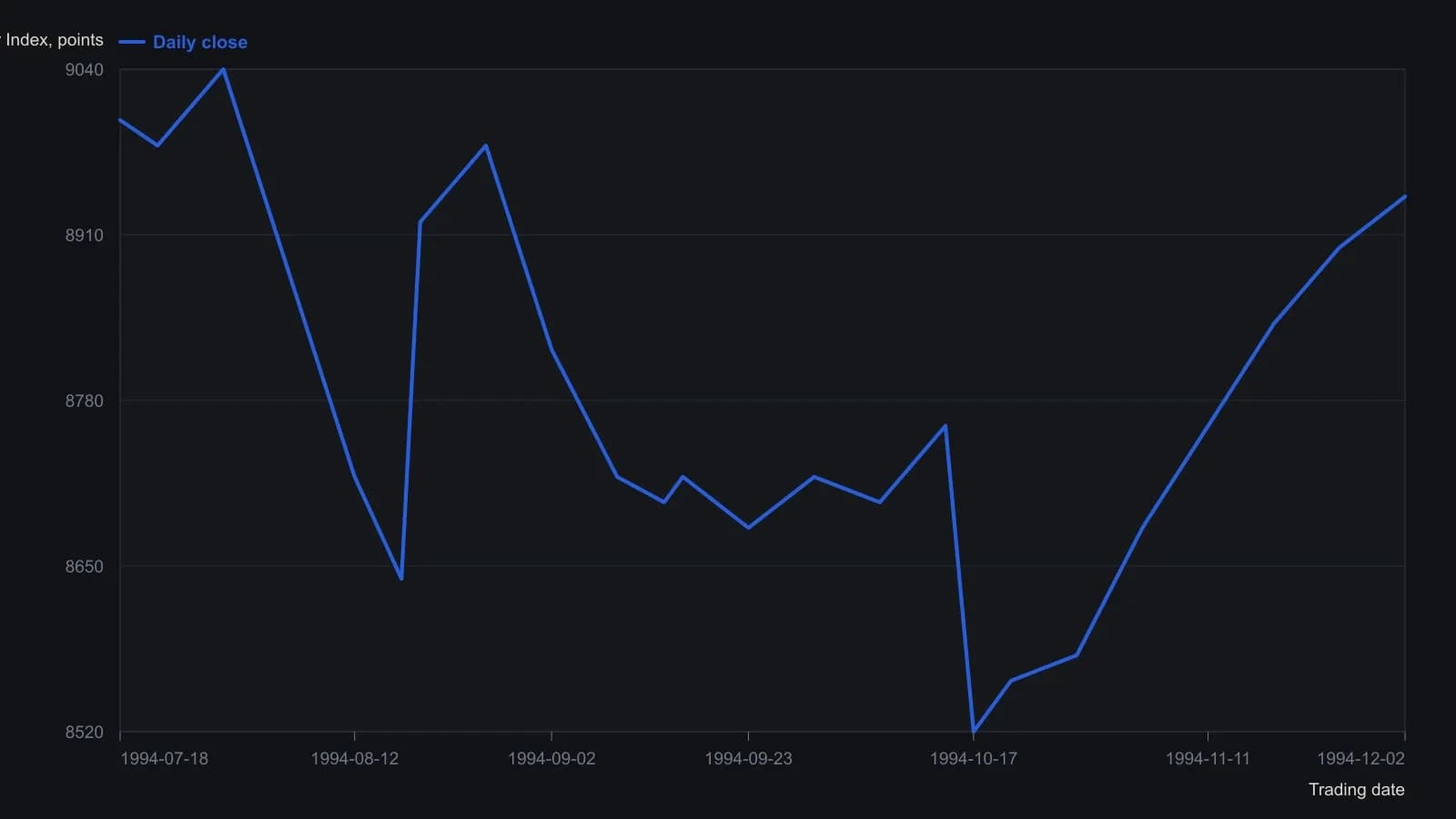
Closes were read off the raster against the printed 8500–9200 scale, so levels are approximate to about 20 index points. Sequential setup is nine closes versus the close four days earlier; countdown is thirteen closes versus the close two days earlier. The first August setup was recycled and is not an entry.
All readings on this track · 39 readings
- 1982Three gates on a 1982 pork-belly short
- 1982Scale-free Commodity Channel Index construction
- 1986Constructing a commodity channel index and a regression price channel
- 1987Constructing scaled OHLC matrices for study overlays
- 1987Constructing the commodity channel, average directional, and relative strength indexes on a shared cycle scale
- 1992Eleven-bar commodity channel index from typical price and mean deviation
- 1992Evaluating Commodity Channel Index breakout versus range rules
- 1992Evaluating breakout and CCI rules as complete mechanical procedures
- 1993Constructing stochastic, RSI and CCI inputs for forecasts
- 1993Nested centered channels with a commodity channel index confirmation gate
- 1993Listed-option timing as three separable clocks
- 1994Constructing an eleven-period commodity channel index
- 1994Confirming Elliott wave turns with channels and the commodity channel index
- 1995Commodity Channel Index band rules lag zero-line timing
- 1995Building the commodity channel index from typical price
- 1995Staged reversal rules with commodity channel index and average channels
- 1995Commodity channel index construction from typical price to a smoothed zero line
- 2001Reader tests for unfinished lookback oscillators
- 2002Constructing the commodity channel index from typical price
- 2003Breadth-filtered commodity channel index entry and exit rules
- 2003Constructing the Commodity Channel Index from typical price and scaled deviation
- 2003A shallow, poorly participated advance is an unconfirmed trend
- 2003CCI and RSI parameter defaults as scaling conventions
- 2003A cost and capital audit of a Commodity Channel Index trade engine
- 2003Commodity channel index peak divergence as an exit after twin patterns
- 2004Constructing the Commodity Channel Index from typical price
- 2004Constructing the Commodity Channel Index from typical price and mean deviation
- 2006Building custom indicators from the Commodity Channel Index, a least squares moving average and a rule-based entry
- 2012Confirming breakouts and retracements with CCI, ADX, and averages
- 2012Stacking oscillator lookbacks into a heatmap mosaic
- 2013Constructing a consensus and volatility-normalized value oscillator
- 2013Walk-forward system evaluation with a commodity channel index and chandelier exits
- 2014Dual detrended oscillators and dual Bollinger Band channels
- 2014RSI, CCI, and moving-average trend-filter construction
- 2014Dual RSI, a moving average, and CCI as a confirmation stack
- 2017Constructing dual-average cross and channel-index filters
- 2018Treat CAM as a classification layer before confirmation becomes an entry
- 2018Four-state slope labels gated by a moving average and a commodity channel index
- 2018Deviation-Scaled Moving Average construction from a two-bar difference