2013issue C0759-62
Step candle confirmations with wave count and chandelier exit
Step-up and step-down candle sequences confirm a prior 1-2-3 wave-count setup, then a chandelier exit keeps the stop volatility-scaled after the trade is on.
- Treat the 1-2-3 wave count as the setup and the step-candle pattern as confirmation only, not as a stand-alone entry.
- Adding the candle confirmations is described as filtering out entries judged least likely to move in the intended direction.
- A built-in chandelier exit keeps the stop volatility-scaled after the trade is on.
- A comparison without the confirmations is presented so the effect on trade count and drawdown can be inspected.
Coded step candles on a prior wave count
Step-up and step-down candle sequences are defined from successive open and close relationships so the same chart condition can be coded and tested. The step candle conditions are intended as extra confirmation on a prior 1-2-3 wave-count setup rather than as a stand-alone entry method.
The step-candle pattern is a two-bar open-close sequence that marks a directional step up or down. It is used only as confirmation, not as a standalone entry. Wave counting is the 1-2-3 swing structure used to locate a potential turning point before any candlestick filter is applied.
Pattern confirmation keeps the intended direction
Pattern confirmation uses the defined candlestick condition to keep only those wave-count setups that also print the step-up or step-down sequence. Adding the candle confirmations to the wave-count system is described as filtering out entries judged least likely to move in the intended direction.
A chandelier exit after the trade is on
One implementation pairs the filtered entries with a built-in chandelier exit so the stop stays volatility-scaled after the trade is on. The chandelier exit is a volatility-scaled stop that bounds loss and exposure from entry through the life of the position.
What the comparison was for
A comparison run without the candlestick confirmations is presented so the effect of the filter on trade count and drawdown can be inspected. In that comparison, adding the pattern confirmations is reported to cut the number of trades by almost half while also reducing maximum drawdown.
The same rule on another chart scale
The same step-pattern logic is shown as platform code that can be applied to a daily index chart, illustrating that the rule is chart-scale independent once coded.
Euro futures trade with wave-three confirmation and chandelier exit
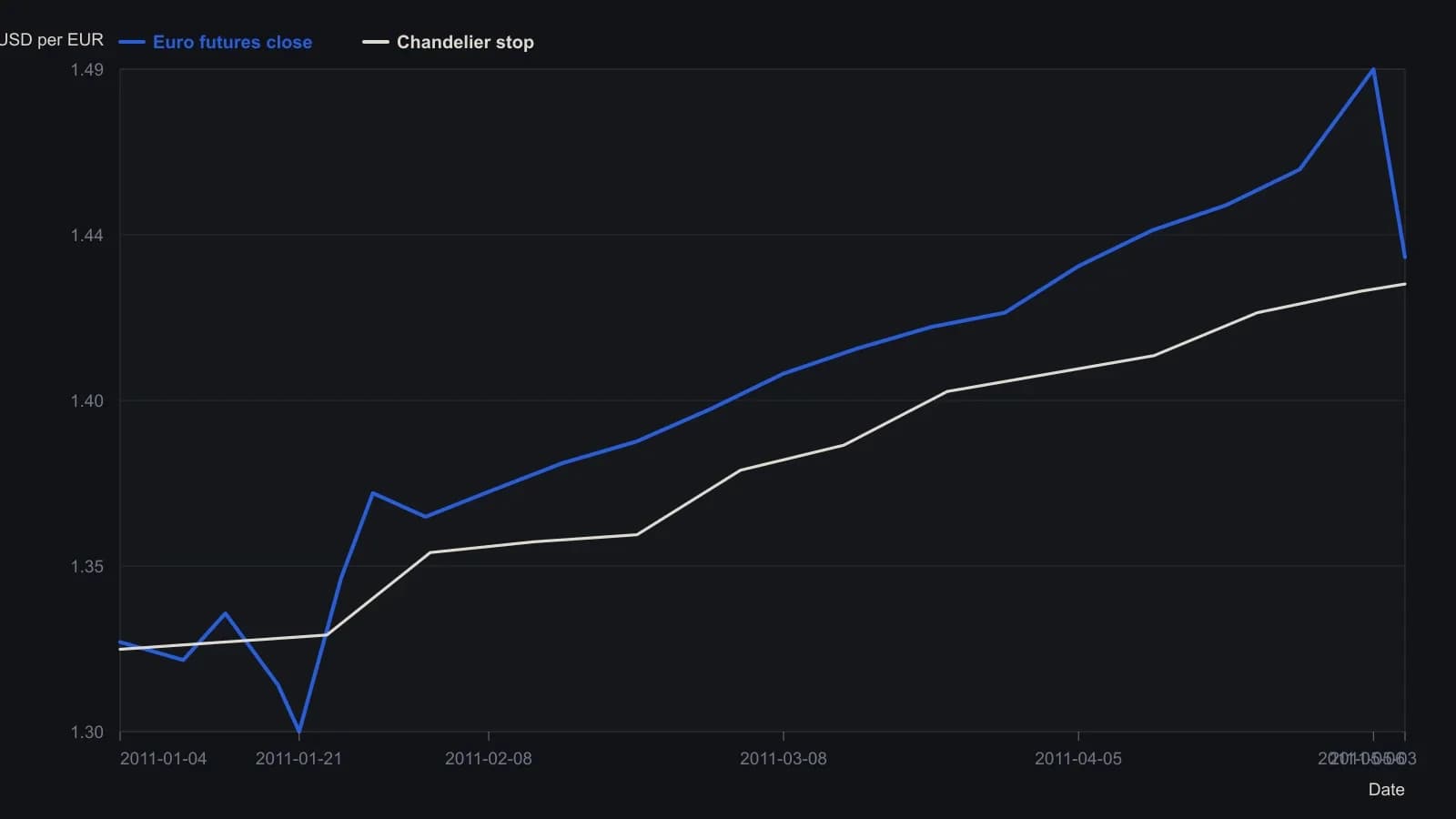
Entry on the source chart requires all three filters at once: wave-three confirmation, a candlestick pattern, and a close outside the two-standard-deviation Bollinger Band. The platform chandelier exit fired after 68 bars on 2011-05-06. Intermediate closes are visual readings on a 0.025 price grid and are only good to about 0.005.
All readings on this track · 16 readings
- 1991Wave counting as a sampling frame for head and shoulders
- 1995Constructing a percent-reversal wave filter
- 1995Filtered waves, overdue duration, candles, and trend
- 1995Filtered swing ledger for MW pattern construction
- 2003Three ratio tests from a completed supercycle
- 2004Wave labels as a checklist for expansion versus contraction
- 2010Constructing wave-ratio signals from a quadratic trend filter
- 2011A temporary placeholder while source evidence is loaded
- 2011Construct a harmonic impulse from measured three-wave limbs
- 2012Three Fibonacci rules to label trend versus countertrend
- 2013Sentiment wave counts before news headlines
- 2013Constructing a 1-2-3 wave count from high-low zigzag swings
- 2013Step candle confirmations with wave count and chandelier exit
- 2016Nested wave rhythms and double-bottom support
- 2016Nested correction-size bands and a derived support price
- 2020Counting a Nasdaq correction before stacking Fibonacci targets