1992issue C021-19
Evaluating Commodity Channel Index breakout versus range rules
The Commodity Channel Index can be written as a Breakout system that enters when the reading leaves the plus or minus 100 band and exits when it returns inside, or as a range-oriented Rule-based entry that buys on a cross above minus 100 and sells on a cross below plus 100. Entering and exiting on the next open with no stops isolates those two procedures.
- The Commodity Channel Index is built from typical price, a simple moving average of that typical price, and a mean deviation scaled by 0.015 so that readings beyond plus or minus 100 mark unusual variability.
- A given lookback keeps the same numeric value for a given bar when earlier or later price history is added, which makes the series stable for system testing.
- The original Breakout system enters when the index leaves the plus or minus 100 band and exits when it returns inside, so the system is not always in the market.
- The oscillator alternative buys when the index crosses above minus 100 and sells when it crosses below plus 100, a Rule-based entry intended for range-bound markets rather than persistent trends.
How the index is built
The Commodity Channel Index is built from typical price, a simple moving average of that typical price, and a mean deviation scaled by 0.015 so that readings beyond plus or minus 100 mark unusual variability.
A given lookback of the Commodity Channel Index keeps the same numeric value for a given bar even when earlier or later price history is added, which makes the series stable for system testing.
Eleven-period CCI leaves the ±100 channel
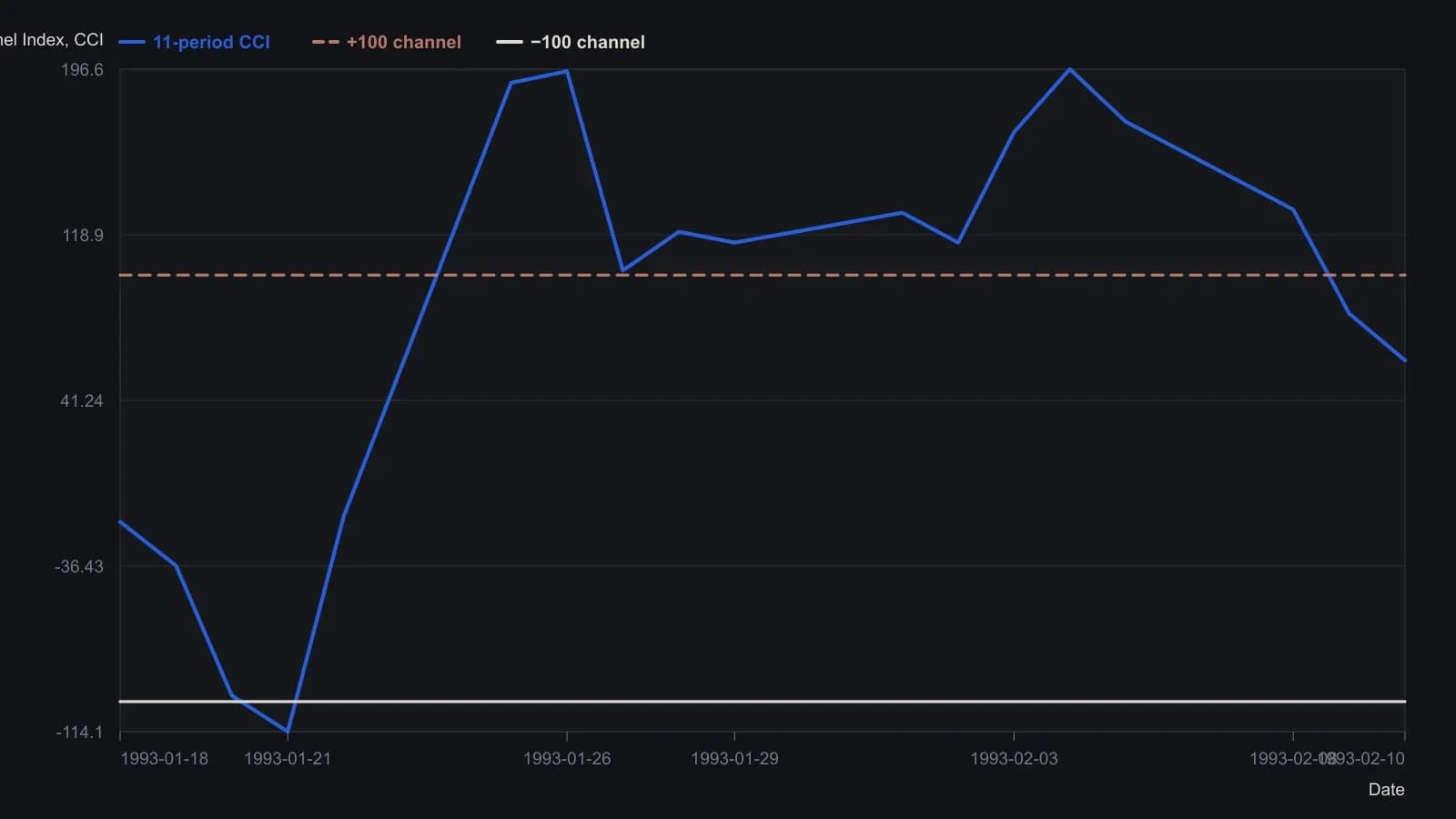
CCI uses an 11-session simple average of typical price (high+low+close)/3 and Lambert’s 0.015 mean-deviation scaler. The first ten rows have no CCI because the lookback is not yet full.
Two rule sets from the same reading
The original Breakout system enters when the Commodity Channel Index leaves the plus or minus 100 band and exits when it returns inside that band, so the system is not always in the market.
An oscillator-style alternative buys when the Commodity Channel Index crosses above minus 100 and sells when it crosses below plus 100. That Rule-based entry is intended for range-bound markets rather than persistent trends.
Lookback as a design decision
Lookback choice is a design decision. Very short windows can produce frequent reversals. Very long windows can miss much of a move. Suggested practice is a length between five and 25 bars, or less than one-third of an observed cycle when a cycle is used.
On a December 1991 Standard & Poor's 500 sample with an average low-to-low span of 35 days, an 11-unit Commodity Channel Index was selected because that length is less than one-third of the counted cycle.
Isolating the two procedures
A side-by-side test of the breakout and oscillator rules on that same December 1991 Standard & Poor's 500 contract entered and exited on the next open after a signal and used no stops, so the comparison isolates the two entry-exit procedures.
Editorial note: TradersWeek reads that setup as a way to hold the oscillator, the sample and the fill rule fixed while changing only the Rule-based entry logic.
All readings on this track · 39 readings
- 1982Three gates on a 1982 pork-belly short
- 1982Scale-free Commodity Channel Index construction
- 1986Constructing a commodity channel index and a regression price channel
- 1987Constructing scaled OHLC matrices for study overlays
- 1987Constructing the commodity channel, average directional, and relative strength indexes on a shared cycle scale
- 1992Eleven-bar commodity channel index from typical price and mean deviation
- 1992Evaluating Commodity Channel Index breakout versus range rules
- 1992Evaluating breakout and CCI rules as complete mechanical procedures
- 1993Constructing stochastic, RSI and CCI inputs for forecasts
- 1993Nested centered channels with a commodity channel index confirmation gate
- 1993Listed-option timing as three separable clocks
- 1994Constructing an eleven-period commodity channel index
- 1994Confirming Elliott wave turns with channels and the commodity channel index
- 1995Commodity Channel Index band rules lag zero-line timing
- 1995Building the commodity channel index from typical price
- 1995Staged reversal rules with commodity channel index and average channels
- 1995Commodity channel index construction from typical price to a smoothed zero line
- 2001Reader tests for unfinished lookback oscillators
- 2002Constructing the commodity channel index from typical price
- 2003Breadth-filtered commodity channel index entry and exit rules
- 2003Constructing the Commodity Channel Index from typical price and scaled deviation
- 2003A shallow, poorly participated advance is an unconfirmed trend
- 2003CCI and RSI parameter defaults as scaling conventions
- 2003A cost and capital audit of a Commodity Channel Index trade engine
- 2003Commodity channel index peak divergence as an exit after twin patterns
- 2004Constructing the Commodity Channel Index from typical price
- 2004Constructing the Commodity Channel Index from typical price and mean deviation
- 2006Building custom indicators from the Commodity Channel Index, a least squares moving average and a rule-based entry
- 2012Confirming breakouts and retracements with CCI, ADX, and averages
- 2012Stacking oscillator lookbacks into a heatmap mosaic
- 2013Constructing a consensus and volatility-normalized value oscillator
- 2013Walk-forward system evaluation with a commodity channel index and chandelier exits
- 2014Dual detrended oscillators and dual Bollinger Band channels
- 2014RSI, CCI, and moving-average trend-filter construction
- 2014Dual RSI, a moving average, and CCI as a confirmation stack
- 2017Constructing dual-average cross and channel-index filters
- 2018Treat CAM as a classification layer before confirmation becomes an entry
- 2018Four-state slope labels gated by a moving average and a commodity channel index
- 2018Deviation-Scaled Moving Average construction from a two-bar difference