2003issue C031-4
Breadth-filtered commodity channel index entry and exit rules
A lone commodity channel index extreme is not a complete entry or exit command. This article teaches a two-layer mechanical procedure: market breadth names the bullish or bearish regime first, the oscillator times only the trades that fit that regime, and standing aside is written as an explicit rule.
- In a strong advance the commodity channel index can remain overbought, and in a decline it can remain oversold, so a lone extreme is not a complete entry or exit command.
- A three-day simple moving average of the high-low ratio stayed near 0.7 to 0.9 in a strong advance and near 0.1 to 0.3 in a strong decline, supporting its use as a bullish versus bearish market-breadth regime reading.
- The combined long rule required an oversold commodity channel index reading plus either a high-low ratio above a bullish threshold or positive ratio momentum. Shorts were reserved for overbought oscillator conditions in a bearish regime.
- Fully coded exits were treated as incomplete, and the write-up states that one mechanical trading system is unlikely to serve both trending and sideways markets equally.
Why a lone oscillator is incomplete
The commodity channel index is a leading overbought and oversold oscillator of price versus its typical range. In this procedure it is only the timing trigger inside a broader rule set. In a strong advance it can remain overbought, and in a decline it can remain oversold, so a lone extreme is not a complete entry or exit command.
On the illustrated Nasdaq 100 tracking series, commodity channel index extremes clustered near plus or minus 150 and the oscillator spent little time in the mid-range.
Market breadth names the regime first
Market breadth is a market-wide reading of participation. Here it is the balance of new highs and new lows, used to label a bullish or bearish regime. The high-low ratio is new highs divided by the sum of new highs and new lows, often smoothed, and is the bullish or bearish breadth reading in these rules.
A three-day simple moving average of that high-low ratio stayed near 0.7 to 0.9 during a strong advance and near 0.1 to 0.3 during a strong decline. That pattern supported using the ratio as a bullish versus bearish market-breadth regime reading.
A breadth-only mechanical trading system entered and exited from the momentum of that high-low ratio, taken as the difference of two exponential averages versus a signal line. It also used separate long and short ratio thresholds, a one-session entry delay, and same-session exits.
Combined entry rules
The combined long rule required an oversold commodity channel index reading plus either a high-low ratio above a bullish threshold or positive ratio momentum. Shorts were reserved for overbought oscillator conditions in a bearish regime.
After testing an overbought oscillator alert paired with negative ratio momentum, the short-entry rule was reduced to the overbought commodity channel index alert. Adding the momentum filter did not change the equity path.
Four-year QQQ profit: CCI, breadth, and both together
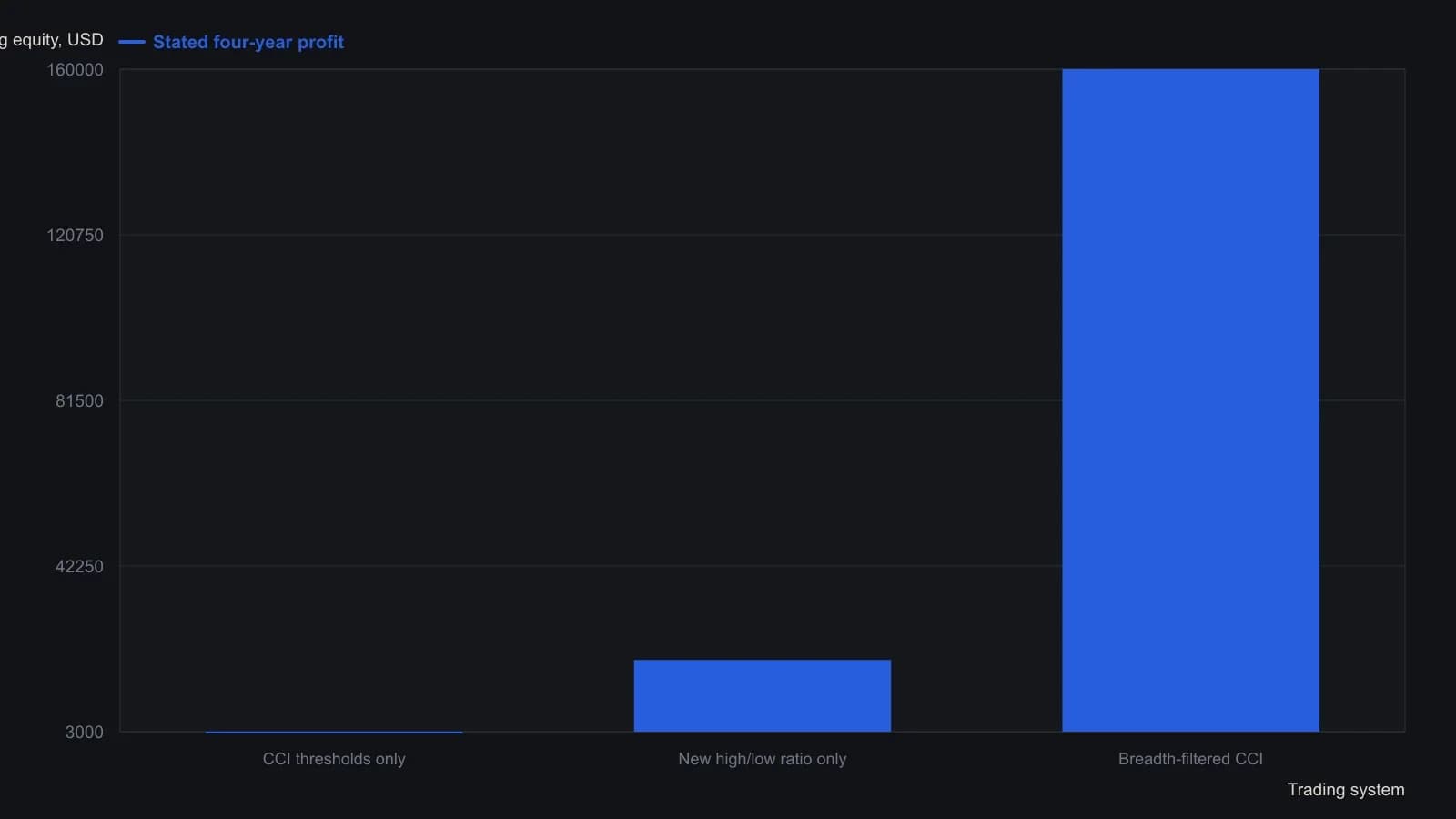
MetaStock reinvested the full account plus margin on every trade, so later wins dominate the dollar total. The combined-system pane prints ending equity as 164,717.8, in line with the rounded $160,000 profit.
Coded exits stay incomplete
A mechanical trading system is a fully specified procedure that states when to enter, exit, or abstain from coded conditions instead of discretionary judgment. Fully coded exits were still treated as incomplete. In a bullish regime the procedure wanted to wait until ratio momentum turned negative, but how far negative remained a judgment, and same-session discretionary exits were described as simpler than a mechanical close.
The coded long exit required the high-low ratio below an upper band, negative ratio momentum, and a still-slightly-overbought commodity channel index. The coded short exit required a bullish ratio reading plus an oversold oscillator.
The mechanical short-close rule failed to release a short during a strong late-1999 advance because market breadth stayed too bullish for the exit conditions to fire.
Range, trend, and the practical split
The write-up states that one mechanical trading system is unlikely to serve both trending and sideways markets equally. Protective stops plus choosing a procedure suited to range or trend conditions is the practical split.
Editorial reading
Editorial: the archive is taught here as a two-layer mechanical procedure, not as a claim that either layer is sufficient on its own. Market breadth names the regime first. The commodity channel index is allowed to time only the entries and exits that fit that regime. Standing aside is written as an explicit rule rather than left to the oscillator alone.
All readings on this track · 39 readings
- 1982Three gates on a 1982 pork-belly short
- 1982Scale-free Commodity Channel Index construction
- 1986Constructing a commodity channel index and a regression price channel
- 1987Constructing scaled OHLC matrices for study overlays
- 1987Constructing the commodity channel, average directional, and relative strength indexes on a shared cycle scale
- 1992Eleven-bar commodity channel index from typical price and mean deviation
- 1992Evaluating Commodity Channel Index breakout versus range rules
- 1992Evaluating breakout and CCI rules as complete mechanical procedures
- 1993Constructing stochastic, RSI and CCI inputs for forecasts
- 1993Nested centered channels with a commodity channel index confirmation gate
- 1993Listed-option timing as three separable clocks
- 1994Constructing an eleven-period commodity channel index
- 1994Confirming Elliott wave turns with channels and the commodity channel index
- 1995Commodity Channel Index band rules lag zero-line timing
- 1995Building the commodity channel index from typical price
- 1995Staged reversal rules with commodity channel index and average channels
- 1995Commodity channel index construction from typical price to a smoothed zero line
- 2001Reader tests for unfinished lookback oscillators
- 2002Constructing the commodity channel index from typical price
- 2003Breadth-filtered commodity channel index entry and exit rules
- 2003Constructing the Commodity Channel Index from typical price and scaled deviation
- 2003A shallow, poorly participated advance is an unconfirmed trend
- 2003CCI and RSI parameter defaults as scaling conventions
- 2003A cost and capital audit of a Commodity Channel Index trade engine
- 2003Commodity channel index peak divergence as an exit after twin patterns
- 2004Constructing the Commodity Channel Index from typical price
- 2004Constructing the Commodity Channel Index from typical price and mean deviation
- 2006Building custom indicators from the Commodity Channel Index, a least squares moving average and a rule-based entry
- 2012Confirming breakouts and retracements with CCI, ADX, and averages
- 2012Stacking oscillator lookbacks into a heatmap mosaic
- 2013Constructing a consensus and volatility-normalized value oscillator
- 2013Walk-forward system evaluation with a commodity channel index and chandelier exits
- 2014Dual detrended oscillators and dual Bollinger Band channels
- 2014RSI, CCI, and moving-average trend-filter construction
- 2014Dual RSI, a moving average, and CCI as a confirmation stack
- 2017Constructing dual-average cross and channel-index filters
- 2018Treat CAM as a classification layer before confirmation becomes an entry
- 2018Four-state slope labels gated by a moving average and a commodity channel index
- 2018Deviation-Scaled Moving Average construction from a two-bar difference