2014issue C128-9
The triangle qualifier came after the rating pre-screen and the fifty-day bounce
The archive records a reader who replicated a published triangle setup and asked whether the pattern was scanned or reviewed by eye. The practitioner applied the triangle only after a rating pre-screen and a visible fifty-day bounce, with volume as a later check.
- The triangle qualifier was applied only after names had already met a combined fundamental and technical rating pre-screen.
- Remaining names were then qualified by visually locating a fifty-day bounce.
- Volume verification came after that bounce and was not the opening filter.
- The practitioner treated triangle work as visual review of an already filtered list, not as a first-pass scan for the pattern.
How the question arose
A reader described replicating a published triangle setup in charting software and then continuing to watch the method after missing the first entry.
That reader asked whether the triangle condition was located with a dedicated scan or by reviewing a shorter watchlist visually.
The order that was described
The practitioner said the triangle was applied only after names had already met a combined fundamental and technical rating screen. That rating pre-screen is an earlier fundamental-and-technical filter that shrinks the candidate list before any pattern work begins.
Remaining names were then qualified by visually locating bounces off a 50-day moving average. The fifty-day bounce is a visible reaction off the 50-day moving average used to qualify remaining names.
Volume was described as a further verification step after the moving-average bounce, not as the opening filter. Volume verification is a later check that participation agrees with the price structure before the setup is treated as complete.
The practitioner characterized the triangle work as visual review of an already filtered list rather than a first-pass scan for the pattern itself. The triangle qualifier is a contracting price structure used as a late visual condition, not as the first scan.
Editorial reading
The following paragraph is a TradersWeek editorial reading and is not attributed to the archive. The case is a lesson in entry-rule order, not in isolated pattern recognition. A triangle is only a complete, falsifiable setup after a prior rating screen, a fifty-day average bounce, and a separate volume check.
Payout on a winning bet versus a losing bet
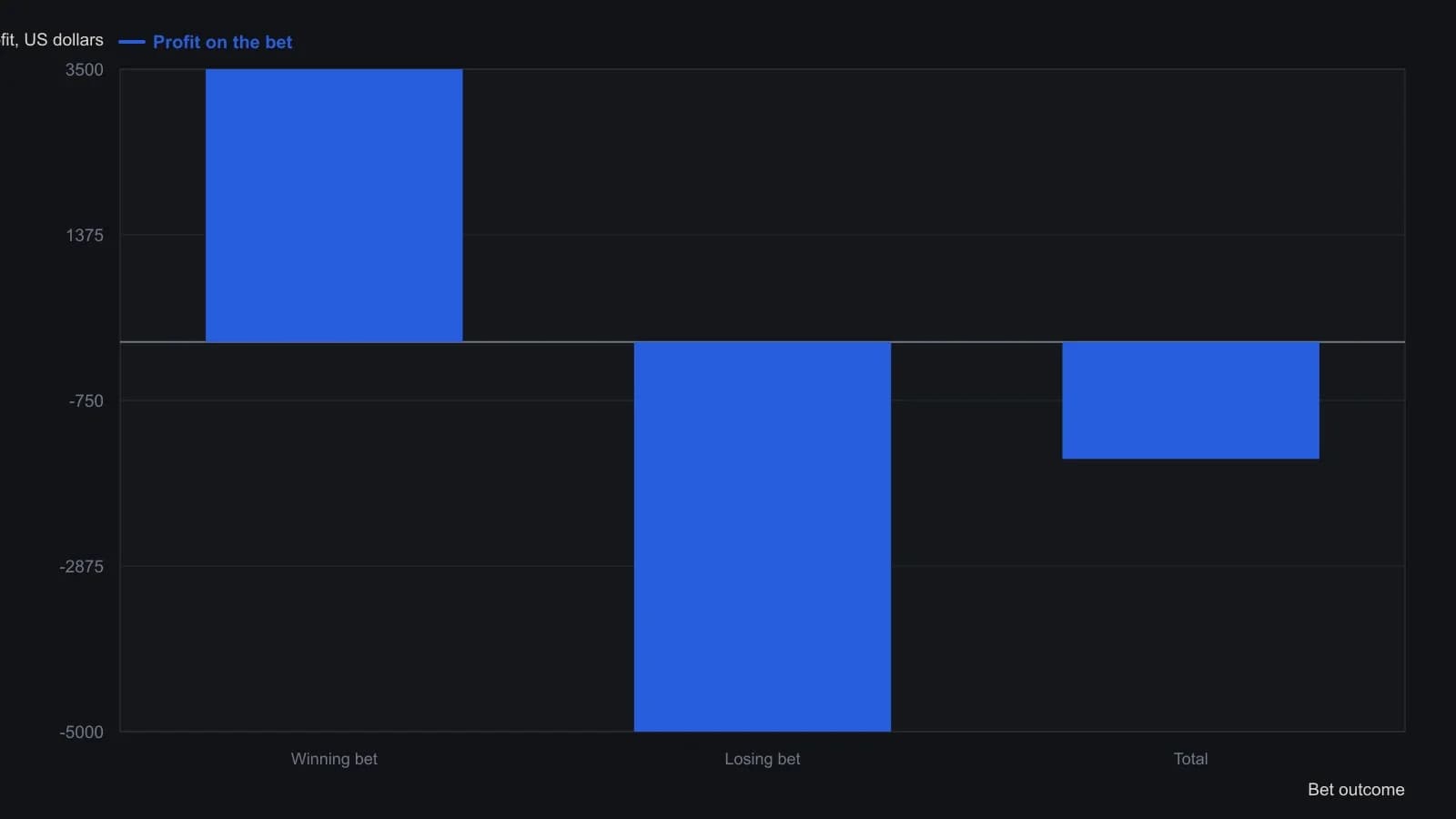
Brown’s letter applies Gail Mercer’s November 2014 values B = 0.5 and R = 0.7, which give E = 0.5 × 1.7 − 1 = −0.15, matching the table total of −$1,500 on $10,000.
All readings on this track · 33 readings
- 1986Gold as a double zigzag before a contracting B-wave triangle
- 1990Scoring competing wave counts after a crash
- 1992Pre-trade checklist for trendline and triangle signals
- 1995Chart patterns as tactics, not strategy
- 1996Constructing Elliott wave counts with triangles and Fibonacci
- 1996A price-channel case study with a pending triangle signal and a planned stop-loss
- 1996Expanding triangle as a dual-label fourth-wave reversal worksheet
- 1997Rising wedge construction, breakout, and volume
- 1997Confirm structure and conditions before naming a Triangle pattern
- 1999Drawing the Triangle pattern before Breakout confirmation and the Stop-loss order
- 2000Four-phase market cycle triangle breakouts
- 2000Continuation triangles as a three-lock experiment
- 2001Folding rule: stacking three trendlines on an accelerating swing
- 2003A scored symmetrical triangle on a utility stock
- 2003Constructing wedges versus flat-boundary triangles
- 2004Testing triangle breakouts against volume filters
- 2004Mute triangles, histogram force, and trader optimization
- 2004Constructing falsifiable reversal and continuation patterns
- 2004Construct a corrective rising wedge before treating it as a short
- 2004A continuation triangle with Fibonacci targets and an apex stop
- 2005Pre-breakout filters for classic chart patterns
- 2005Reverse trendlines as a geometry lab for convergence and expanding triangles
- 2005Volume shapes versus triangle and double-pattern breakouts
- 2005A nested-pattern checklist on the 2005 euro
- 2005Volume test for a descending triangle breakout
- 2010Constructing triangle, broadening, and head and shoulders patterns
- 2011Treat a numeric pattern rank as a shortlist
- 2011Evaluating the head-and-shoulders as a falsifiable reversal
- 2013Auditing chart patterns by the first post-breakout swing
- 2014A three-gate entry for a triangle pullback
- 2014Golden triangle: a 50-day pause that still needs both gates
- 2014The triangle qualifier came after the rating pre-screen and the fifty-day bounce
- 2018Aligning daily, weekly, and monthly triangles with trendlines and Fibonacci retracements