2015issue C0522-24
Index dip reversion is horizon and regime dependent
Keep a long-side 10-day-low entry on the S&P 500 fixed and change only the hold. The two-session path split on 19 October 1987, so the same rule is a holding-period-test of continuation versus mean-reversion.
- Mean-reversion is a bounce toward a recent average after a short-term decline, and it is treated as instrument-dependent: commodity and currency series as more continuation-prone, the US equity daily series as more reversion-prone.
- A holding-period-test keeps the 10-day-low entry fixed and changes only the exit horizon, so the same long-side signal can show continuation or reversion.
- After that same entry, a two-session hold showed follow-through into further weakness through 1987 and bounce behavior after 19 October 1987.
- Four named drivers of the short-horizon flip are exponential volume growth, instant stop execution, broader electronic short covering, and automated buying of oversold conditions.
A laboratory with one entry
Editorial reading: teach a single long-side dip rule as a laboratory. Keep the 10-day-low entry fixed and vary only the hold. Treat the result as a classifier for whether that market’s stop, liquidity, and short-covering environment still favors continuation or has flipped to mean-reversion.
Continuation is follow-through in the same direction after a short-term extreme, here a fresh multi-day low that keeps falling. Mean-reversion is a tendency for price to bounce toward a recent average after a short-term decline rather than to extend the move. Short-covering-pressure is buy-to-cover demand that can lift a falling price back toward its recent mean when short interest is large.
What the archive held fixed
The long-side procedure bought the S&P 500 close on a 10-day low, exited after a fixed 10-session hold, and used a constant 100000-dollar ticket with no costs from 1970 through 2013.
The same study focused on long-side reversion: an upward move after a short-term decline, not a two-sided fade.
Mean-reversion is instrument-dependent
Mean-reversion is treated as instrument-dependent. Commodity and currency series are described as more continuation-prone, while the US equity daily series is described as more reversion-prone.
Change the hold, not the entry
Shortening the hold to two sessions after the same 10-day-low entry split the path: follow-through into further weakness through 1987, then bounce behavior thereafter. The two-session path’s inflection is dated to 19 October 1987.
A short-term drop in the index was described as more often followed by a bounce than by immediate further decline in the first few sessions, in both rising and falling market stretches.
Reversion that took several days in the 1970s and 1980s is described as completing on a shorter clock in the later sample.
S&P 500 two-day-hold equity after 10-day lows
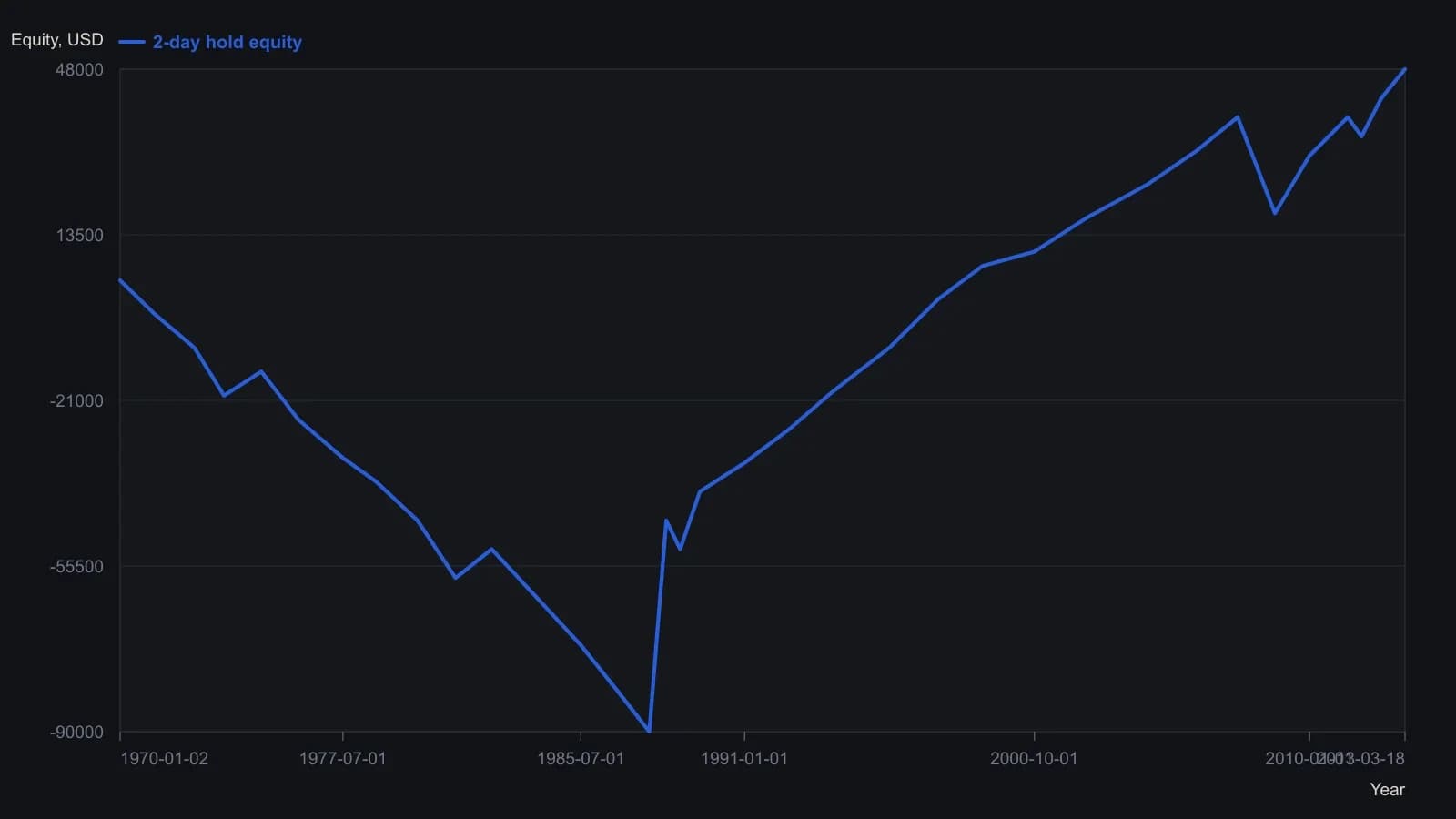
Buy the S&P 500 close at a 10-day low; sell the close two days later. Each trade $100,000, no commissions or slippage. The source dates the inflection to 19 October 1987.
Stops and the pre-automation cascade
Before the mid-1980s, stop-loss fills often waited until the next session and could stack selling across days. That stacking is a stop-cascade: a sequence in which delayed stop-loss fills generate further stops and stretch a decline across sessions. Same-session automated stops later compressed that cascade into the trading day.
Named drivers of the short-horizon flip
Four candidate drivers of the short-horizon flip are named: exponential volume growth, instant stop execution, broader electronic short covering, and automated buying of oversold conditions.
Transaction volume is described as growing exponentially from the early 1960s and reaching a high in the fourth quarter of 2008, offered as one reason later markets could absorb selling without multi-day runs.
Editorial use of the split
Editorial reading: once the entry is fixed, the two-session versus 10-session contrast classifies the stop, liquidity, and short-covering-pressure setting. If the short hold still extends the low, continuation remains the relevant market-regime for that clock. If the short hold bounces, mean-reversion has taken the first few sessions.
The dated flip on the two-session path sits on the pre- versus post-automation line. The archive separately described a bounce bias in the first few sessions in both rising and falling stretches, so that bull-or-bear contrast is not the split being dated.
All readings on this track · 36 readings
- 1986A futures fade as one range, order, and secrecy procedure
- 1992Constructing the mass-index range-reversal procedure
- 1993Switch trend following and mean reversion with an equity-curve filter
- 1994Evaluating weekly trend-following and mean-reversion timing rules
- 1996Dual-horizon bands for a precious-metals cash switch
- 1997Constructing a moving regression oscillator
- 1997Regime-dependent long and short rules in mechanical systems
- 2002A same-session pair book with a morning-fixed volatility envelope
- 2004Combining noncorrelated trend and reversion systems
- 2004Failed-breakout overlays on trending markets
- 2004Rank rotation after a path split, then Robustness testing
- 2004Range-bound tape as a filter for trend and oscillator rules
- 2005A moving-average short pullback that is only in scope in a decline
- 2006Constructing an adaptive price zone from a double-smoothed range
- 2007Two-period relative strength index versus a one-week universe baseline
- 2008Building ETF mean-reversion entries with a two-bar washout
- 2008Rebuild a short-period stochastic as a premier stochastic oscillator
- 2008A three-market regime map for equity bounces and dollar cycles
- 2009Option trade adjustment as one testable procedure
- 2010Implied volatility as a May 2010 market-regime lab for the S&P 500
- 2011Treat a large one-day move as a classified event
- 2011Long-call exits, volatility regimes, and spread assignment
- 2011Pairing same-horizon oscillators with a walk filter
- 2012Two-bar band extreme entries with trailing stops
- 2012An eight-month average as a monthly gate for high-yield bonds
- 2014Complete the checklist before the trade
- 2014Coded rules should face one test, not a kinder sample
- 2015Build a mean-reversion basket from one correlation path
- 2015Index dip reversion is horizon and regime dependent
- 2016Treat the end of a trend as a handoff, not a broken system
- 2017A testable half-swing pullback for trend continuation
- 2017Evaluating four swing detection rules for mean reversion
- 2018Intraday breakout and mean reversion as one rule set
- 2018Evaluating rare consecutive-close mean-reversion entries
- 2020Moving-average baselines, price vetoes, and mean reversion
- 2020Two-dimensional FX scaling for trend and reversal systems