2014issue C0645-48
Coded rules should face one test, not a kinder sample
A mechanical trading system is one coded procedure. Lookbacks, hold times, stops, and a mean-reversion centerline belong to that same test, because hunting an optimal lookback is framed as curve-fitting.
- A mechanical trading system encodes entry, exit, and abstention so coded rules, not discretionary timing, fire each trade.
- Parameterization, including moving-average lengths, is a design problem presented with walk-forward optimization, not a license to hunt one kind lookback.
- The system report is the post-backtest inspection surface, especially accuracy and the ratio of average winning trade to average losing trade.
- Mean reversion assumes an overshot true value; a parameter-free centerline and a multi-pattern bond procedure still sit inside the same rule set as exits and filters.
Write the procedure, then let it trade
A mechanical trading system is created by encoding the rules and then letting those coded rules place the trades. Mechanical design is contrasted with discretionary timing: building the system means writing code so the procedure, not a moment-by-moment judgment, fires each trade.
In that framing, a mechanical trading system is a complete set of coded entry, exit, and abstention rules that generate signals without a discretionary override at each decision.
Parameterization is part of the design
Parameterization is the choice of numeric inputs, such as moving-average lengths, that define how a rule set behaves across changing conditions. It is framed as a general design problem, illustrated by choosing faster and slower moving-average lengths and then changing those periods as market conditions change.
Walk-forward optimization is included among the validation topics presented with parameterization. That validation style re-estimates parameters on successive in-sample windows and then tests them on later unseen periods.
Inspect the system report
After a backtest, the system report is treated as a primary inspection surface. Accuracy and the ratio of average winning trade to average losing trade are singled out as two of its more important fields.
Short-hold systems lasting a few days are described as typically showing higher accuracy and a win/loss ratio near 1. Systems that hold a few weeks seek large winners to offset large losers. Around 60 percent accuracy with smaller profits is presented as a practical expectation that still requires sizing for drawdowns.
Shared ideas, including a parameter-free pattern
A bond procedure is built from 16 patterns that share three ideas: exit at the first profitable open, infer direction from bar-to-bar relationships, and filter with day-of-week seasonality. At least one pattern is written using no free parameters.
Hunting an optimal lookback
Tables of profit versus lookback period across a range of parameter values are used to argue that hunting an optimal lookback is a fallacy. Curve-fitting is the central risk of that search: selecting parameters that look profitable mainly because they were tuned to the same history used to judge them.
System optimization is the search of lookback windows and other parameters against historical results, including the risk that the chosen values only fit the sample.
Daily equity curve on SPY, January 2000 to August 2013
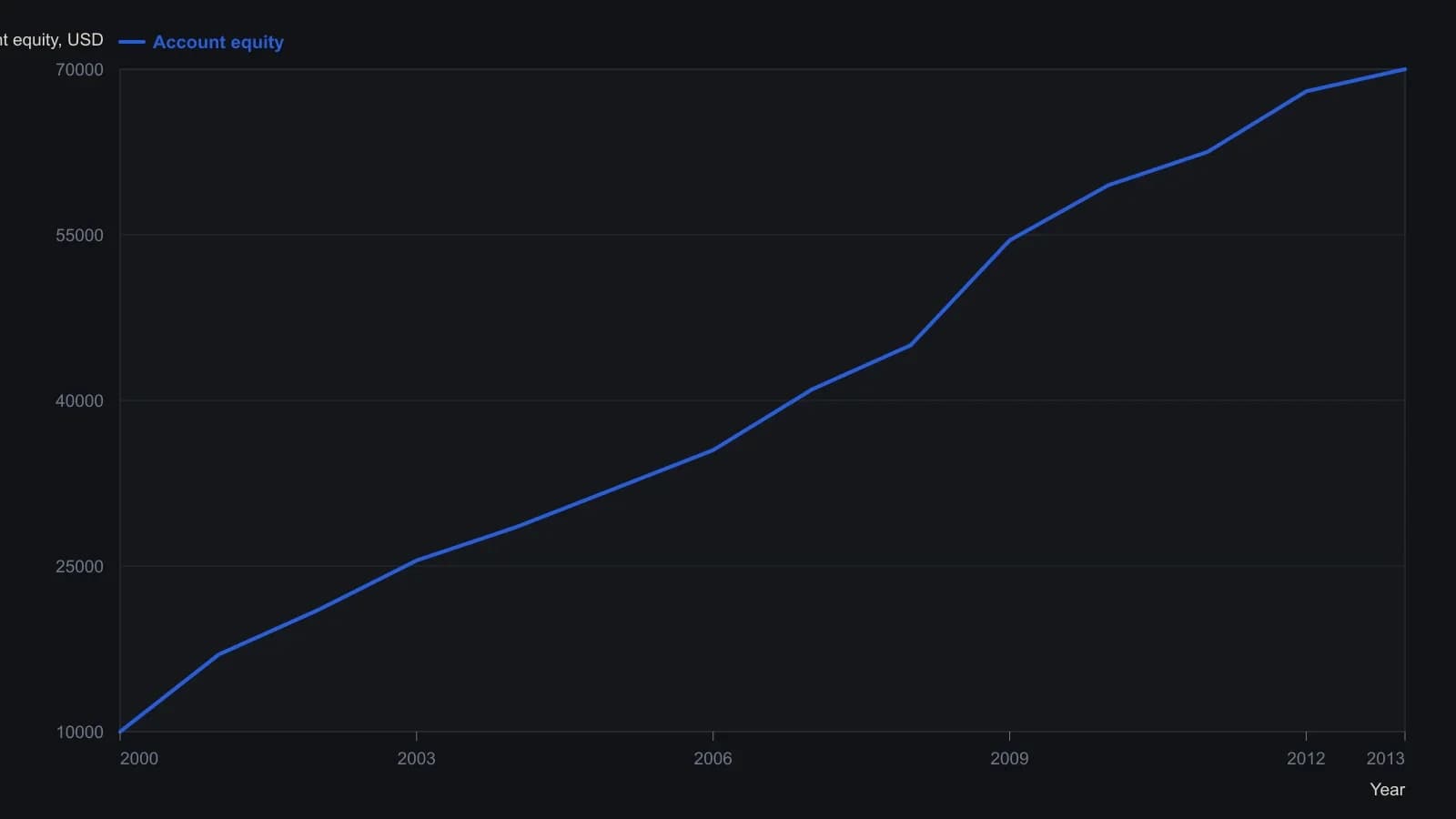
The review withholds the coded rules because this snapshot is from Beann's live personal account, so the path cannot be independently replicated from the article alone. Values are approximate readings against the five-thousand-dollar grid, not a tabulated series.
Mean reversion as a premise
Mean-reversion systems are defined as those that assume a true value overshot when the market is overbought or oversold. The design premise is that price can overshoot a fair value and later revert after those extremes.
One parameter-free example uses a centerline from the square root of high times low, buying if the next open is below it and shorting if the next open is above it, with exits created by reversing the position.
Editorial view: that centerline is still part of the same procedure as the reverse exits. It should not be treated as a separate knob that can be fitted after the entries already look kind.
Drawdowns and stop-losses
Drawdowns are treated as a reason traders abandon a still-running procedure. A drawdown is an equity decline large enough that many traders leave before later trades can occur. A sizing rule of thumb is offered so an account can survive a worst-case decline.
A separate analysis section presents stop-losses as one of several ways a rule set can lose money. Editorial view: a stop is another coded rule in the same procedure, not a patch added after the sample has been made to look kind.
All readings on this track · 36 readings
- 1986A futures fade as one range, order, and secrecy procedure
- 1992Constructing the mass-index range-reversal procedure
- 1993Switch trend following and mean reversion with an equity-curve filter
- 1994Evaluating weekly trend-following and mean-reversion timing rules
- 1996Dual-horizon bands for a precious-metals cash switch
- 1997Constructing a moving regression oscillator
- 1997Regime-dependent long and short rules in mechanical systems
- 2002A same-session pair book with a morning-fixed volatility envelope
- 2004Combining noncorrelated trend and reversion systems
- 2004Failed-breakout overlays on trending markets
- 2004Rank rotation after a path split, then Robustness testing
- 2004Range-bound tape as a filter for trend and oscillator rules
- 2005A moving-average short pullback that is only in scope in a decline
- 2006Constructing an adaptive price zone from a double-smoothed range
- 2007Two-period relative strength index versus a one-week universe baseline
- 2008Building ETF mean-reversion entries with a two-bar washout
- 2008Rebuild a short-period stochastic as a premier stochastic oscillator
- 2008A three-market regime map for equity bounces and dollar cycles
- 2009Option trade adjustment as one testable procedure
- 2010Implied volatility as a May 2010 market-regime lab for the S&P 500
- 2011Treat a large one-day move as a classified event
- 2011Long-call exits, volatility regimes, and spread assignment
- 2011Pairing same-horizon oscillators with a walk filter
- 2012Two-bar band extreme entries with trailing stops
- 2012An eight-month average as a monthly gate for high-yield bonds
- 2014Complete the checklist before the trade
- 2014Coded rules should face one test, not a kinder sample
- 2015Build a mean-reversion basket from one correlation path
- 2015Index dip reversion is horizon and regime dependent
- 2016Treat the end of a trend as a handoff, not a broken system
- 2017A testable half-swing pullback for trend continuation
- 2017Evaluating four swing detection rules for mean reversion
- 2018Intraday breakout and mean reversion as one rule set
- 2018Evaluating rare consecutive-close mean-reversion entries
- 2020Moving-average baselines, price vetoes, and mean reversion
- 2020Two-dimensional FX scaling for trend and reversal systems