2004issue C011-3
Combining noncorrelated trend and reversion systems
Portfolio construction in this archive workflow is a stacking problem. The same trend-following-crossover is placed first on markets that do not share a drawdown window, a mean-reversion-procedure is added on a shorter clock, and every signal is kept executable so the book can collect both sleeves.
- Stack the same trend-following-crossover first on markets whose peak-to-valley episodes do not arrive together.
- A mean-reversion-procedure is not an oscillator reading. It needs a profit exit and a fail-safe-stop, and its winners arrive on a shorter clock than the trend sleeve.
- When the two procedures issue opposite signals, contract-month-separation keeps both fills available instead of forcing a choice.
- Additive-sleeve-return appears when a noncorrelated-combination is held by taking every generated signal rather than selecting the better sleeve.
Portfolio construction as a stacking problem
TradersWeek editorial reading: construction here is a stacking problem rather than a choice between styles. The first layer is one fully specified trend-following-crossover. The second layer is a mean-reversion-procedure whose winners arrive on a different clock. The book is finished only when every generated signal can still be filled.
A mechanical-trading-system turns price history, market state, and risk limits into entry, exit, and abstention actions without discretionary override. Both sleeves in this workflow meet that test. The portfolio question is how to hold them together.
Same trend rule, separate drawdown windows
The archive workflow ran one trend-following-crossover on dated Brent and on yen-dollar. The rule changed side when a shorter average crossed a longer average and held that side for the system holding period. Typical trend holdings ran into months rather than days.
Each market was a complete book on its own. Taken together as a noncorrelated-combination, the two-market trend book issued the union of the two signal lists. The worst peak-to-valley episode of the joint book stayed close to the worse of the two single-market declines. The second market did not add a second, stacked drawdown window.
A shorter mean-reversion sleeve
The second sleeve was a mean-reversion-procedure completed on spot S&P 500 and dated Brent. Stretched relative-strength readings were faded. Profit exits were taken when the oscillator closed back through the designated threshold for longs or for shorts. A fail-safe-stop, expressed as a percentage of value, sat behind each trade. The stop was tighter on the equity index than on dated Brent.
An oscillator reading is not a trading system. The profit exit and the fail-safe-stop are what make the fade a mechanical-trading-system. The fail-safe-stop exists so that one trend cannot erase a long run of smaller reversion gains.
Those reversion trades were typically measured in weeks, a shorter clock than the trend sleeve. Winners arrived more often than they did in the trend-following book. TradersWeek editorial note: a busier win list is not a reason to drop the slower sleeve. The construction task is still to collect both.
Keep opposite signals fillable
When the two procedures issued opposite signals, both could be taken. The mean-reversion trade was placed in a nearer contract month. The trend-following trade was placed in a deferred month. Contract-month-separation is an execution constraint, not a forecast. It exists so the book does not have to cancel one sleeve in order to honor the other.
Collect both sleeves
The stacked workflow applied both procedures across dated Brent, yen-dollar, and spot S&P 500 and took every generated signal. The combined book issued more trades than the trend sleeve alone, and a higher share of those trades were winners. The worst peak-to-valley episode did not deepen relative to the trend-only book.
TradersWeek editorial reading: that pattern is additive-sleeve-return. When independent markets or independent signal types do not share the same peak-to-valley episodes, and when every generated signal is taken, uncorrelated books can contribute their individual rates of return to the combined result. The portfolio is built by keeping the sleeves independent and fillable, not by selecting the better of the two procedures.
Annualized return and worst drawdown as sleeves are stacked
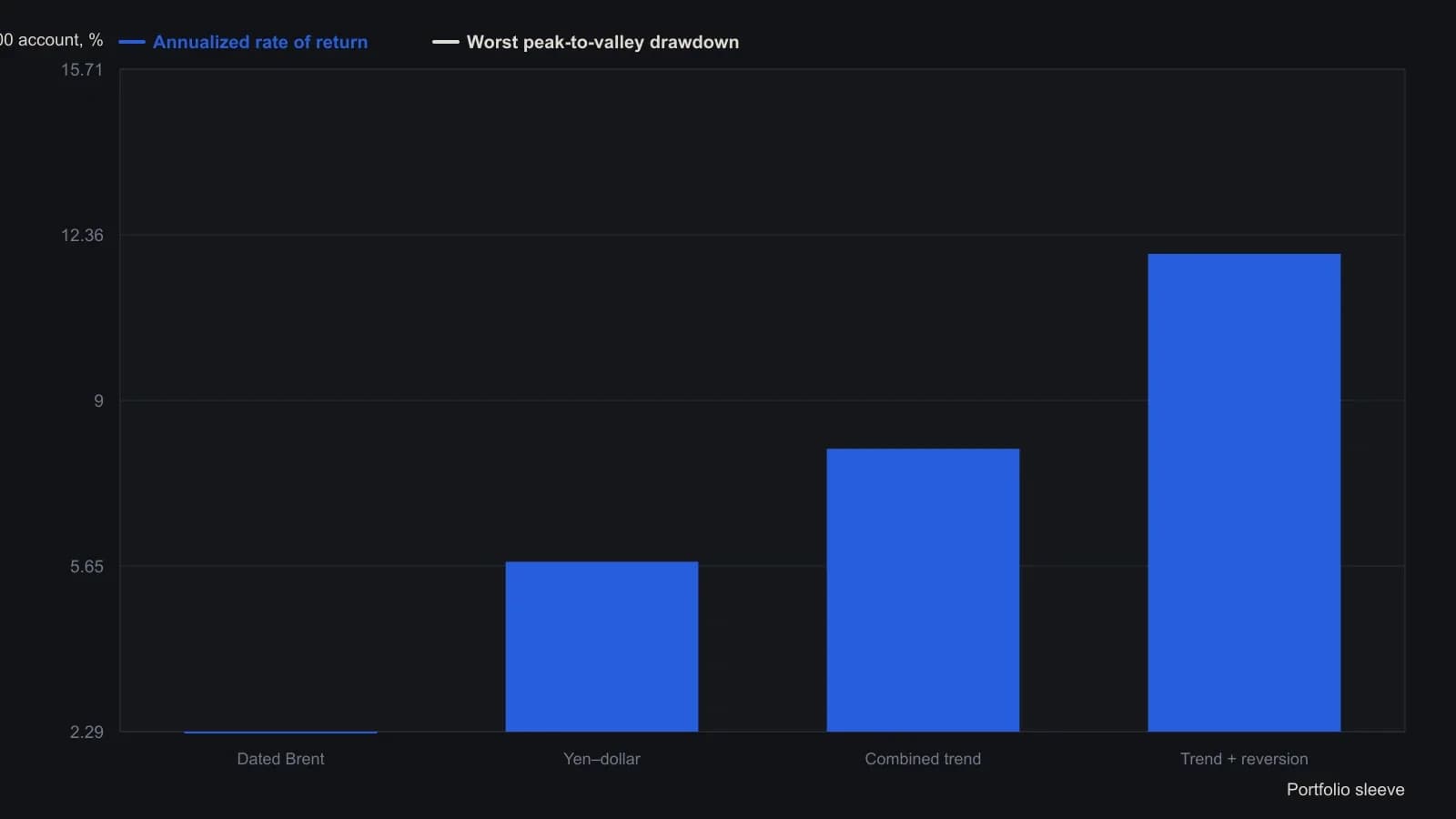
Account size is the $100,000 Weissman assumed throughout. Round-turn costs are the $75 slippage-and-commission deduction he applied to every trade. The crossover and RSI rules were chosen as only marginally profitable so the lift would come from diversification. Mean-reversion fail-safe stops were 7.5% on S&P 500 and 20% on dated Brent.
All readings on this track · 36 readings
- 1986A futures fade as one range, order, and secrecy procedure
- 1992Constructing the mass-index range-reversal procedure
- 1993Switch trend following and mean reversion with an equity-curve filter
- 1994Evaluating weekly trend-following and mean-reversion timing rules
- 1996Dual-horizon bands for a precious-metals cash switch
- 1997Constructing a moving regression oscillator
- 1997Regime-dependent long and short rules in mechanical systems
- 2002A same-session pair book with a morning-fixed volatility envelope
- 2004Combining noncorrelated trend and reversion systems
- 2004Failed-breakout overlays on trending markets
- 2004Rank rotation after a path split, then Robustness testing
- 2004Range-bound tape as a filter for trend and oscillator rules
- 2005A moving-average short pullback that is only in scope in a decline
- 2006Constructing an adaptive price zone from a double-smoothed range
- 2007Two-period relative strength index versus a one-week universe baseline
- 2008Building ETF mean-reversion entries with a two-bar washout
- 2008Rebuild a short-period stochastic as a premier stochastic oscillator
- 2008A three-market regime map for equity bounces and dollar cycles
- 2009Option trade adjustment as one testable procedure
- 2010Implied volatility as a May 2010 market-regime lab for the S&P 500
- 2011Treat a large one-day move as a classified event
- 2011Long-call exits, volatility regimes, and spread assignment
- 2011Pairing same-horizon oscillators with a walk filter
- 2012Two-bar band extreme entries with trailing stops
- 2012An eight-month average as a monthly gate for high-yield bonds
- 2014Complete the checklist before the trade
- 2014Coded rules should face one test, not a kinder sample
- 2015Build a mean-reversion basket from one correlation path
- 2015Index dip reversion is horizon and regime dependent
- 2016Treat the end of a trend as a handoff, not a broken system
- 2017A testable half-swing pullback for trend continuation
- 2017Evaluating four swing detection rules for mean reversion
- 2018Intraday breakout and mean reversion as one rule set
- 2018Evaluating rare consecutive-close mean-reversion entries
- 2020Moving-average baselines, price vetoes, and mean reversion
- 2020Two-dimensional FX scaling for trend and reversal systems