2015issue C0422-25
Build a mean-reversion basket from one correlation path
A mean-reverting basket is constructed so members generally move together. A directed acyclic graph maps pairwise correlation onto the longest continuous linkage of names, then the same mean-reversion rules fade leaders and buy laggards inside that group.
- A mean-reverting basket is constructed so members generally move together; nonconforming names can disrupt the intended group behavior.
- A directed acyclic graph can map equities as nodes and pairwise correlation as weighted edges, then return the longest continuous linkage as the candidate basket.
- Correlation analysis is used because the goal is co-movement of the whole group, not the two-asset cointegration framing often used for pair selection in Pairs trading.
- The intended trade fades members that lead away from the group mean and buys members that lag, using an overbought/oversold metric such as relative strength index.
Membership is part of the design
A mean-reverting basket is constructed so that members generally move together. Nonconforming names can disrupt the intended group behavior.
One correlation path as the basket
A directed acyclic graph can map equities as nodes and pairwise correlation as weighted edges, then return the longest continuous linkage of interrelated names as the candidate basket.
One illustrated pipeline starts from a large universe, measures Pearson correlation on 250 calendar days of end-of-day prices, ranks pairs, loads the top pairs into the graph, and takes the critical path as the output set.
Group co-movement instead of pair cointegration
Correlation analysis is used here because the design goal is co-movement of the whole group, not the two-asset cointegration framing often used for pair selection in Pairs trading.
Mean reversion on group outliers
The intended trade is to fade members that lead away from the group mean and to buy members that lag, using an overbought/oversold metric such as relative strength index to identify outliers.
One illustrated outlier rule computes relative strength index on each member and, each period, selects the highest and lowest readings in the group as the active names.
Construction as a test platform
Comparative backtests of random, near-zero-correlation, negatively correlated, and high-correlation DAG baskets were used to judge whether tighter intercorrelation improved the mean-reversion test platform.
Further testing is still required before treating DAG group selection as superior to other basket-construction mechanisms.
Correlated DAG basket versus SPY, 2006–2014
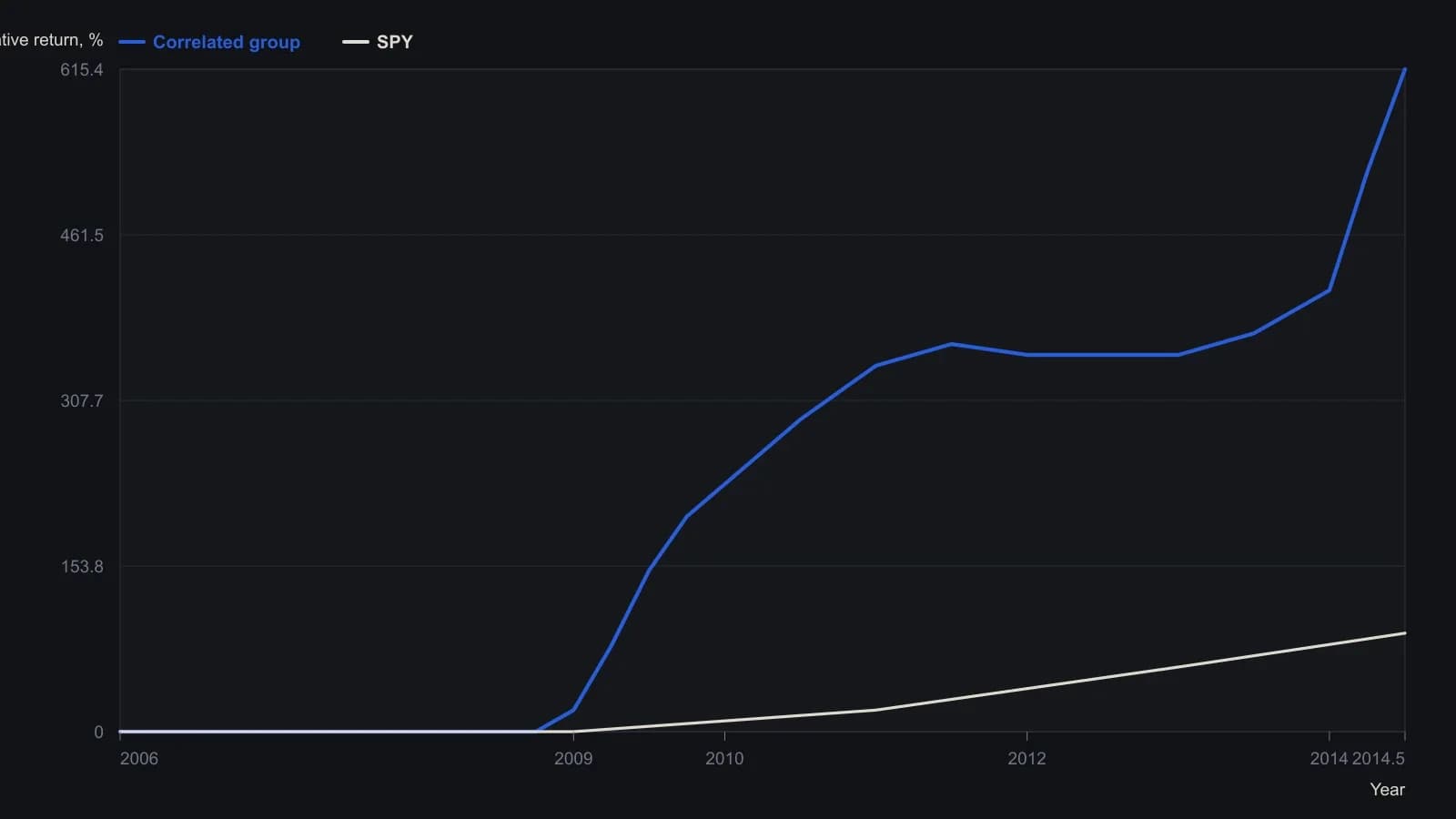
Pearson pairwise correlations used 250 calendar days of 2010 end-of-day prices; the basket is the DAG critical path of 19 S&P 500 names, traded with RSI method 1. Intermediate points are approximate raster readings rounded to 10 percentage points. The 615.4% and 91.5% endings are the printed legend values. SPY sits near the axis on this scale, so only its ending is precise.
All readings on this track · 36 readings
- 1986A futures fade as one range, order, and secrecy procedure
- 1992Constructing the mass-index range-reversal procedure
- 1993Switch trend following and mean reversion with an equity-curve filter
- 1994Evaluating weekly trend-following and mean-reversion timing rules
- 1996Dual-horizon bands for a precious-metals cash switch
- 1997Constructing a moving regression oscillator
- 1997Regime-dependent long and short rules in mechanical systems
- 2002A same-session pair book with a morning-fixed volatility envelope
- 2004Combining noncorrelated trend and reversion systems
- 2004Failed-breakout overlays on trending markets
- 2004Rank rotation after a path split, then Robustness testing
- 2004Range-bound tape as a filter for trend and oscillator rules
- 2005A moving-average short pullback that is only in scope in a decline
- 2006Constructing an adaptive price zone from a double-smoothed range
- 2007Two-period relative strength index versus a one-week universe baseline
- 2008Building ETF mean-reversion entries with a two-bar washout
- 2008Rebuild a short-period stochastic as a premier stochastic oscillator
- 2008A three-market regime map for equity bounces and dollar cycles
- 2009Option trade adjustment as one testable procedure
- 2010Implied volatility as a May 2010 market-regime lab for the S&P 500
- 2011Treat a large one-day move as a classified event
- 2011Long-call exits, volatility regimes, and spread assignment
- 2011Pairing same-horizon oscillators with a walk filter
- 2012Two-bar band extreme entries with trailing stops
- 2012An eight-month average as a monthly gate for high-yield bonds
- 2014Complete the checklist before the trade
- 2014Coded rules should face one test, not a kinder sample
- 2015Build a mean-reversion basket from one correlation path
- 2015Index dip reversion is horizon and regime dependent
- 2016Treat the end of a trend as a handoff, not a broken system
- 2017A testable half-swing pullback for trend continuation
- 2017Evaluating four swing detection rules for mean reversion
- 2018Intraday breakout and mean reversion as one rule set
- 2018Evaluating rare consecutive-close mean-reversion entries
- 2020Moving-average baselines, price vetoes, and mean reversion
- 2020Two-dimensional FX scaling for trend and reversal systems