2017issue C0150-55
A testable half-swing pullback for trend continuation
This archive article restates a historical workflow that waits for a pullback toward a half-swing midpoint and re-enters only after price resumes the prior trend, provided a longer average of closes still agrees. Mean reversion is used as a midpoint setup, not as a reversal forecast.
- The procedure waits for a pullback in an existing trend and enters only after price resumes the prior direction.
- A trigger line at the arithmetic midpoint of a stored swing high and swing low is the re-entry cross, while channel extrema update those references and flip long or short permission.
- A 50-period average of closes is the trend-filter: long entries require price above it and short entries require price below it.
- The same breakout, pullback, and resumption sequence can be coded on intraday or daily bars, and a delayed zigzag-style detector can encode the idea without an exact half-swing retracement.
What the procedure waits for
The archive workflow waits for a pullback in an existing trend and enters only after price resumes the prior direction.
Mean reversion, in this procedure, is a pullback toward a measured midpoint of a recent swing. That pullback is treated as a setup, not as a standalone reversal forecast.
Swing trading here means holding through a multi-bar continuation after a pullback rather than scalping the first tick of the bounce.
The half-swing trigger line
A half-swing midpoint between a stored high and low is used as the re-entry trigger line. Fibonacci retracement, as used here, is that half-swing reference: the midpoint between a recent high and low of the same impulse.
The trigger line is the arithmetic midpoint of the stored swing high and swing low, used as the re-entry cross condition.
Channel extrema over a lookback window update the swing references and flip long or short permission flags. Those extrema are the highest high and lowest low over the lookback window, and they mark when a new swing reference may be stored.
Alphabet 60-minute closes with the 50-bar average
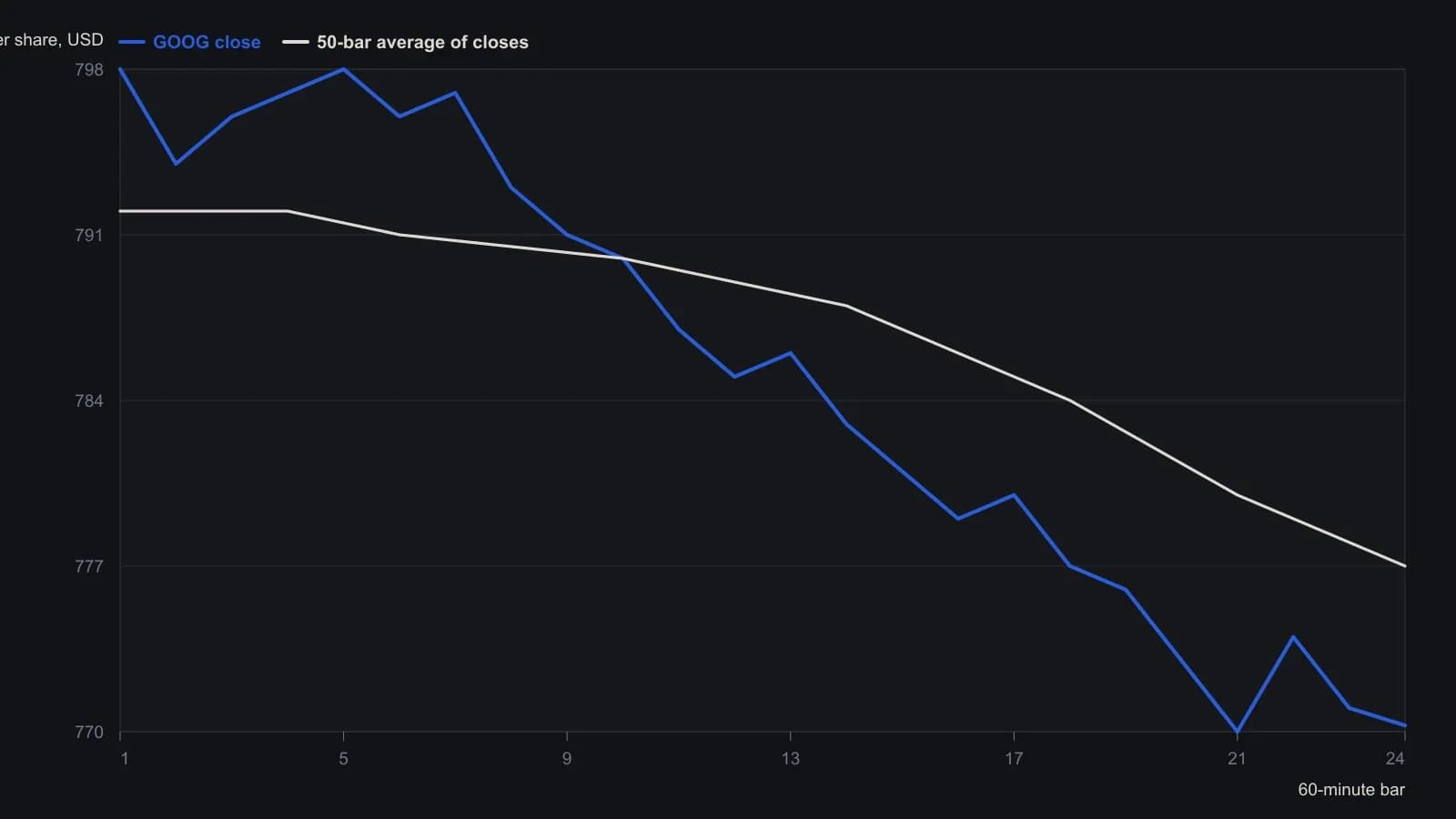
The EasyLanguage study used a 20-bar high-low channel, a 50-bar average of closes, and a half-swing trigger at the midpoint of the latest channel extremes. Digitized closes are given to the nearest dollar except the last print, which is the platform readout of 770.26.
Scanner, bars, and an added exit
A scanner can require a minimum prior upswing, a close near the half-swing midpoint, then an uptick off that pullback low.
The same breakout-pullback-resumption sequence can be coded for both intraday and daily bars. That sequence is the one-two-three-pattern: a breakout, pullback, and resumption used as a programmable continuation template.
One implementation adds an explicit profit target because the archive rules emphasize entries more than exits.
Wave labels and a zigzag alternative
Wave labels drawn after the fact are subjective because a swing is confirmed only after the reversal is large enough to be stable. That delay is wave-confirmation-lag: the delay inherent in labeling a swing only after the reversal is large enough to be mechanically stable.
A delayed zigzag-style swing detector can encode the same pullback-continuation idea without requiring an exact half-swing retracement.
All readings on this track · 36 readings
- 1986A futures fade as one range, order, and secrecy procedure
- 1992Constructing the mass-index range-reversal procedure
- 1993Switch trend following and mean reversion with an equity-curve filter
- 1994Evaluating weekly trend-following and mean-reversion timing rules
- 1996Dual-horizon bands for a precious-metals cash switch
- 1997Constructing a moving regression oscillator
- 1997Regime-dependent long and short rules in mechanical systems
- 2002A same-session pair book with a morning-fixed volatility envelope
- 2004Combining noncorrelated trend and reversion systems
- 2004Failed-breakout overlays on trending markets
- 2004Rank rotation after a path split, then Robustness testing
- 2004Range-bound tape as a filter for trend and oscillator rules
- 2005A moving-average short pullback that is only in scope in a decline
- 2006Constructing an adaptive price zone from a double-smoothed range
- 2007Two-period relative strength index versus a one-week universe baseline
- 2008Building ETF mean-reversion entries with a two-bar washout
- 2008Rebuild a short-period stochastic as a premier stochastic oscillator
- 2008A three-market regime map for equity bounces and dollar cycles
- 2009Option trade adjustment as one testable procedure
- 2010Implied volatility as a May 2010 market-regime lab for the S&P 500
- 2011Treat a large one-day move as a classified event
- 2011Long-call exits, volatility regimes, and spread assignment
- 2011Pairing same-horizon oscillators with a walk filter
- 2012Two-bar band extreme entries with trailing stops
- 2012An eight-month average as a monthly gate for high-yield bonds
- 2014Complete the checklist before the trade
- 2014Coded rules should face one test, not a kinder sample
- 2015Build a mean-reversion basket from one correlation path
- 2015Index dip reversion is horizon and regime dependent
- 2016Treat the end of a trend as a handoff, not a broken system
- 2017A testable half-swing pullback for trend continuation
- 2017Evaluating four swing detection rules for mean reversion
- 2018Intraday breakout and mean reversion as one rule set
- 2018Evaluating rare consecutive-close mean-reversion entries
- 2020Moving-average baselines, price vetoes, and mean reversion
- 2020Two-dimensional FX scaling for trend and reversal systems