2012issue C0612-17
An eight-month average as a monthly gate for high-yield bonds
A case study treats an eight-month simple moving average of monthly closes as the sole quantitative baseline for whether a high-yield bond fund is in a buy state or a sell state. Entry is a monthly close above that average with purchase on the following day; exit is a monthly close below it.
- The case study uses an eight-month simple moving average of monthly closes as the only quantitative baseline for a buy state or a sell state in a high-yield bond fund.
- Entry is a monthly close above that average, with purchase on the following day; exit is a monthly close below it.
- Evaluating the same rule on monthly closes, rather than daily ones, is presented as the way to remove many intra-month whipsaws.
- TradersWeek editorial reading: seasonality and mean reversion become useful only after the trend filter has already decided whether the system may act.
A single average as the only baseline
The case study treats an eight-month simple moving average of monthly closes as the sole quantitative baseline for deciding whether a high-yield bond fund is in a buy state or a sell state.
Price above the average is a buy state. Price below it is a sell or cash state.
How entry, exit, and standing aside are defined
Entry is defined as a monthly close above the eight-month average, with purchase on the following day. Exit is defined as a monthly close below that average.
The source argues that high-yield bond prices tend to persist from one period to the next, which is why a trend filter is offered as a natural fit for that market.
Monthly closes as the sampling calendar
Monthly rather than daily evaluation is presented as the device that removes many intra-month whipsaws from the same moving-average rule.
Seasonal trading, as used here, is that monthly sampling calendar. Entry, exit, and abstention decisions are generated only on period closes, so the holding period is the month, not the daily path inside it.
The downward cross as the stand-aside rule
Mean reversion, as used here, is a procedure that waits for price to fall back through the defined average and then stands aside or exits.
The crossing itself is the testable signal. It is not treated as a forecast of fair value.
What the source tabulated
A tabulated signal list in the source shows alternating buy and sell states, including a buy still open at the last monthly close of the illustrated window.
The archive records a comparison of that timed series with uninterrupted holding of the same fund.
FAGIX monthly close versus the eight-month average at each signal
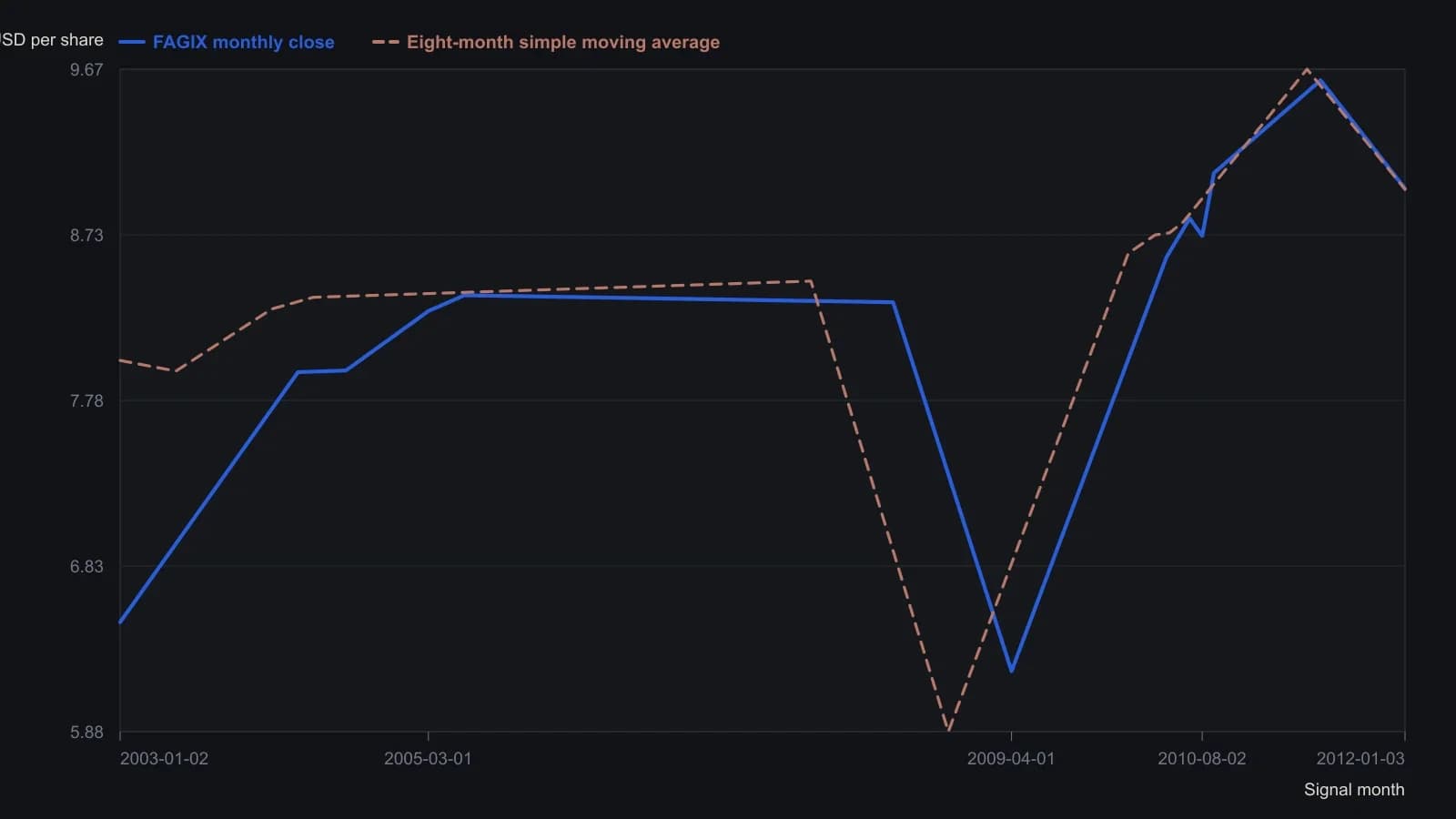
The source averaged unadjusted monthly closes and left dividends out of the average. The January 2012 buy was still open when the table was published. The January 2003 buy row did not print an average, so that month appears only on the price series.
All readings on this track · 36 readings
- 1986A futures fade as one range, order, and secrecy procedure
- 1992Constructing the mass-index range-reversal procedure
- 1993Switch trend following and mean reversion with an equity-curve filter
- 1994Evaluating weekly trend-following and mean-reversion timing rules
- 1996Dual-horizon bands for a precious-metals cash switch
- 1997Constructing a moving regression oscillator
- 1997Regime-dependent long and short rules in mechanical systems
- 2002A same-session pair book with a morning-fixed volatility envelope
- 2004Combining noncorrelated trend and reversion systems
- 2004Failed-breakout overlays on trending markets
- 2004Rank rotation after a path split, then Robustness testing
- 2004Range-bound tape as a filter for trend and oscillator rules
- 2005A moving-average short pullback that is only in scope in a decline
- 2006Constructing an adaptive price zone from a double-smoothed range
- 2007Two-period relative strength index versus a one-week universe baseline
- 2008Building ETF mean-reversion entries with a two-bar washout
- 2008Rebuild a short-period stochastic as a premier stochastic oscillator
- 2008A three-market regime map for equity bounces and dollar cycles
- 2009Option trade adjustment as one testable procedure
- 2010Implied volatility as a May 2010 market-regime lab for the S&P 500
- 2011Treat a large one-day move as a classified event
- 2011Long-call exits, volatility regimes, and spread assignment
- 2011Pairing same-horizon oscillators with a walk filter
- 2012Two-bar band extreme entries with trailing stops
- 2012An eight-month average as a monthly gate for high-yield bonds
- 2014Complete the checklist before the trade
- 2014Coded rules should face one test, not a kinder sample
- 2015Build a mean-reversion basket from one correlation path
- 2015Index dip reversion is horizon and regime dependent
- 2016Treat the end of a trend as a handoff, not a broken system
- 2017A testable half-swing pullback for trend continuation
- 2017Evaluating four swing detection rules for mean reversion
- 2018Intraday breakout and mean reversion as one rule set
- 2018Evaluating rare consecutive-close mean-reversion entries
- 2020Moving-average baselines, price vetoes, and mean reversion
- 2020Two-dimensional FX scaling for trend and reversal systems