1994issue C121-7
Evaluating weekly trend-following and mean-reversion timing rules
Long-horizon timing is evaluated only when lookbacks, confirmation filters, and the execution calendar form one closed procedure. This archive article compares a lagged trend-following design with a thresholded mean-reversion oscillator on the same weekly index tape.
- One-variable timing rules are teaching starting points that may fit trending or range-bound regimes but are unlikely to remain effective in every market condition.
- Trend-following, moving-average, and mean-reversion designs here are long-horizon timing procedures, typically holding for many months or years, and were built and evaluated on weekly closes of a broad equity index.
- A trend-following entry requires the weekly close to exceed both the smoothed 40-week average and the five-week high, with action specified for Friday of the signal week.
- Mean-reversion action waits until Friday of the week after the overextended oscillator has already recrossed its thresholds.
One-variable rules as a starting point
One-variable timing rules are framed as teaching starting points that may fit trending or range-bound regimes but are unlikely to remain effective in every market condition.
All three procedures are long-horizon timing designs, typically holding for many months or years, and were built and evaluated on weekly closes of a broad equity index. The moving average is the shared quantitative baseline. Trend-following and mean-reversion are the two timing procedures compared on that same weekly tape.
The lagged trend-following design
The trend-following design uses a 40-week simple moving average, a three-week average of that average, a five-week high, and a 10-week low of the weekly close. The moving average is the trend baseline. The three-week average of that average is a smoothed confirmation line.
A trend-following entry requires the weekly close to exceed both the smoothed 40-week average and the five-week high. An exit requires the weekly close to fall below both the smoothed 40-week average and the 10-week low. The procedure waits for price to confirm a prevailing direction before entering or exiting, and it accepts delayed signals.
Trend-following action is specified for Friday of the signal week and requires computing in advance the close that would trigger the rule. That weekday and that same-week confirmation belong to the execution calendar.
The thresholded mean-reversion design
The mean-reversion design measures a five-week average of the gap between the weekly close and a 55-week simple moving average, then acts when that oscillator recrosses stated thresholds. That smoothed gap is the overextended oscillator. Large departures from the long moving average are treated as extreme.
Mean-reversion entries occur when the smoothed oscillator moves from below -15 to above -15 or from below zero to above zero. Exits occur when it falls below -15, crosses from above zero to below zero, or crosses from above +50 to below +50.
Mean-reversion action is specified for Friday of the week after the triggering oscillator values have already printed. The extra week is part of the execution calendar.
Compare both designs on the same weekly tape
Both designs are long-horizon timing procedures on the same weekly index closes. They differ in what they wait for. Trend-following waits for the close to confirm the smoothed moving-average line and a recent five-week high or 10-week low. Mean-reversion waits for the overextended oscillator to recross fixed thresholds.
They also differ in the execution calendar. Trend-following is specified for Friday of the signal week, after the triggering close has been computed in advance. Mean-reversion is specified for Friday of the following week, after the oscillator values have already printed.
What the historical evaluation recorded
The historical evaluation spans 22 years through mid-1994 and records between 10 and 22 complete buy-and-sell cycles, with time invested ranging from 56.3% to 68.8% of the sample. Editorial reading: those figures describe how often the closed procedures completed a cycle and how much of the sample they spent invested. They are not a claim about present-day results.
Annual capital-gain returns of weekly S&P 500 timing rules
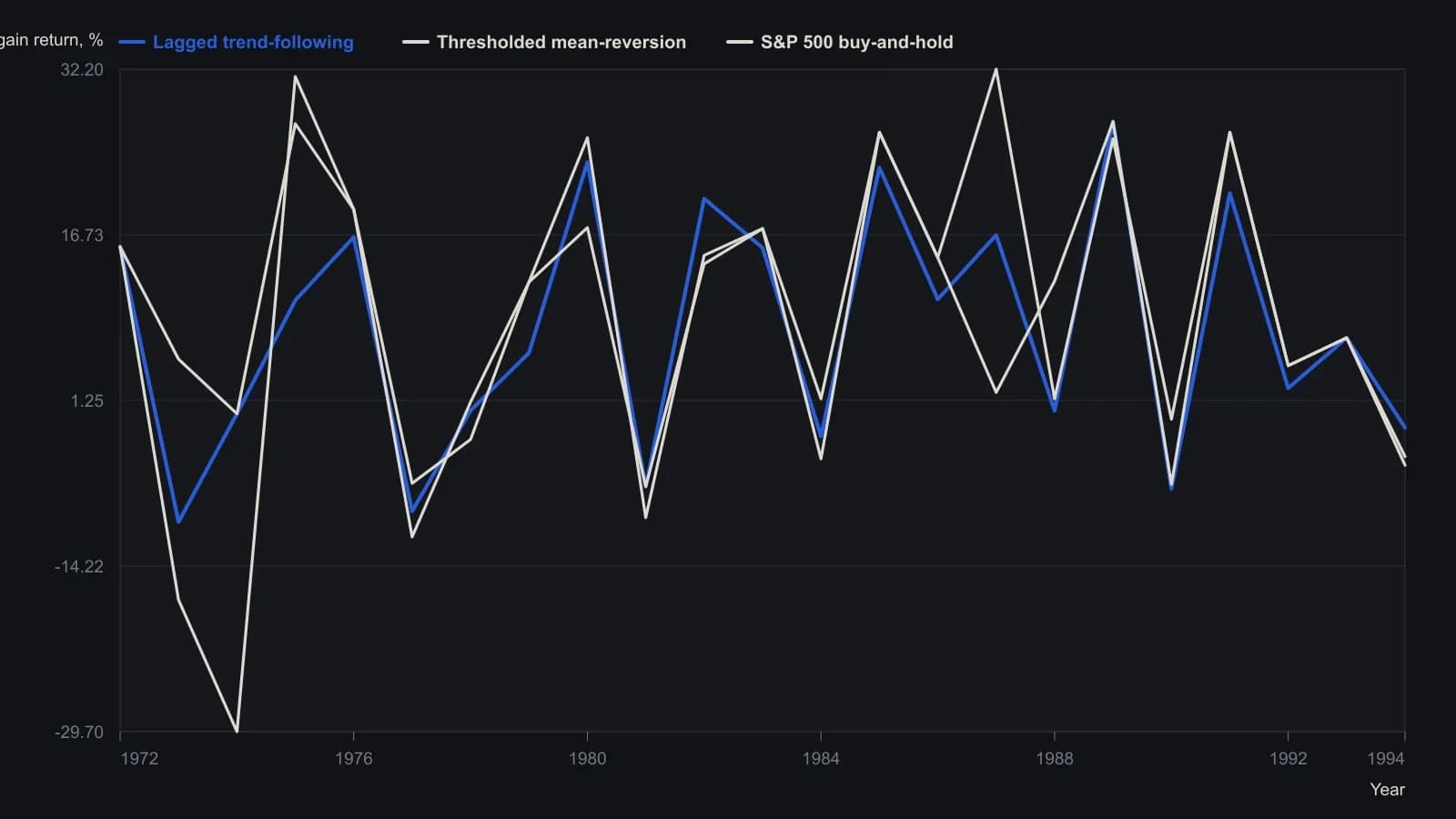
1994 is January–June only; all three timers were on a sell at 30 June 1994. Returns are capital-gain only. The source also printed a prime-rate rule, omitted here so the chart matches the two weekly designs under evaluation.
All readings on this track · 36 readings
- 1986A futures fade as one range, order, and secrecy procedure
- 1992Constructing the mass-index range-reversal procedure
- 1993Switch trend following and mean reversion with an equity-curve filter
- 1994Evaluating weekly trend-following and mean-reversion timing rules
- 1996Dual-horizon bands for a precious-metals cash switch
- 1997Constructing a moving regression oscillator
- 1997Regime-dependent long and short rules in mechanical systems
- 2002A same-session pair book with a morning-fixed volatility envelope
- 2004Combining noncorrelated trend and reversion systems
- 2004Failed-breakout overlays on trending markets
- 2004Rank rotation after a path split, then Robustness testing
- 2004Range-bound tape as a filter for trend and oscillator rules
- 2005A moving-average short pullback that is only in scope in a decline
- 2006Constructing an adaptive price zone from a double-smoothed range
- 2007Two-period relative strength index versus a one-week universe baseline
- 2008Building ETF mean-reversion entries with a two-bar washout
- 2008Rebuild a short-period stochastic as a premier stochastic oscillator
- 2008A three-market regime map for equity bounces and dollar cycles
- 2009Option trade adjustment as one testable procedure
- 2010Implied volatility as a May 2010 market-regime lab for the S&P 500
- 2011Treat a large one-day move as a classified event
- 2011Long-call exits, volatility regimes, and spread assignment
- 2011Pairing same-horizon oscillators with a walk filter
- 2012Two-bar band extreme entries with trailing stops
- 2012An eight-month average as a monthly gate for high-yield bonds
- 2014Complete the checklist before the trade
- 2014Coded rules should face one test, not a kinder sample
- 2015Build a mean-reversion basket from one correlation path
- 2015Index dip reversion is horizon and regime dependent
- 2016Treat the end of a trend as a handoff, not a broken system
- 2017A testable half-swing pullback for trend continuation
- 2017Evaluating four swing detection rules for mean reversion
- 2018Intraday breakout and mean reversion as one rule set
- 2018Evaluating rare consecutive-close mean-reversion entries
- 2020Moving-average baselines, price vetoes, and mean reversion
- 2020Two-dimensional FX scaling for trend and reversal systems