2017issue C0524-26
Evaluating four swing detection rules for mean reversion
Four swing detectors named a turning point inside one long-or-short mean-reversion procedure. Entry, sizing and the holding period stayed fixed, and each detector’s outcomes were related to historical volatility across US sector funds.
- A swing is a short-horizon move of two opposing legs around a pivot that can serve as an entry or exit level.
- Four detectors named the turning point. The rest of the mean-reversion procedure stayed the same.
- Each rule entered long or short on the next open after a swing signal and exited after a fixed holding period, with no new entry while a position was already open.
- The archive related each detector’s outcomes to historical volatility so the rules could be compared across instruments.
A swing is two legs around a pivot
A price swing can be described as two opposing moves around a midpoint pivot. That pivot is the intermediate high or low that separates the two legs, and large participants may treat it as an entry or exit level.
In this archive a swing is a short-horizon price move. The work asked how to name the turning point, then how to test that name inside one mean-reversion procedure.
Four rules for naming the turning point
Four swing detectors were specified: a pivot high and low rule, a Bollinger Bands cross, a relative strength index threshold cross, and a relative strength index reading combined with a higher low or lower high.
A pivot low was defined when the prior bar’s low sits below both the two-bars-back low and the current low, marking an upswing. A pivot high used the symmetric high condition to mark a downswing.
Bollinger Bands are a moving-average envelope whose outer bands supply swing signals when price crosses them. Under that detector, an upswing was signaled when the close crossed above the lower 12-bar, two-deviation band, and a downswing when the close crossed below the upper band.
The relative strength index is a bounded oscillator of recent closes used with oversold and overbought thresholds, alone or with a higher-low or lower-high filter. Under the threshold-cross detector, an upswing was signaled when a 5-bar relative strength index crossed above 40, and a downswing when that reading crossed below 60.
The combined detector required a 5-bar relative strength index below 40 plus a higher low for an upswing, and a 5-bar relative strength index above 60 plus a lower high for a downswing.
One mean-reversion procedure
Each detector was run as a long-or-short mean-reversion procedure. Mean reversion, in this archive, enters against a just-detected swing and exits after a fixed holding period, with no new entry while a position is already open.
The shared steps were the same for every detector: enter on the next open after the swing signal, size a fixed notional by the close, and exit after four weekly bars. The holding period is that fixed number of bars. Only the rule that named the turning point changed.
Compare detectors through historical volatility
The evaluation used weekly bars on nine US sector exchange-traded funds over a 20-year window. Each detector’s outcomes were related to historical volatility, measured as average true range divided by the average of the last 120 monthly bars.
Historical volatility, in this archive, is average true range scaled by a long lookback of monthly average price. It was used to compare detectors across instruments, not to declare a single winner.
Average four-week trade by swing detector on US sector ETFs
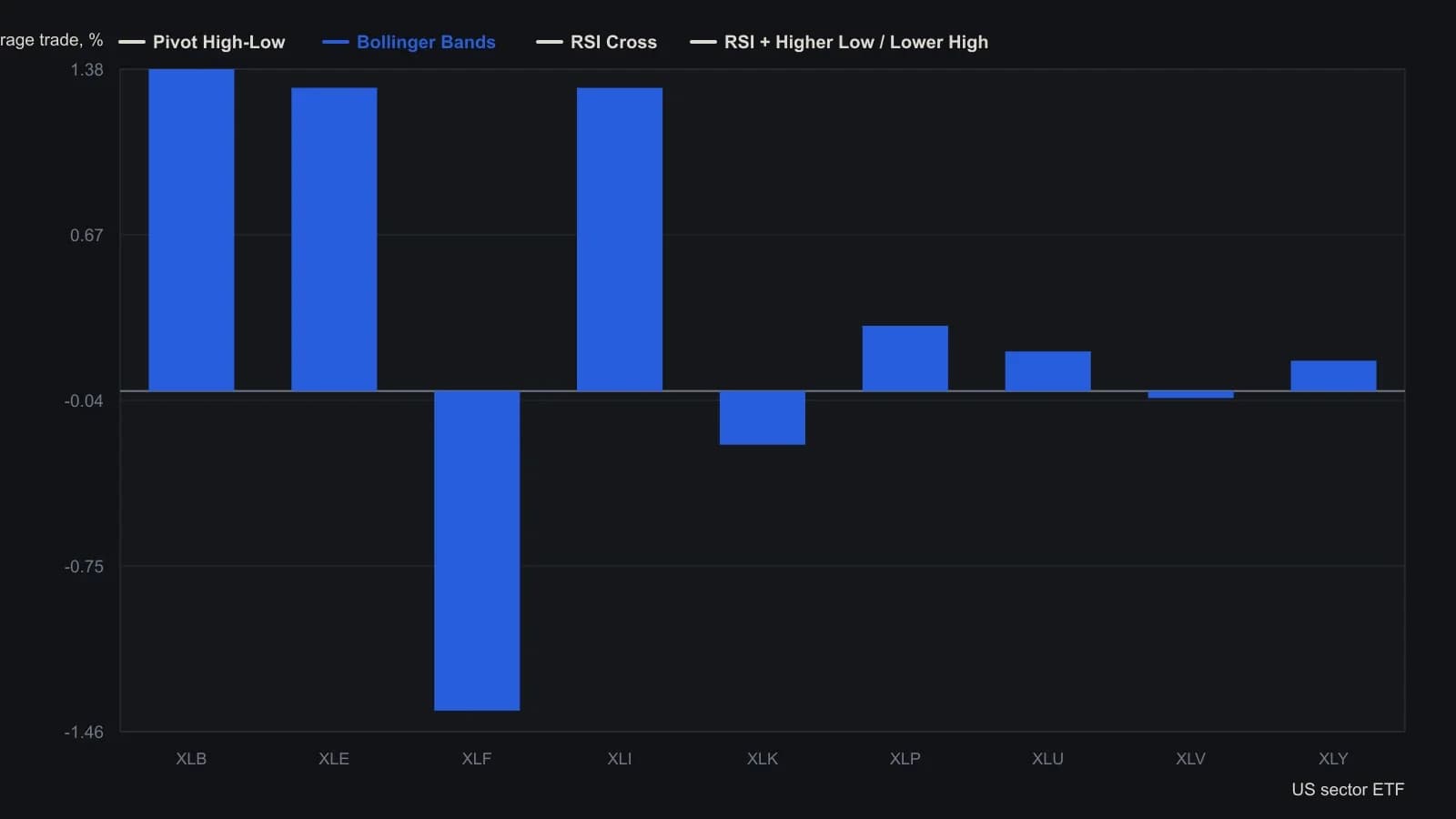
Size is 10,000 divided by close. Historical volatility in the source table is ATR divided by the average of the last 120 monthly bars. The EasyLanguage window starts after 1 January 2000 and flattens on 30 December 2016.
All readings on this track · 36 readings
- 1986A futures fade as one range, order, and secrecy procedure
- 1992Constructing the mass-index range-reversal procedure
- 1993Switch trend following and mean reversion with an equity-curve filter
- 1994Evaluating weekly trend-following and mean-reversion timing rules
- 1996Dual-horizon bands for a precious-metals cash switch
- 1997Constructing a moving regression oscillator
- 1997Regime-dependent long and short rules in mechanical systems
- 2002A same-session pair book with a morning-fixed volatility envelope
- 2004Combining noncorrelated trend and reversion systems
- 2004Failed-breakout overlays on trending markets
- 2004Rank rotation after a path split, then Robustness testing
- 2004Range-bound tape as a filter for trend and oscillator rules
- 2005A moving-average short pullback that is only in scope in a decline
- 2006Constructing an adaptive price zone from a double-smoothed range
- 2007Two-period relative strength index versus a one-week universe baseline
- 2008Building ETF mean-reversion entries with a two-bar washout
- 2008Rebuild a short-period stochastic as a premier stochastic oscillator
- 2008A three-market regime map for equity bounces and dollar cycles
- 2009Option trade adjustment as one testable procedure
- 2010Implied volatility as a May 2010 market-regime lab for the S&P 500
- 2011Treat a large one-day move as a classified event
- 2011Long-call exits, volatility regimes, and spread assignment
- 2011Pairing same-horizon oscillators with a walk filter
- 2012Two-bar band extreme entries with trailing stops
- 2012An eight-month average as a monthly gate for high-yield bonds
- 2014Complete the checklist before the trade
- 2014Coded rules should face one test, not a kinder sample
- 2015Build a mean-reversion basket from one correlation path
- 2015Index dip reversion is horizon and regime dependent
- 2016Treat the end of a trend as a handoff, not a broken system
- 2017A testable half-swing pullback for trend continuation
- 2017Evaluating four swing detection rules for mean reversion
- 2018Intraday breakout and mean reversion as one rule set
- 2018Evaluating rare consecutive-close mean-reversion entries
- 2020Moving-average baselines, price vetoes, and mean reversion
- 2020Two-dimensional FX scaling for trend and reversal systems