2008issue C061-4
Building ETF mean-reversion entries with a two-bar washout
This article teaches construction of a long-only exchange-traded fund procedure that nests a two-bar washout inside a long moving-average regime. Every snapback trade is then forced to finish on a short bounce, a two-session high, or a hard session count.
- Keep the book to diversified exchange-traded funds, hold three names at a time, and treat an oversized decline as a snapback candidate only while the fund remains above a long average of closes.
- Arm a buy only when a two-period oscillator of highs prints below 2 after a prior-session reading above 1, so the washout must bottom and recover inside one session.
- Place a next-session limit 2.5 percent above the prior low, then close on the high from two sessions earlier, on a 7.5 percent stretch above that high, or after six sessions.
- If more than three funds qualify, accept tickers in alphabetical order. The same rules were described as only partly transferable to individual stocks because mean reversion is weaker there.
The archive describes a long-only exchange-traded fund procedure written to hold three names at a time from a candidate set reduced to 100 funds. Diversified funds were treated as more likely than individual stocks to form trends and then revert after an oversized decline.
Mean reversion is the working premise that a diversified fund which has fallen too far is more likely than a single stock to recover toward a typical valuation. The moving average is a 200-period average of closes used as a regime gate so washout buys are taken only while the fund remains in an advance.
Nest the washout inside the regime
A buy was armed only when the two-period relative strength index of highs was below 2, the prior session reading was above 1, and price stood above the 200-period simple moving average. The relative strength index is a two-period oscillator applied to successive highs so an extreme reading can mark a one-session washout.
Highs were used for the oscillator because they were observed to drop earlier than closes at the start of a decline and to lift earlier at the start of an advance. The prior-session oscillator floor was added so a washout had to bottom and recover inside one session before an order could be placed.
Force a dip for the fill
The entry was a next-session limit placed 2.5 percent above the prior session low so a further dip was required for a fill. That limit-fill is a next-session buy instruction set a fixed percentage above the prior low so execution itself requires a further dip.
Finish every open name
A position was closed if price cleared the high from two sessions earlier, reached 7.5 percent above that earlier high, or remained open for six sessions. The last rule is a time-stop, a calendar exit that closes any position still open after a fixed number of sessions if neither price exit has fired.
When more than three funds qualified, names were accepted in alphabetical ticker order until three positions were open.
What does not transfer to stocks
The same rules were described as only partly transferable to individual stocks, with weaker mean reversion offered as the reason.
Editorial: The stock caveat belongs to the construction, not to a later adjustment. The procedure was written around the idea that a diversified fund is the instrument that can trend, wash out and recover toward a typical valuation.
ETF timing-model equity versus buy-and-hold, 2003–2007
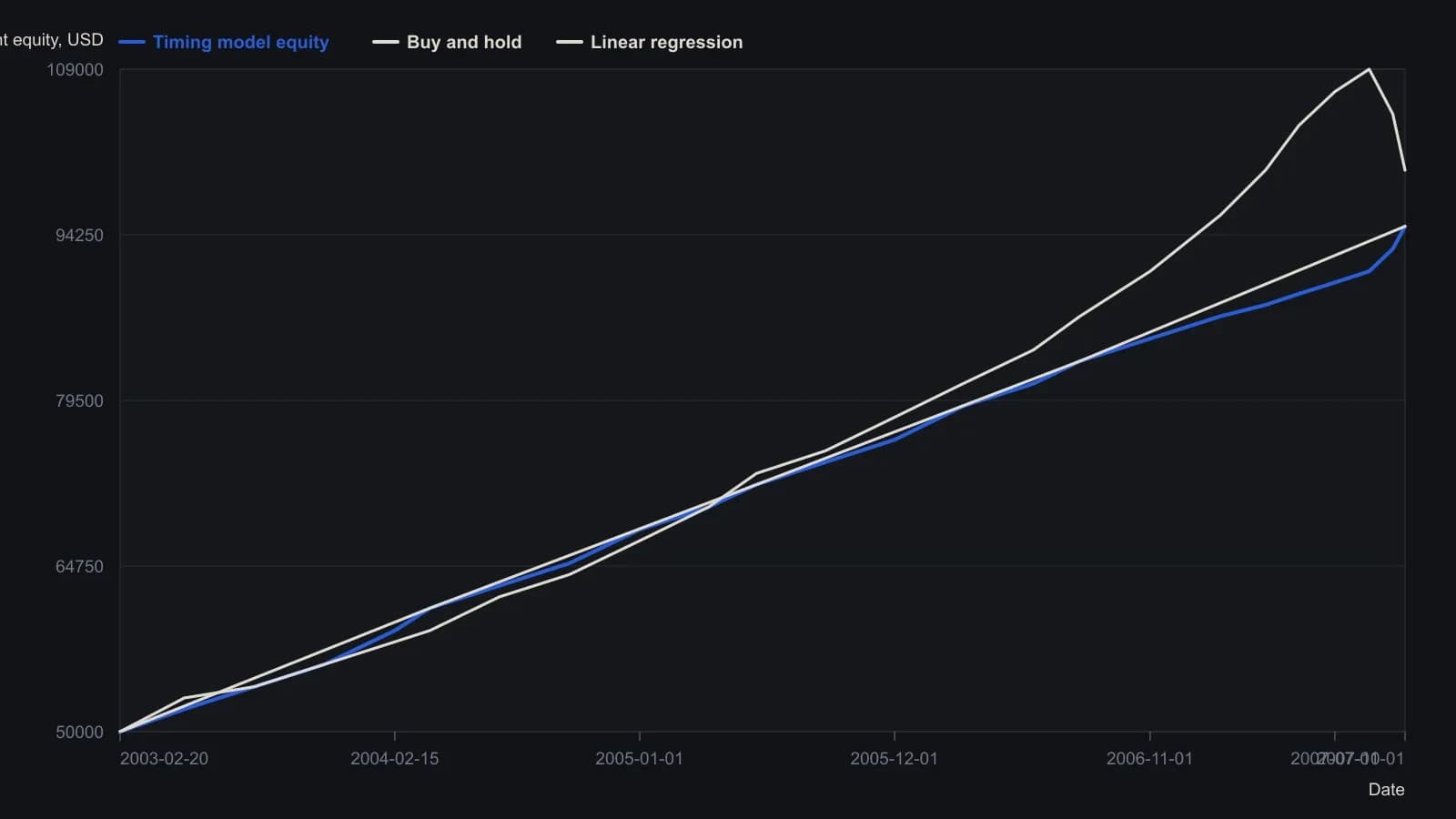
Backtest starts at $50,000, holds at most three funds, charges $20 per ticket, and omits interest on idle cash. Average exposure is 26 percent. Two-period RSI is computed on the high, not the close.
All readings on this track · 36 readings
- 1986A futures fade as one range, order, and secrecy procedure
- 1992Constructing the mass-index range-reversal procedure
- 1993Switch trend following and mean reversion with an equity-curve filter
- 1994Evaluating weekly trend-following and mean-reversion timing rules
- 1996Dual-horizon bands for a precious-metals cash switch
- 1997Constructing a moving regression oscillator
- 1997Regime-dependent long and short rules in mechanical systems
- 2002A same-session pair book with a morning-fixed volatility envelope
- 2004Combining noncorrelated trend and reversion systems
- 2004Failed-breakout overlays on trending markets
- 2004Rank rotation after a path split, then Robustness testing
- 2004Range-bound tape as a filter for trend and oscillator rules
- 2005A moving-average short pullback that is only in scope in a decline
- 2006Constructing an adaptive price zone from a double-smoothed range
- 2007Two-period relative strength index versus a one-week universe baseline
- 2008Building ETF mean-reversion entries with a two-bar washout
- 2008Rebuild a short-period stochastic as a premier stochastic oscillator
- 2008A three-market regime map for equity bounces and dollar cycles
- 2009Option trade adjustment as one testable procedure
- 2010Implied volatility as a May 2010 market-regime lab for the S&P 500
- 2011Treat a large one-day move as a classified event
- 2011Long-call exits, volatility regimes, and spread assignment
- 2011Pairing same-horizon oscillators with a walk filter
- 2012Two-bar band extreme entries with trailing stops
- 2012An eight-month average as a monthly gate for high-yield bonds
- 2014Complete the checklist before the trade
- 2014Coded rules should face one test, not a kinder sample
- 2015Build a mean-reversion basket from one correlation path
- 2015Index dip reversion is horizon and regime dependent
- 2016Treat the end of a trend as a handoff, not a broken system
- 2017A testable half-swing pullback for trend continuation
- 2017Evaluating four swing detection rules for mean reversion
- 2018Intraday breakout and mean reversion as one rule set
- 2018Evaluating rare consecutive-close mean-reversion entries
- 2020Moving-average baselines, price vetoes, and mean reversion
- 2020Two-dimensional FX scaling for trend and reversal systems