2004issue C061-5
Rank rotation after a path split, then Robustness testing
Archive screens first split each path into up-draw and down-draw segments, then asked whether one-rank rotation helped the down-draw. Yearly switching, drawdown, and persistence were the later Robustness testing filters.
- After a conventional 10 percent zigzag split, one-rank rotation mainly improved the down-draw segment rather than the already-strong up-draw segment across an eight-fund comparison.
- A very small zigzag confirmation threshold can remove peak-and-trough delay, but a one-day action lag collapses the zero-lag path result toward the one-rank result on the same fund and decade.
- In the eight-fund screen, one-rank rotation improved buy-and-hold on six funds with yearly switching below 63 and failed on two names above 63, with the same split in maximum-drawdown improvement.
- Of 166 later specialty-firm funds screened for one-rank use, only five were judged good, and year-by-year diagnostics showed declining persistence in the later years of the sample.
Split the path before judging rotation
A conventional 10 percent zigzag split divided each fund path into up-draw and down-draw segments. Across an eight-fund comparison, one-rank rotation mainly improved the down-draw segment rather than the already-strong up-draw segment.
A very small zigzag confirmation threshold can remove peak-and-trough delay, but adding a one-day action lag collapses the zero-lag path result toward the one-rank result on the same fund and decade.
Editorial: TradersWeek reads that down-draw focus as the Mean reversion question inside the same procedure, not as a hunt for extra upside on the up-draw.
One-rank versus zigzag on the down-draw
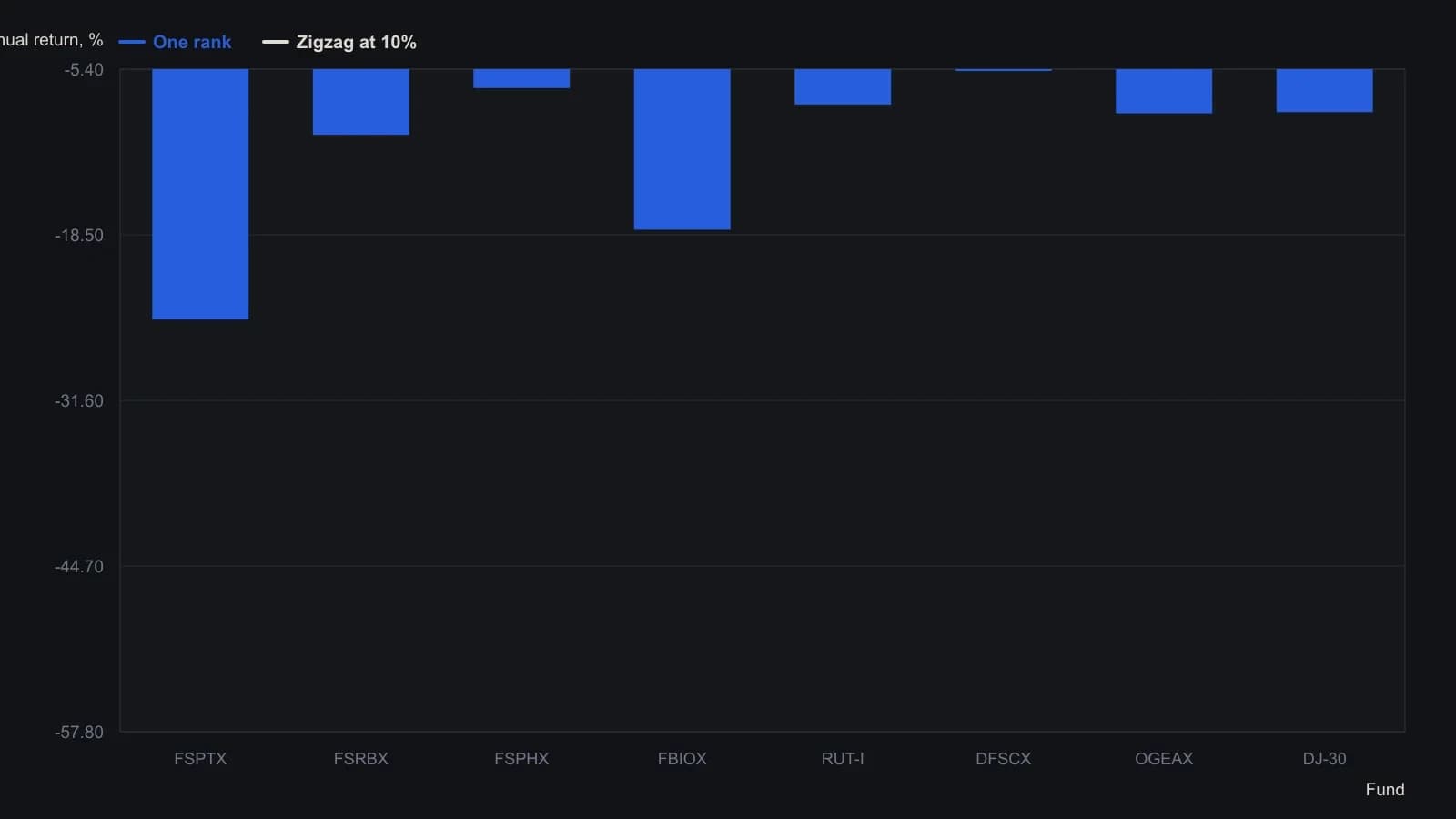
Zigzag filter fixed at 10 percent. One-rank is applied only on the isolated down-draw segment. OGEAX is the poor-switching contrast case.
Yearly switching and drawdown
In that eight-fund screen, one-rank rotation improved buy-and-hold on six funds whose yearly switching rate was below 63, and failed on the two names whose switching rate exceeded 63.
The same six funds also showed a large maximum-drawdown improvement, while the two high-switching names were nearly unaffected or worse on drawdown.
A 200-fund, 10-year one-rank screen found that maximum drawdown stayed low when yearly switching stayed low, with value names generally showing lower drawdown than growth names at a given switching rate.
Across that value-versus-growth comparison, value names offered the better one-rank tradeoff of drawdown against return, while growth names combined higher annualized return with higher volatility.
Editorial: Robustness testing in this workflow is that switching, drawdown, and persistence screen, not a search for more upside.
Separate regions, later screens, and persistence
Applying one-rank separately to up-draw and down-draw regions raised buy-and-hold annualized return and Ulcer Performance Index while reducing down-draws and maximum drawdown.
Of 166 later specialty-firm funds screened for one-rank use, only five were judged good, and just two combined strong annualized return with strong drawdown control.
Year-by-year one-rank diagnostics on a sector fund and the Dow industrials showed declining persistence, making viable rotation candidates harder to find in the later years of the sample.
All readings on this track · 36 readings
- 1986A futures fade as one range, order, and secrecy procedure
- 1992Constructing the mass-index range-reversal procedure
- 1993Switch trend following and mean reversion with an equity-curve filter
- 1994Evaluating weekly trend-following and mean-reversion timing rules
- 1996Dual-horizon bands for a precious-metals cash switch
- 1997Constructing a moving regression oscillator
- 1997Regime-dependent long and short rules in mechanical systems
- 2002A same-session pair book with a morning-fixed volatility envelope
- 2004Combining noncorrelated trend and reversion systems
- 2004Failed-breakout overlays on trending markets
- 2004Rank rotation after a path split, then Robustness testing
- 2004Range-bound tape as a filter for trend and oscillator rules
- 2005A moving-average short pullback that is only in scope in a decline
- 2006Constructing an adaptive price zone from a double-smoothed range
- 2007Two-period relative strength index versus a one-week universe baseline
- 2008Building ETF mean-reversion entries with a two-bar washout
- 2008Rebuild a short-period stochastic as a premier stochastic oscillator
- 2008A three-market regime map for equity bounces and dollar cycles
- 2009Option trade adjustment as one testable procedure
- 2010Implied volatility as a May 2010 market-regime lab for the S&P 500
- 2011Treat a large one-day move as a classified event
- 2011Long-call exits, volatility regimes, and spread assignment
- 2011Pairing same-horizon oscillators with a walk filter
- 2012Two-bar band extreme entries with trailing stops
- 2012An eight-month average as a monthly gate for high-yield bonds
- 2014Complete the checklist before the trade
- 2014Coded rules should face one test, not a kinder sample
- 2015Build a mean-reversion basket from one correlation path
- 2015Index dip reversion is horizon and regime dependent
- 2016Treat the end of a trend as a handoff, not a broken system
- 2017A testable half-swing pullback for trend continuation
- 2017Evaluating four swing detection rules for mean reversion
- 2018Intraday breakout and mean reversion as one rule set
- 2018Evaluating rare consecutive-close mean-reversion entries
- 2020Moving-average baselines, price vetoes, and mean reversion
- 2020Two-dimensional FX scaling for trend and reversal systems