2017issue C0549-56
Four swing-entry rules that share a timed exit
Four swing detectors sit inside one rule-based entry that may open only from a flat book, and they share one timed exit. A strategy selector swaps a three-bar pivot, a Bollinger band cross, and two short-lookback relative strength index constructions through that same shell.
- With fills and the holding period held fixed, the four detectors can be rotated so a pivot, a band touch, and two relative strength index rules mark turning points on the same bars.
- The switchable system is a rule-based entry that may open only when the book is already flat.
- The testable pivot high/low is a three-bar local extreme, even when prose or a figure describes a different pivot.
- Fixed relative strength index thresholds can keep firing in one direction during a persistent trend, so variants ignore successive same-direction swings or replace the fixed bands with adaptive thresholds.
A switchable shell around four swing detectors
A price swing is a sizable price change over a short interval, treated as the event a detector must mark. Four alternative swing-detection procedures are specified: a pivot high/low rule, a Bollinger band cross rule, a relative strength index cross rule, and a relative strength index rule filtered by a higher low or lower high.
The four detectors are packaged as one switchable system. A strategy selector, an integer input, swaps one of the four detectors into the same entry-exit shell. That shell is a rule-based entry: a boolean procedure that maps market state to long, short, or no action. The system may open a position only when the book is already flat.
How each detector marks a turning point
A pivot-low signal is coded as the prior low standing below both the low two bars back and the current low. A pivot-high signal is the symmetric three-bar condition on highs. In this construction a pivot high/low is a three-bar local extreme in which the middle bar's high or low stands beyond both neighboring bars.
The Bollinger bands construction goes long when close crosses the lower envelope and short when close crosses the upper envelope. The envelope uses a two-deviation width, while independent ports set the lookback to 12, 15, or 20. Bollinger bands here are a moving-average envelope scaled by a stated number of standard deviations.
The relative strength index is a bounded oscillator of recent closes used here as a short-lookback cross or as a threshold filter. The cross construction uses a 5-period relative strength index, going long on a cross of 40 and short on a cross of 60.
The filtered construction requires a 5-period relative strength index below 40 plus a higher-low filter for a long, or a reading above 60 plus a lower-high filter for a short. The higher-low filter is a confirmation that the current low is above the prior low, paired with an oversold oscillator reading. The lower-high filter is a confirmation that the current high is below the prior high, paired with an overbought oscillator reading.
A timed exit and next-bar fills
The shared exit is a timed exit, a close triggered after a fixed number of bars rather than by an opposing detector. Weekly ports commonly use four bars, while other ports use five or twenty.
Entries and timed exits are specified to fill by next-bar execution, typically at market or on the open. Next-bar execution means filling a signal on the following bar at market or on the open.
The pivot that must be tested
A prose pivot definition can differ from both a conventional one-to-two-bar pivot and the accompanying figure. The coded three-bar comparison is the rule that must be tested.
Fixed oscillator bands in a trend
Fixed relative strength index thresholds can keep firing in one direction during a persistent trend. Construction variants include ignoring successive same-direction swings or replacing the fixed bands with adaptive thresholds.
Long and short net profit by swing detector
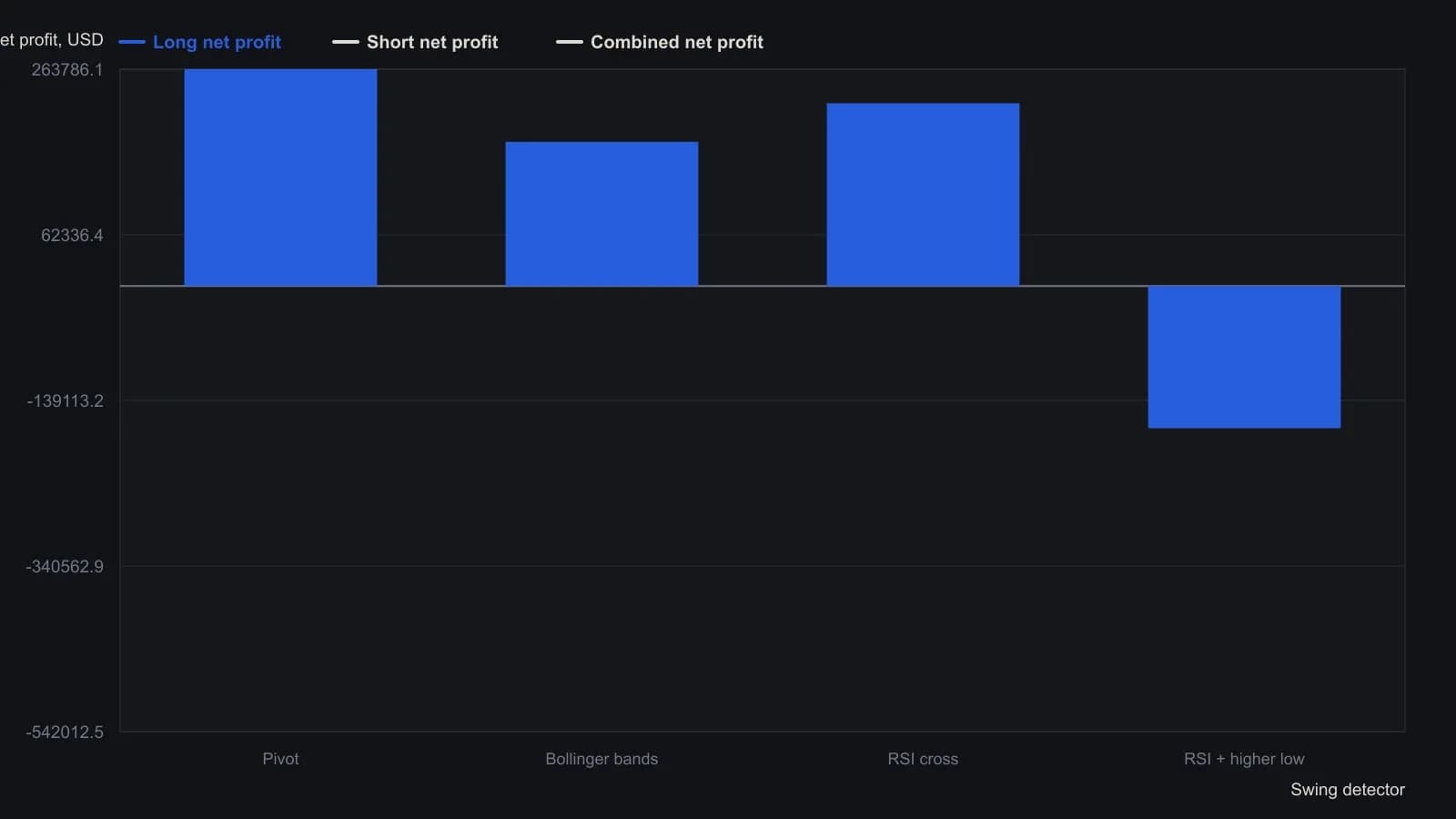
Columns 1–4 are the three-bar pivot, a Bollinger-band cross, RSI(5) crossing 40/60, and RSI(5) with a higher low or lower high. The tester used weekly bars, next-bar fills, and a four-bar timed exit on a different book and a shorter window than the original article’s 20-year stock test.
All readings on this track · 45 readings
- 1992Constructing volatility-scaled bands with relative strength index confirmation
- 1994Implied volatility as a band-defined regime filter for index options
- 1995Constructing projection bands from least-squares slopes
- 1995Constructing regression projection bands and range oscillators
- 1996Constructing Bollinger bands, percent-b, and stochastics
- 1996Constructing mechanical rules from Bollinger Bands and stochastics
- 1996Constructing a standard-error envelope around a linear regression
- 1996Dual-horizon ratio envelopes and regression error channels
- 1997Rational group structure with a trend screen, RSI, and bands
- 1997Asymmetric volatility band construction
- 1998Constructing three-state filters from Bollinger band envelopes
- 1999Combination filters with Bollinger Bands and the relative strength index
- 1999Constructing stochastic timed exits and band-RSI reversals
- 1999Evaluating Bollinger Bands against fixed-width and range-based envelopes
- 2000Constructing a Bollinger Band target as a forward price
- 2001Numeric candlestick encoding with local size bands
- 2001Ranked candlestick sentiment to band-cross entries
- 2002Combining Bollinger Bands, RSI, and a stop-loss
- 2002Bollinger Bands remain filters, not forecasts
- 2002Constructing a stochastic RSI with Bollinger bands
- 2002Constructing a StochRSI and Bollinger mechanical system
- 2003Constructing volatility-scaled Bollinger envelopes
- 2003Why tick breadth fails as a market personality
- 2005Constructing Bollinger bands versus fixed trading bands
- 2006Squared versus absolute deviation in envelope construction
- 2006Confirming yen crossovers with implied volatility and bands
- 2006A daily candle reversal is a hypothesis until shorter sessions fail at the same zone
- 2008Rebuild the Relative Strength Index as price-scale bands
- 2008Reading Relative Strength Index extremes on one price axis with Bollinger Bands and moving averages
- 2011Three-filter confirmation for short-swing futures
- 2011Constructing an inverse Fisher stochastic with bands and averages
- 2012Constructing a Bollinger Band indicator suite
- 2012Stacking price extremes, crossovers, bands, and MACD
- 2012Adaptive Bollinger band impulse, trend, and momentum filters
- 2013Rescaling stochastic, percent-B, and wave-count parameters
- 2014Industry-group quartile pivots as a Bollinger Bands case study
- 2014Bollinger Bands as adaptive price envelopes: a 2014 classroom case
- 2016Trend-channel entry rules from stacked moving averages
- 2016A permission stack for Bollinger, RSI, and the 50-period average
- 2017Constructing weighted Bollinger bands and volume averages
- 2017Four swing-entry rules that share a timed exit
- 2017Two-wave monthly cycles as a regime filter
- 2019Constructing exponential-deviation-bands from a midline-average
- 2020Critiquing exponential variants of Bollinger Bands
- 2020Constructing selectable volatility and moving-average bands