2013issue C1261-62
Constructing swing trades with a fifty-day average and a five-bar exponential average
A simple swing system can be constructed so a 50-day moving average of the close is the only permission to go long or short, while a five-bar exponential average and the bar open set both the entry price and the matching exit. A newest-first ledger can mark an unfinished trade to the latest close so the finished procedure stays reconstructable.
- Long trades are allowed only in uptrends and short trades only in downtrends, with trend permission taken from how price sits relative to a 50-day moving average of the close.
- Gating direction with that permission-average is intended to keep the procedure from initiating trades against the prevailing move and to keep a one-way-book, so long and short trades are not interspersed.
- Entry and exit prices are set by how the bar open relates to a five-bar trigger-smoother that both opens and exits the trade.
- A reconstructable ledger can list generated trades newest first and apply an open-trade-mark at the current bar close when the latest trade is still open.
One procedure for permission and trade
A simple swing system can be constructed so long trades are allowed only in uptrends and short trades only in downtrends. Trend permission for that system is taken from how price sits relative to a 50-day moving average of the close.
Editorial note from TradersWeek: treat the 50-day close average, the five-bar exponential average, and the ledger as one auditable procedure, so entry, exit, and abstention stay testable together.
Gating direction with a permission-average
The permission-average is a longer average of the close that decides whether market state allows longs, shorts, or neither. Gating direction with that average is intended to keep the procedure from initiating trades against the prevailing move and prevents long and short trades from being interspersed.
That interspersing constraint is the one-way-book: long and short trades do not appear inside the same permitted regime.
A trigger-smoother for both sides of the trade
Entry and exit prices are set by how the bar open relates to a five-bar exponential average that both opens and exits the trade. That short exponential average is the trigger-smoother: compared with the bar open, it sets both the entry price and the matching exit price.
Attach the finished procedure
The same finished procedure can be attached to a chart from a trading-system list rather than being rebuilt from formulas on every session.
A newest-first ledger and an open-trade-mark
A reconstructable trade ledger can list generated trades newest first and, if the latest trade is still open, mark it to the current bar's closing price. The open-trade-mark is that ledger rule: a still-open position is valued at the current bar close so unfinished risk remains visible.
Citigroup long-swing running balance, newest first
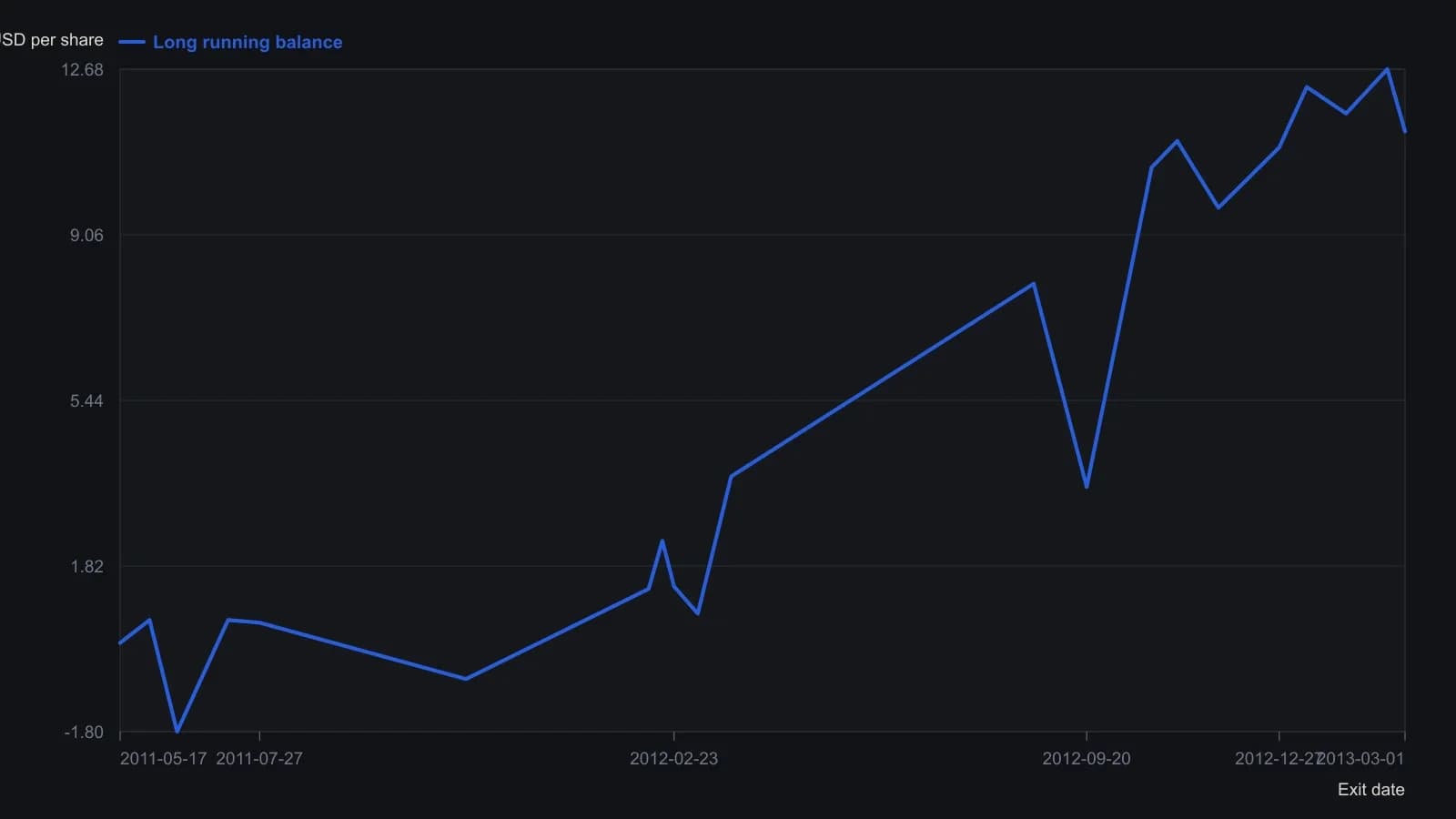
Trade size is one share. The top row is still open and marked to the current-bar close, so the finished procedure stays reconstructable. Reporting window on the tab is 10 November 2009 to 15 March 2013.
All readings on this track · 35 readings
- 2001Swing trading with trailing stops and fixed loss exits
- 2003Linear regression swing alerts and trailing stops
- 2005Range-width gates for swing entries at base edges
- 2006Beyond setups: a six-factor trading process
- 2007Angle of ascent, chart scale, and style-fit
- 2010Stacking a short-horizon oscillator with a moving average and swing hold rules
- 2010A weekly contest long treated as one swing procedure
- 2011Four-color volume-price states for long-only swing actions
- 2012Classify momentum, velocity, or volatility before the swing signal
- 2013Swing rules as a portable entry and exit procedure
- 2013Constructing paired percent-b and stochastic swing oscillators
- 2013Give the fast band line and the slow stochastic complementary jobs
- 2013Smoothed percent-b divergences for numbered swing-wave rules
- 2013Portable swing rules for candle turns and a 1-2-3 wave count
- 2013A three-average swing and breakout case study
- 2013Constructing swing trades with a fifty-day average and a five-bar exponential average
- 2014From aliasing and dilation to a roofed stochastic swing
- 2014Channel width and trend-filter lookback as separate swing-trading choices
- 2016Constructing volume-confirmed multiday breakout swings
- 2017Constructing swing signals from a volume-weighted average cross
- 2017Golden-cross swing entry with a trailing-stop exit
- 2017One swing procedure: group leadership first, then a volume-price leave
- 2017Four-day green-candle breakout entry as one swing procedure
- 2017Swing pivots need a 100-period crossover and a breakout candle
- 2017Supply and demand zones as bounded swing maps
- 2018Three-bar volume-confirmed swing breakout
- 2018Tight stops first on swing breakouts with a range filter
- 2018Constructing trend and swing rules from horizon to crossover
- 2019Decade-level breakouts as one closed swing procedure
- 2019Inverse-pair swing trading with a shared buy-stop
- 2019Week-range next-day breakout on bitcoin pairs
- 2019Ranking strength before confirming a multi-timeframe breakout
- 2019Forty-five-degree multi-week swing breakout as a closed procedure
- 2020A dual pending-stop pair as one bitcoin swing construction
- 2020High-low activator, directional oscillator, and momentum swing agreement