2017issue C1150-56
Four-day green-candle breakout entry as one swing procedure
A swing construction starts from four consecutive daily green candles, then arms a delayed buy-stop, limits how long that order stays valid, and finishes with sizing and a trailing stop so the sequence can be judged as one rule set.
- The four-day-green-candle-pattern is four consecutive daily closes above their opens and is used as a momentum-strength condition, not a reversal signal.
- A complete procedure arms a breakout-stop-entry after the pattern prints and cancels it if the entry-wait-window expires unfilled.
- A trend-and-price-filter can further qualify the setup, while position-and-exit-rules finish the same procedure after a fill.
- Studies, scanners, templates, and no-code builders can reuse the same conditions so platform builds are compared as one rule set.
Treat the swing system as one procedure
A swing construction is complete only when the qualifying pattern, the delayed entry, the time the order remains valid, and the later management sit in one sequence. The archive workflow starts from four consecutive daily green candles and then arms a buy-stop, rather than treating the pattern itself as the entry.
Editorial view: each platform implementation should be judged as the same rule set only when those pieces stay bound together. If they are coded as separate signals, the procedure has already been split.
Define the four-day-green-candle-pattern
The core setup is four consecutive daily green candles. Each candle is defined as a close greater than its open. The archive treats this as a momentum-strength pattern rather than a reversal pattern.
That four-day-green-candle-pattern is the qualifying strength condition. No buy-stop is armed until the four-bar sequence has first appeared.
Arm a breakout-stop-entry inside an entry-wait-window
A complete procedure arms a buy-stop after the pattern first appears. The stop is placed at the highest high of the four pattern bars plus a configurable increment. That breakout-stop-entry is meant to fill only if price continues through the pattern.
The order is not left open without a time limit. An entry-wait-window keeps the stop valid for only a limited number of subsequent bars. If the order is not filled inside that window, it is cancelled and the setup is abandoned.
WTW daily price path used to illustrate the four-day breakout
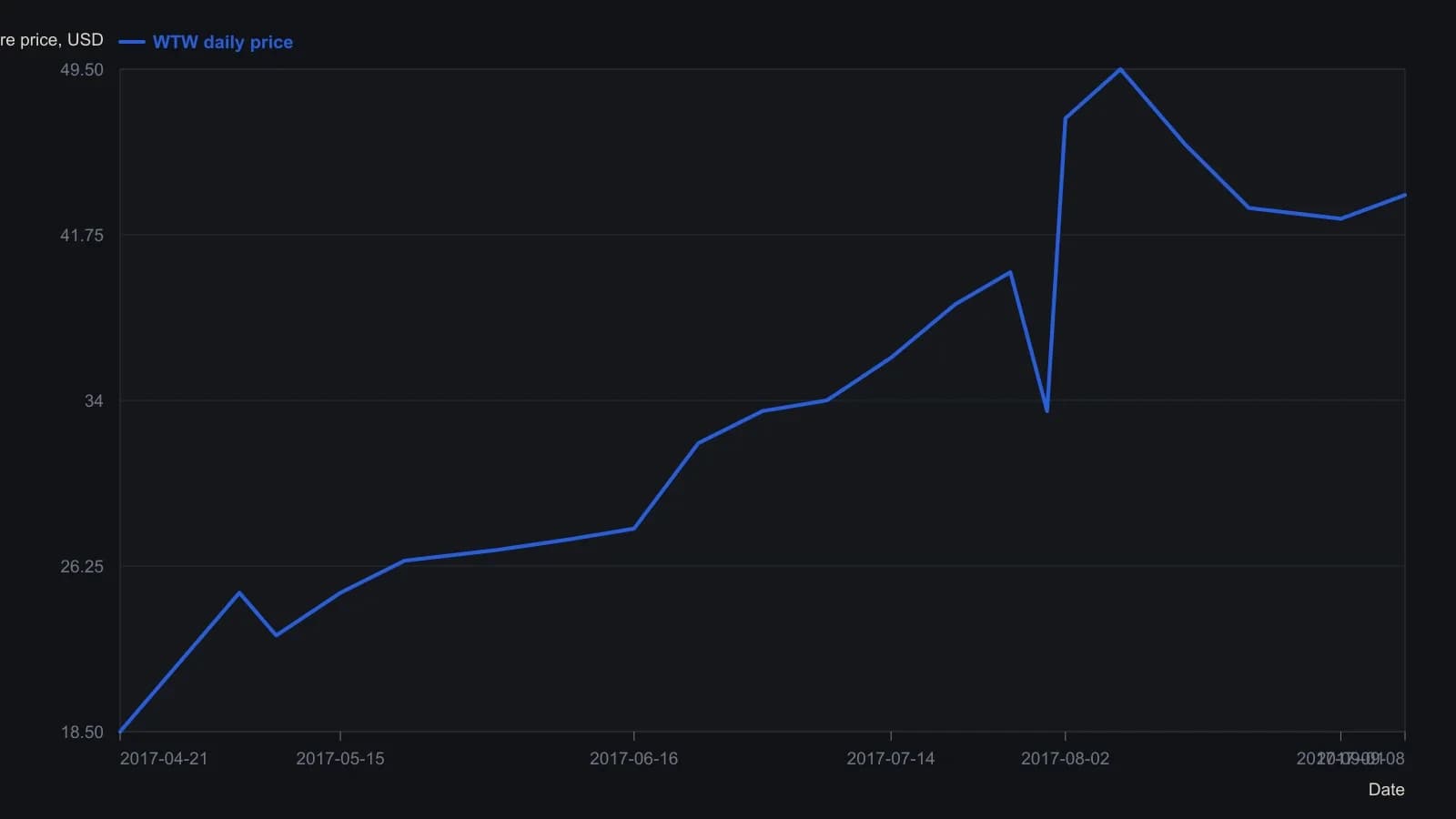
Weekly-scale reads from a daily candlestick pane, not a published close table. Signal arrows are drawn offset from the bars, so they were not treated as prices. The formula used a 0.50 breakout buffer above the prior high and a 2-dollar trailing stop.
Add a trend-and-price-filter only as qualification
A trend-and-price-filter can sit in front of the pattern without replacing it. One exploration formula keeps the same four consecutive close-greater-than-open condition and further requires price to remain above the 50-, 100-, and 200-period simple moving averages for a user-adjustable stretch of recent bars.
A no-code rule builder can approximate the same swing procedure by combining a four-bar channel-high buy-stop, a price-range filter, an uptrend defined by price above a moving average that itself is rising, and four consecutive rising closes. Editorial view: those extras change who qualifies, but they still belong inside the same procedure rather than as a second strategy.
Finish with position-and-exit-rules and reusable studies
Trade management in the coded strategy uses a fixed dollar allocation to size the position and a dollar trailing stop after a per-share stop is set. Those position-and-exit-rules complete the procedure after entry.
An accompanying scanner or indicator can mark how many bars have elapsed since the four-green-candle pattern last printed, so a watchlist can be filtered for live setups. Multiple platforms packaged the same four consecutive close-greater-than-open condition as reusable studies, highlight bars, chart templates, and overlay strategies, so the pattern, entry, and management can be applied without rewriting the logic from scratch.
All readings on this track · 35 readings
- 2001Swing trading with trailing stops and fixed loss exits
- 2003Linear regression swing alerts and trailing stops
- 2005Range-width gates for swing entries at base edges
- 2006Beyond setups: a six-factor trading process
- 2007Angle of ascent, chart scale, and style-fit
- 2010Stacking a short-horizon oscillator with a moving average and swing hold rules
- 2010A weekly contest long treated as one swing procedure
- 2011Four-color volume-price states for long-only swing actions
- 2012Classify momentum, velocity, or volatility before the swing signal
- 2013Swing rules as a portable entry and exit procedure
- 2013Constructing paired percent-b and stochastic swing oscillators
- 2013Give the fast band line and the slow stochastic complementary jobs
- 2013Smoothed percent-b divergences for numbered swing-wave rules
- 2013Portable swing rules for candle turns and a 1-2-3 wave count
- 2013A three-average swing and breakout case study
- 2013Constructing swing trades with a fifty-day average and a five-bar exponential average
- 2014From aliasing and dilation to a roofed stochastic swing
- 2014Channel width and trend-filter lookback as separate swing-trading choices
- 2016Constructing volume-confirmed multiday breakout swings
- 2017Constructing swing signals from a volume-weighted average cross
- 2017Golden-cross swing entry with a trailing-stop exit
- 2017One swing procedure: group leadership first, then a volume-price leave
- 2017Four-day green-candle breakout entry as one swing procedure
- 2017Swing pivots need a 100-period crossover and a breakout candle
- 2017Supply and demand zones as bounded swing maps
- 2018Three-bar volume-confirmed swing breakout
- 2018Tight stops first on swing breakouts with a range filter
- 2018Constructing trend and swing rules from horizon to crossover
- 2019Decade-level breakouts as one closed swing procedure
- 2019Inverse-pair swing trading with a shared buy-stop
- 2019Week-range next-day breakout on bitcoin pairs
- 2019Ranking strength before confirming a multi-timeframe breakout
- 2019Forty-five-degree multi-week swing breakout as a closed procedure
- 2020A dual pending-stop pair as one bitcoin swing construction
- 2020High-low activator, directional oscillator, and momentum swing agreement