2018issue C0212-13
Three-bar volume-confirmed swing breakout
A long swing-breakout is written as two checks, then as orders: three expanding up-bars, a same-window volume rise, a buy stop above the latest high, and a fixed initial and trailing stop. The price sequence is not treated as a complete entry signal until volume confirms it.
- The long setup is a momentum-bar-sequence of three consecutive uptrend candles that increase in both price and height.
- Volume-price-confirmation, a day-over-day volume rise in the same window, is required before that sequence is treated as a complete entry signal.
- A three-day advance on declining volume is participation-failure and is skipped or reduced in size.
- After confirmation, a buy-stop breakout-trigger and a 2.00 swing-risk-template finish the written procedure.
What counts as the long setup
The long setup is defined as three consecutive uptrend candles that increase in both price and height. In the archive workflow that run is the momentum-bar-sequence, used as a visual proxy for accelerating buying.
The volume gate
Day-over-day volume expansion during that same window is required before the price sequence is treated as a complete entry signal. That requirement is volume-price-confirmation: a same-window rise in traded volume that must accompany the bar sequence before the setup is treated as a breakout hypothesis.
How the archive frames the pattern
The combined price-and-volume sequence is framed as an early clue for emerging swing-trading breakouts, not as a price-only pattern.
Participation-failure
A three-day price advance that occurs while daily volume declines is treated as weak buying pressure. That case is participation-failure: a multi-day price advance that occurs while daily volume contracts, read as insufficient buying pressure. The procedure either skips the setup or reduces its size.
Chart and price range
The procedure is specified on a 90-day daily candlestick chart for stocks priced from 20 to 70 per share.
Breakout-trigger and swing-risk-template
After the confirmed sequence, the initial entry trigger is a buy stop 0.50 above the high of the most recent candle. That order is the breakout-trigger, a buy stop placed a fixed increment above the latest bar high after the confirmed sequence appears.
The matching swing template uses a 2.00 initial stop-loss and a 2.00 trailing stop. Those distances are the swing-risk-template, a predefined initial and trailing stop distance applied once the breakout-trigger is elected.
D.R. Horton (DHI) 90-day daily closes, Aug–Nov 2017
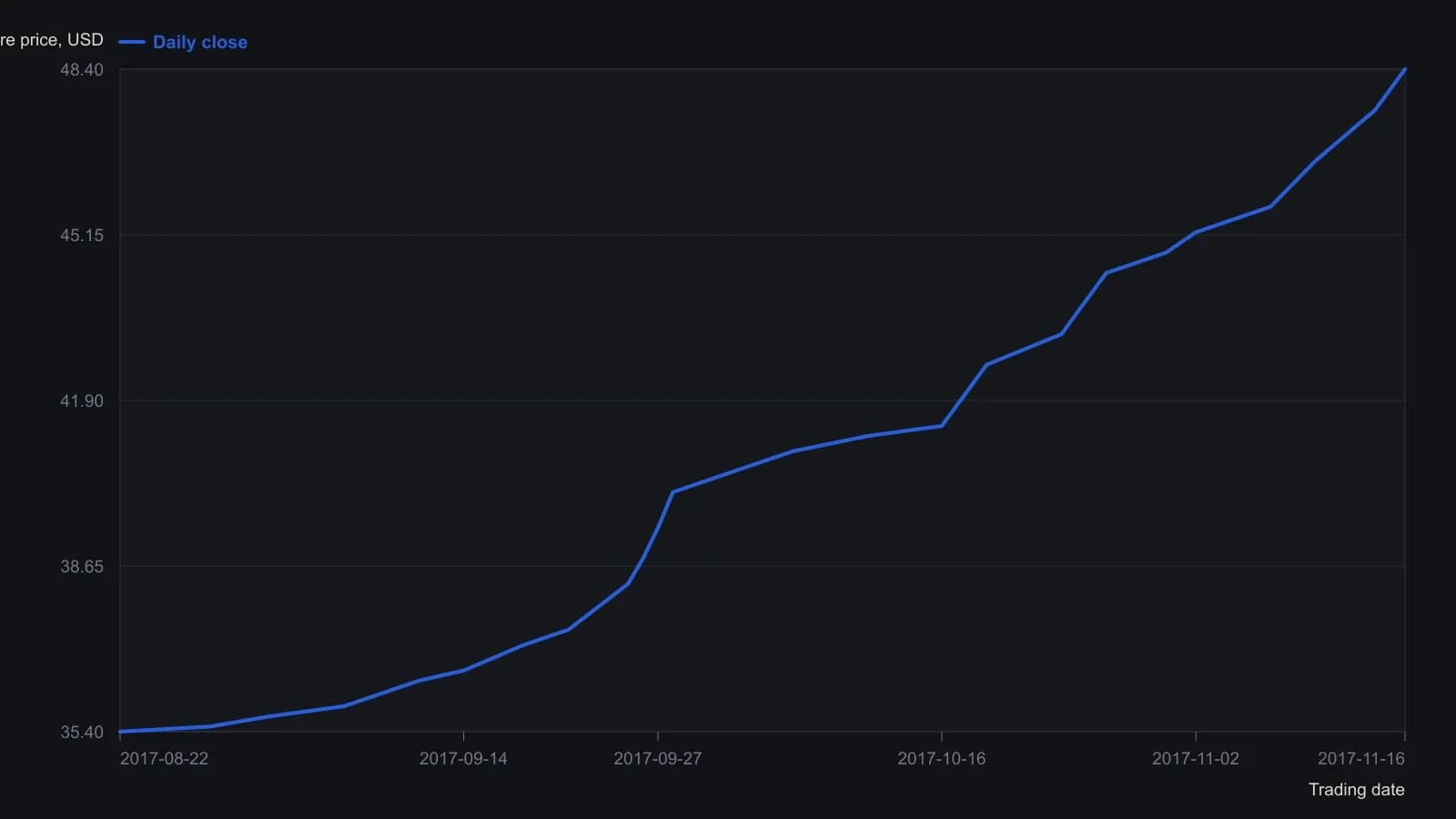
Raster digitization of the published daily candle chart. Closes are approximate to about 0.25–0.50 dollars. The source also highlights a matching three-bar volume expansion at the same late-September window and uses a $0.50 buy stop above the latest high plus a $2.00 initial and trailing stop; those order levels are stated in the text, not plotted as series.
All readings on this track · 35 readings
- 2001Swing trading with trailing stops and fixed loss exits
- 2003Linear regression swing alerts and trailing stops
- 2005Range-width gates for swing entries at base edges
- 2006Beyond setups: a six-factor trading process
- 2007Angle of ascent, chart scale, and style-fit
- 2010Stacking a short-horizon oscillator with a moving average and swing hold rules
- 2010A weekly contest long treated as one swing procedure
- 2011Four-color volume-price states for long-only swing actions
- 2012Classify momentum, velocity, or volatility before the swing signal
- 2013Swing rules as a portable entry and exit procedure
- 2013Constructing paired percent-b and stochastic swing oscillators
- 2013Give the fast band line and the slow stochastic complementary jobs
- 2013Smoothed percent-b divergences for numbered swing-wave rules
- 2013Portable swing rules for candle turns and a 1-2-3 wave count
- 2013A three-average swing and breakout case study
- 2013Constructing swing trades with a fifty-day average and a five-bar exponential average
- 2014From aliasing and dilation to a roofed stochastic swing
- 2014Channel width and trend-filter lookback as separate swing-trading choices
- 2016Constructing volume-confirmed multiday breakout swings
- 2017Constructing swing signals from a volume-weighted average cross
- 2017Golden-cross swing entry with a trailing-stop exit
- 2017One swing procedure: group leadership first, then a volume-price leave
- 2017Four-day green-candle breakout entry as one swing procedure
- 2017Swing pivots need a 100-period crossover and a breakout candle
- 2017Supply and demand zones as bounded swing maps
- 2018Three-bar volume-confirmed swing breakout
- 2018Tight stops first on swing breakouts with a range filter
- 2018Constructing trend and swing rules from horizon to crossover
- 2019Decade-level breakouts as one closed swing procedure
- 2019Inverse-pair swing trading with a shared buy-stop
- 2019Week-range next-day breakout on bitcoin pairs
- 2019Ranking strength before confirming a multi-timeframe breakout
- 2019Forty-five-degree multi-week swing breakout as a closed procedure
- 2020A dual pending-stop pair as one bitcoin swing construction
- 2020High-low activator, directional oscillator, and momentum swing agreement