2005issue C011-4
Range-width gates for swing entries at base edges
A swing procedure becomes eligible only after a range-width-gate shows that the market can host a multi-day hold. New entries are then confined to the edges of the base, and a four-session relative strength index is used only to confirm exits near support or resistance.
- Rising, falling, and sideways markets are examined as separate cases before any swing rule is eligible.
- The holding-period-ladder prefers the longest style the current range can still support, so a tight range replaces swing rules with short-term rules.
- While the market is basing, new longs and shorts start only at the boundaries. Mid-base-abstention keeps the interior for managing open trades.
- A four-session relative strength index corroborates exits or reversals as price nears a prior swing high or low, rather than holding for a first-try breakout.
The archive examines a trading procedure in rising, falling, and sideways markets as separate cases, not only across one multiyear mixed sample. Swing setups are generated only after that case is named.
Editorial interpretation: regime is a hard eligibility filter. A completed chart setup is not enough until a range-width-gate shows that the market can host a hold of several days to a few weeks.
How a range-width-gate assigns the holding period
A range-width-gate is a pre-scan test of how many sessions and how many points the market typically needs to travel from one range boundary to the other. It is used to choose among short-term, swing, and intermediate-term rules.
When more than one holding-period style can fit the current market, the holding-period-ladder selects the longest style those conditions will support.
If the market usually travels from one end of its range to the other in fewer than four sessions, short-term rules are chosen over swing rules. Recognizing a bounce at support or resistance is treated as using one of those sessions.
A range of about 60 points with typical daily travel of about 20 points is treated as too tight for swing holds. A range of about 100 points with the same daily travel is treated as having enough room.
What makes a swing hold eligible
Swing trading is specified as an initial stop under the setup low, a stop that is trailed as price advances, and a typical hold of three days to three weeks. It is applied in a wide range or a trend rather than a tight range.
The procedure is eligible only when the market’s range or trend is wide enough to host that hold. Editorial interpretation: the range-width-gate runs first, and the stop rules are applied only after that gate is passed.
Entries at the edges, not inside the base
When the market is basing, new long swing entries are allowed after a bounce from the lower boundary. New short entries are allowed after a retreat from the upper boundary. The interior of the base is reserved for managing open trades rather than starting new ones.
That interior is mid-base-abstention. Support and resistance are prior swing highs, swing lows, and the flat or sloping boundaries of a trading base. Those levels decide where new longs, new shorts, and forced exits are permitted.
Nasdaq daily closes along the late-2003 swing base
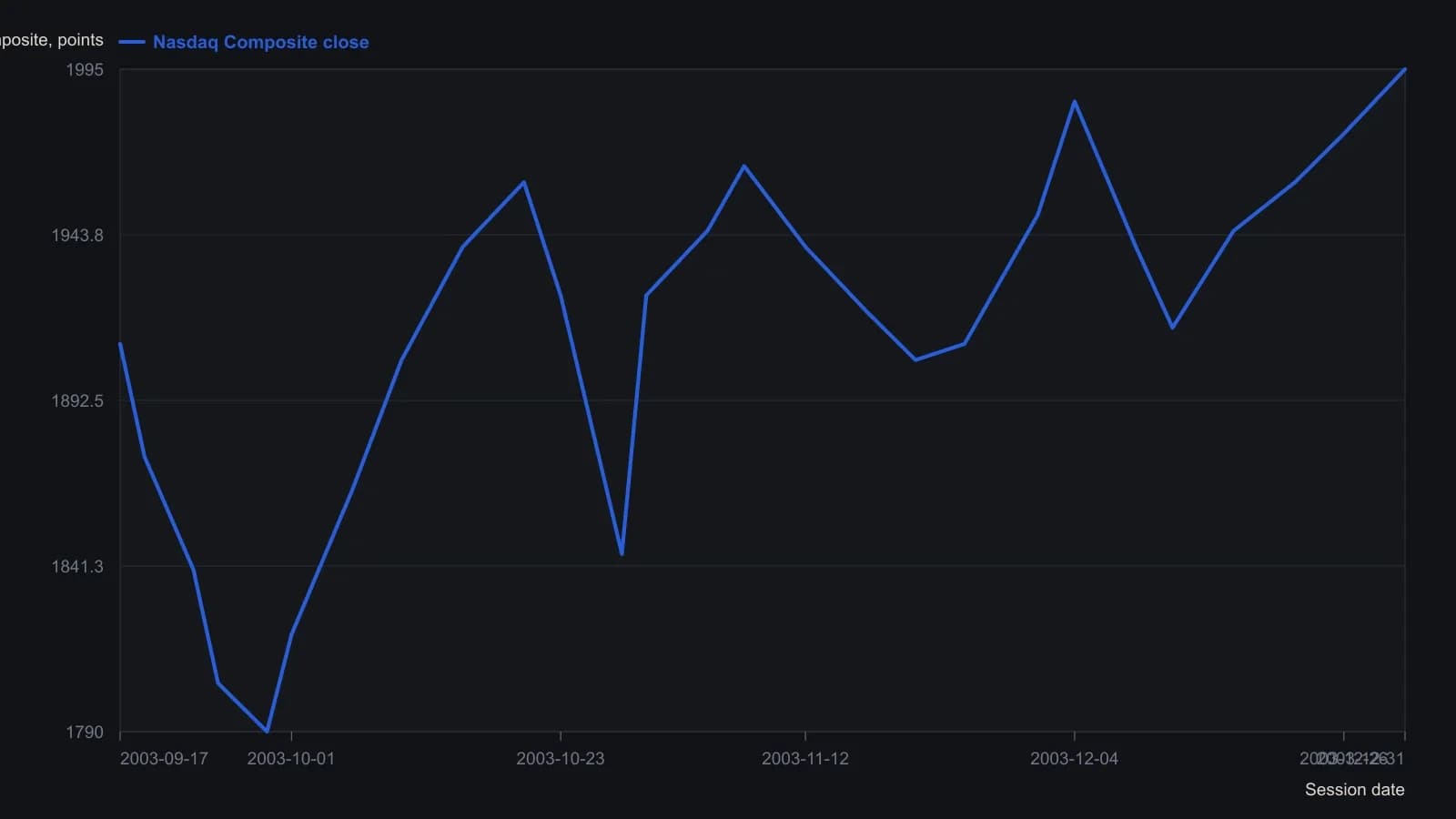
Session dates are interpolated from the October, November and December axis ticks. Each close is only as precise as the screenshot, about ±10 index points. The same pane plots a four-session Wilder RSI used to confirm those edge exits; it is omitted here because it uses a different scale.
A four-session check near prior extremes
A four-session relative strength index is used to corroborate exits or reversals as price nears a prior swing high or low. The premise is that those levels often fail on the first test.
After the base later breaks, new trades are aligned with that break.
Editorial interpretation: the oscillator is a short-lookback overbought or oversold check that supports taking profits or reversing near a prior swing extreme. It is not used as a standalone forecast, and it is not used to justify holding for a first-try breakout.
Several pattern families share the same gate
Setup generation uses several pattern families at once, including pullbacks, trendline breaks, morning stars, and flags. One flag filter keeps issues above five dollars with average volume of at least 200,000 shares that show a brief narrow base after a fast multi-session thrust.
Editorial interpretation: pattern recognition does not override the range-width-gate or mid-base-abstention. A flag that forms in a tight range, or in the interior of a base, remains ineligible for a new swing entry.
All readings on this track · 35 readings
- 2001Swing trading with trailing stops and fixed loss exits
- 2003Linear regression swing alerts and trailing stops
- 2005Range-width gates for swing entries at base edges
- 2006Beyond setups: a six-factor trading process
- 2007Angle of ascent, chart scale, and style-fit
- 2010Stacking a short-horizon oscillator with a moving average and swing hold rules
- 2010A weekly contest long treated as one swing procedure
- 2011Four-color volume-price states for long-only swing actions
- 2012Classify momentum, velocity, or volatility before the swing signal
- 2013Swing rules as a portable entry and exit procedure
- 2013Constructing paired percent-b and stochastic swing oscillators
- 2013Give the fast band line and the slow stochastic complementary jobs
- 2013Smoothed percent-b divergences for numbered swing-wave rules
- 2013Portable swing rules for candle turns and a 1-2-3 wave count
- 2013A three-average swing and breakout case study
- 2013Constructing swing trades with a fifty-day average and a five-bar exponential average
- 2014From aliasing and dilation to a roofed stochastic swing
- 2014Channel width and trend-filter lookback as separate swing-trading choices
- 2016Constructing volume-confirmed multiday breakout swings
- 2017Constructing swing signals from a volume-weighted average cross
- 2017Golden-cross swing entry with a trailing-stop exit
- 2017One swing procedure: group leadership first, then a volume-price leave
- 2017Four-day green-candle breakout entry as one swing procedure
- 2017Swing pivots need a 100-period crossover and a breakout candle
- 2017Supply and demand zones as bounded swing maps
- 2018Three-bar volume-confirmed swing breakout
- 2018Tight stops first on swing breakouts with a range filter
- 2018Constructing trend and swing rules from horizon to crossover
- 2019Decade-level breakouts as one closed swing procedure
- 2019Inverse-pair swing trading with a shared buy-stop
- 2019Week-range next-day breakout on bitcoin pairs
- 2019Ranking strength before confirming a multi-timeframe breakout
- 2019Forty-five-degree multi-week swing breakout as a closed procedure
- 2020A dual pending-stop pair as one bitcoin swing construction
- 2020High-low activator, directional oscillator, and momentum swing agreement