2020issue C0222-23
A dual pending-stop pair as one bitcoin swing construction
A bitcoin swing procedure stays flat until price travels a fixed 40,000-pip distance, then keeps only the filled side of a pending-bracket so direction is an outcome of the rules rather than a forecast.
- The construction places a buy-stop 40,000 pips above the current price and a sell-stop 40,000 pips below it, then stays flat until one side fills.
- When one stop is filled, the unfilled opposite stop is cancelled so the procedure holds only one side.
- The same rule-based-entry is written to operate whether bitcoin is rising or falling, so a directional forecast is not part of the setup.
- The fixed 40,000-pip offset is the only pre-trade distance that can activate a long or short, which bounds the exposure decision before any fill.
One procedure rather than a forecast
The construction problem is to write a bitcoin swing procedure that stays flat until price travels a fixed distance, then keeps only the filled side. Direction then follows from the rules rather than from a separate directional call.
Editorial reading: the dual pending-stop pair should be treated as a single rule-based-entry. The two orders are not two competing forecasts; they are one written procedure whose fill decides the side.
How the pending-bracket is written
The bitcoin construction places a buy-stop 40,000 pips above the current price and a sell-stop 40,000 pips below it. Those two pending orders form a pending-bracket around the market.
A buy-stop becomes a long only after price trades up through the stated level. A sell-stop becomes a short only after price trades down through the stated level. Until one of those levels is reached, the procedure holds no position.
When one stop is filled, the unfilled opposite stop is cancelled so the procedure holds only one side.
The session-window
Those pending stops are specified for placement between 9:00 am and 11:30 pm GMT. That clock interval is the session-window. After the window, the procedure withholds new orders.
Swing-trading instead of indefinite-hold
The procedure is specified as swing-trading on a four-hour bitcoin chart. Swing-trading here means capturing multi-bar moves on that intermediate chart instead of scalping or holding the coin indefinitely.
The same entry rules are written to operate whether bitcoin is rising or falling, so a directional forecast is not part of the setup.
The source separates indefinite-hold, which waits for price to recover above entry, from shorter-horizon trading that can act on both upward and downward swings. Those are treated as different objects: one is an ownership stance, the other is a timed trading rule.
Separate setups inside a bearish year
A broadly bearish calendar year can still contain short-horizon upward and downward swings that the trading procedure treats as separate setups. The archive illustrates that distinction on the four-hour bitcoin chart in April 2018 and in late July to early August 2018.
A stop-loss that bounds activation
The fixed 40,000-pip offset is the only pre-trade distance at which a long or short may be activated, so the exposure decision is bounded before any fill.
Editorial reading: that offset functions as a stop-loss in the precommitment sense. It decides when exposure may start, and it is set before a fill rather than after a loss has already grown.
Bitcoin four-hour path, April 2018
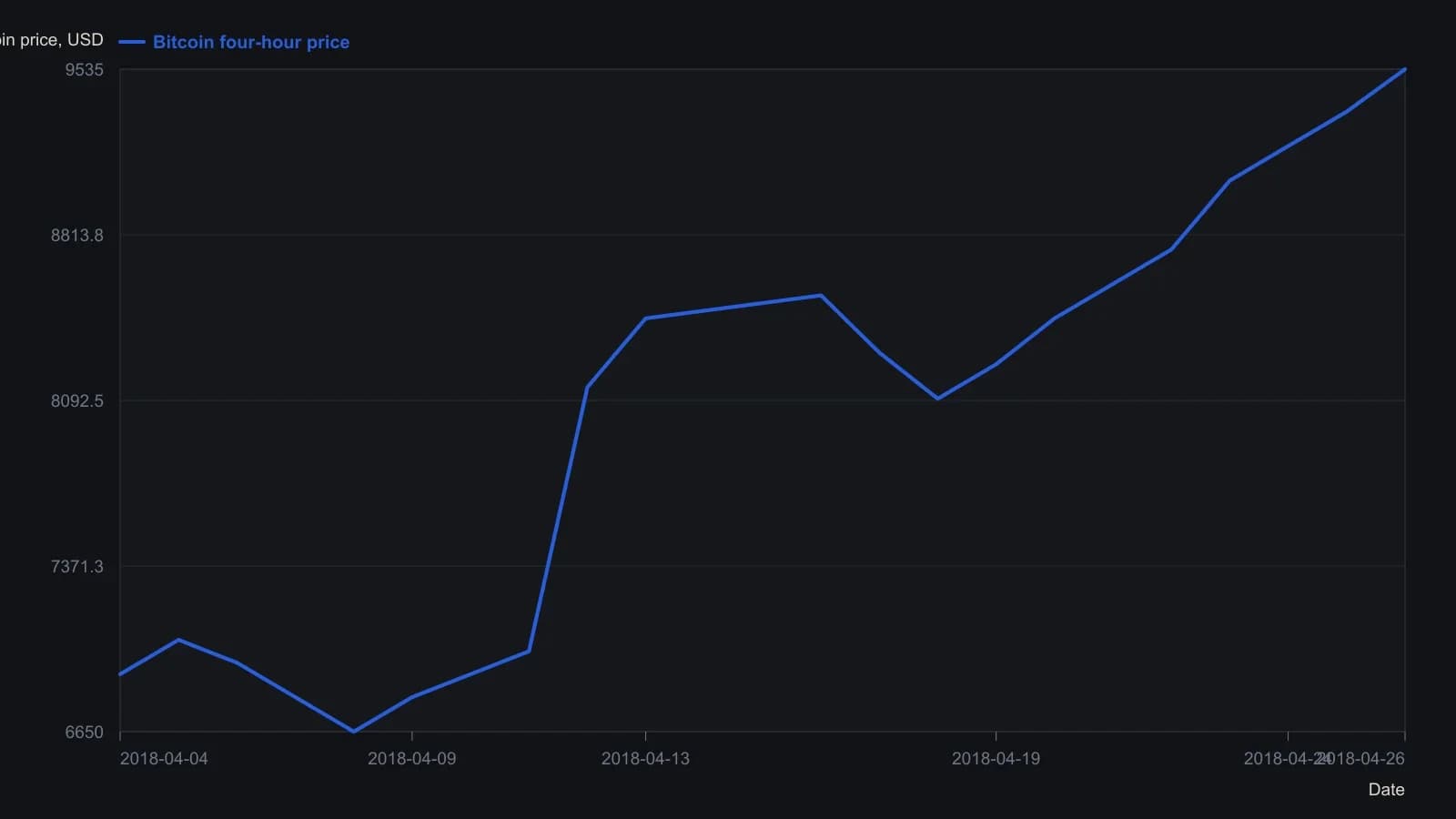
Closes estimated from the four-hour candlestick screenshot; most prices rounded to the nearest 50 dollars. Weekend gaps on the broker pane were skipped. The 26 April print matches the pane’s last-price label.
All readings on this track · 35 readings
- 2001Swing trading with trailing stops and fixed loss exits
- 2003Linear regression swing alerts and trailing stops
- 2005Range-width gates for swing entries at base edges
- 2006Beyond setups: a six-factor trading process
- 2007Angle of ascent, chart scale, and style-fit
- 2010Stacking a short-horizon oscillator with a moving average and swing hold rules
- 2010A weekly contest long treated as one swing procedure
- 2011Four-color volume-price states for long-only swing actions
- 2012Classify momentum, velocity, or volatility before the swing signal
- 2013Swing rules as a portable entry and exit procedure
- 2013Constructing paired percent-b and stochastic swing oscillators
- 2013Give the fast band line and the slow stochastic complementary jobs
- 2013Smoothed percent-b divergences for numbered swing-wave rules
- 2013Portable swing rules for candle turns and a 1-2-3 wave count
- 2013A three-average swing and breakout case study
- 2013Constructing swing trades with a fifty-day average and a five-bar exponential average
- 2014From aliasing and dilation to a roofed stochastic swing
- 2014Channel width and trend-filter lookback as separate swing-trading choices
- 2016Constructing volume-confirmed multiday breakout swings
- 2017Constructing swing signals from a volume-weighted average cross
- 2017Golden-cross swing entry with a trailing-stop exit
- 2017One swing procedure: group leadership first, then a volume-price leave
- 2017Four-day green-candle breakout entry as one swing procedure
- 2017Swing pivots need a 100-period crossover and a breakout candle
- 2017Supply and demand zones as bounded swing maps
- 2018Three-bar volume-confirmed swing breakout
- 2018Tight stops first on swing breakouts with a range filter
- 2018Constructing trend and swing rules from horizon to crossover
- 2019Decade-level breakouts as one closed swing procedure
- 2019Inverse-pair swing trading with a shared buy-stop
- 2019Week-range next-day breakout on bitcoin pairs
- 2019Ranking strength before confirming a multi-timeframe breakout
- 2019Forty-five-degree multi-week swing breakout as a closed procedure
- 2020A dual pending-stop pair as one bitcoin swing construction
- 2020High-low activator, directional oscillator, and momentum swing agreement