2019issue C086-7
Decade-level breakouts as one closed swing procedure
This archive case study binds a decade-level long into one rule-based-entry. The written workflow delays the breakout, parks invalidation under the round number, and exits the full position at the next nine-target.
- Longs are taken only on charts already in an uptrend and trading at or near a decade-level, which the procedure treats as a ten-point-channel boundary.
- The buy stop waits for the confirmation-offset above that hinge. After a fill, the invalidation-offset sits a fixed increment under the same decade-level.
- The nine-target is a full-position sell at the print ending in 9 just under the next decade-level, not a trailing stop.
- Editorial reading: a fill only 0.50 above the decade-level is an abstention rule inside the same rule-based-entry, not a looser breakout.
What the scan is waiting for
The written procedure looks for long setups on charts already in an uptrend and trading at or near a decade-level. That hinge is a share price that is an exact multiple of 10.
Price is described as often consolidating or pulling back at multiples of 10 per share, which is why those levels are treated as ten-point-channel boundaries.
The hold is specified as a swing-trading window of up to two to three months. The setup is kept as one unscaled position so initial stops stay simple.
PPC decade swing from the $20 buy zone to the $29 nine
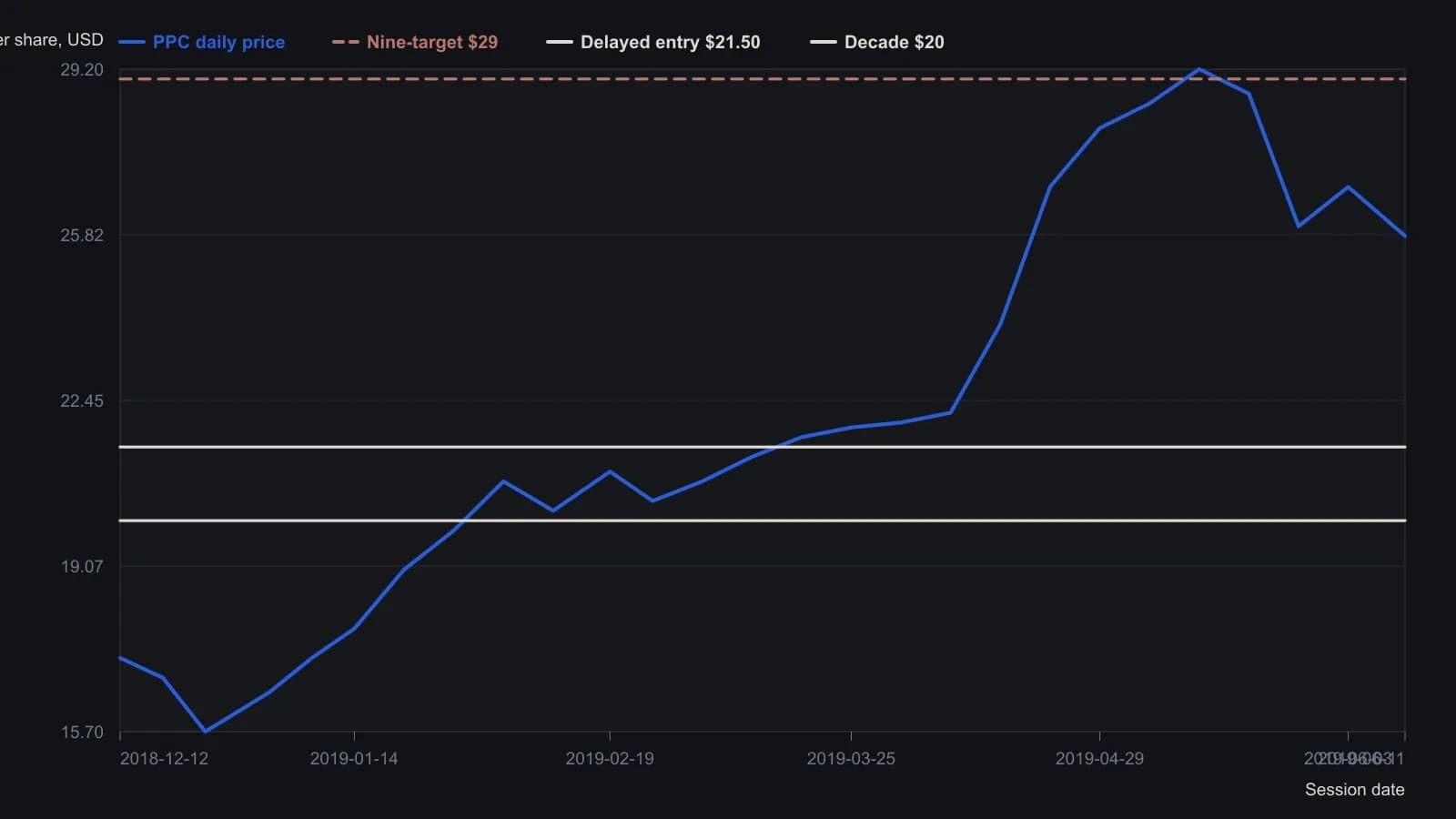
Closes were sampled on the labeled dates and rounded to the nearest $0.10; they are visual readings from the printed daily candles, not exchange prints. The $1.50-above-decade delay is the article's fixed offset for this $20 setup.
How the breakout is delayed
The entry rule is a buy stop at the confirmation-offset, a fixed 1.50 increment above the decade-level. When that decade-level is 20, the buy stop is shown at 21.50.
In this procedure a breakout is price clearing the decade hinge only after the confirmation-offset prints, not the first print through the round number.
After a fill, the protective stop is the invalidation-offset, a fixed 0.50 increment below the same decade-level. When the decade-level is 20, that stop is shown at 19.50.
The nine-target and the worked order
Planned exits are the nine-target, the print ending in 9 just under the next decade-level. The workflow illustrates 19 after an 11-area entry, or 29 after a 21-area entry.
Trade management uses a conditional sell at that nine-target instead of a trailing stop, so the full position exits if the print is reached. Selling at nines is framed as a behavioral reaction to expensive-looking prints rather than as a separate technical indicator.
The written procedure specifies an initial size of 100 shares. The worked order pair is a 100-share buy with a 21.50 stop and a 22 limit, paired with a 100-share sell at 29.
When a nearby fill is not the entry
A fill only 0.50 above the decade-level, shown as 20.50 versus waiting for 21.50, is described as more likely to be shaken out.
Editorial note: TradersWeek treats that warning as an abstention rule inside the same rule-based-entry, not as a reason to move the buy stop closer to the decade-level.
All readings on this track · 35 readings
- 2001Swing trading with trailing stops and fixed loss exits
- 2003Linear regression swing alerts and trailing stops
- 2005Range-width gates for swing entries at base edges
- 2006Beyond setups: a six-factor trading process
- 2007Angle of ascent, chart scale, and style-fit
- 2010Stacking a short-horizon oscillator with a moving average and swing hold rules
- 2010A weekly contest long treated as one swing procedure
- 2011Four-color volume-price states for long-only swing actions
- 2012Classify momentum, velocity, or volatility before the swing signal
- 2013Swing rules as a portable entry and exit procedure
- 2013Constructing paired percent-b and stochastic swing oscillators
- 2013Give the fast band line and the slow stochastic complementary jobs
- 2013Smoothed percent-b divergences for numbered swing-wave rules
- 2013Portable swing rules for candle turns and a 1-2-3 wave count
- 2013A three-average swing and breakout case study
- 2013Constructing swing trades with a fifty-day average and a five-bar exponential average
- 2014From aliasing and dilation to a roofed stochastic swing
- 2014Channel width and trend-filter lookback as separate swing-trading choices
- 2016Constructing volume-confirmed multiday breakout swings
- 2017Constructing swing signals from a volume-weighted average cross
- 2017Golden-cross swing entry with a trailing-stop exit
- 2017One swing procedure: group leadership first, then a volume-price leave
- 2017Four-day green-candle breakout entry as one swing procedure
- 2017Swing pivots need a 100-period crossover and a breakout candle
- 2017Supply and demand zones as bounded swing maps
- 2018Three-bar volume-confirmed swing breakout
- 2018Tight stops first on swing breakouts with a range filter
- 2018Constructing trend and swing rules from horizon to crossover
- 2019Decade-level breakouts as one closed swing procedure
- 2019Inverse-pair swing trading with a shared buy-stop
- 2019Week-range next-day breakout on bitcoin pairs
- 2019Ranking strength before confirming a multi-timeframe breakout
- 2019Forty-five-degree multi-week swing breakout as a closed procedure
- 2020A dual pending-stop pair as one bitcoin swing construction
- 2020High-low activator, directional oscillator, and momentum swing agreement