2019issue C126-7
Forty-five-degree multi-week swing breakout as a closed procedure
This archive case treats a 45-degree multi-week advance after a tall, high-volume bar as one swing procedure: a next-session long a fixed increment above that high, an immediate protective stop, and a stand-aside when those marks are missing.
- The case defines a swing-trading breakout as a multi-week advance that follows a 45-degree path after a large, high-volume strength bar.
- The scan is aimed at choppy or consolidating conditions and prefers names with clearer directional movement than a broad equity index, seeking outlier entries rather than ordinary range trades.
- In the illustrated example the long is specified for the session after the tall bar, 0.50 above the 46.50 high, which is 47, and only after price clears that high.
- After a fill the swing plan places a 2-point stop immediately beneath the entry and, while the advance lacks material pullbacks, allows adding size in roughly two-point increments.
The case as one procedure
The archive case defines a swing-trading breakout as a multi-week advance that follows a 45-degree path after a large, high-volume bar. That path is the angled-breakout: a multi-week advance whose path tracks a roughly 45-degree rise after an initiating strength bar.
A strength-bar is a session whose body height and volume stand out on the chart and is treated as the launch of the breakout.
Where the scan looks
The scan is aimed at choppy or consolidating conditions and prefers names with clearer directional movement than a broad equity index. That preference is the relative-strength-filter: a scan constraint that prefers names moving more directionally than a broad index during consolidation.
In choppy tape the method seeks unusually strong outlier-type entries rather than ordinary range trades. That choice is the outlier-entry: a breakout chosen because it is unusually strong relative to a choppy broader tape.
The strength bar as a launch mark
Tall, high-volume bars are handled analogously to gaps as possible opening marks of a strong upside breakout.
The case chart treats a September 26 bar as the session with the largest body and volume and as the start of the angled breakout.
TSM 90-day daily closes around the 45-degree breakout
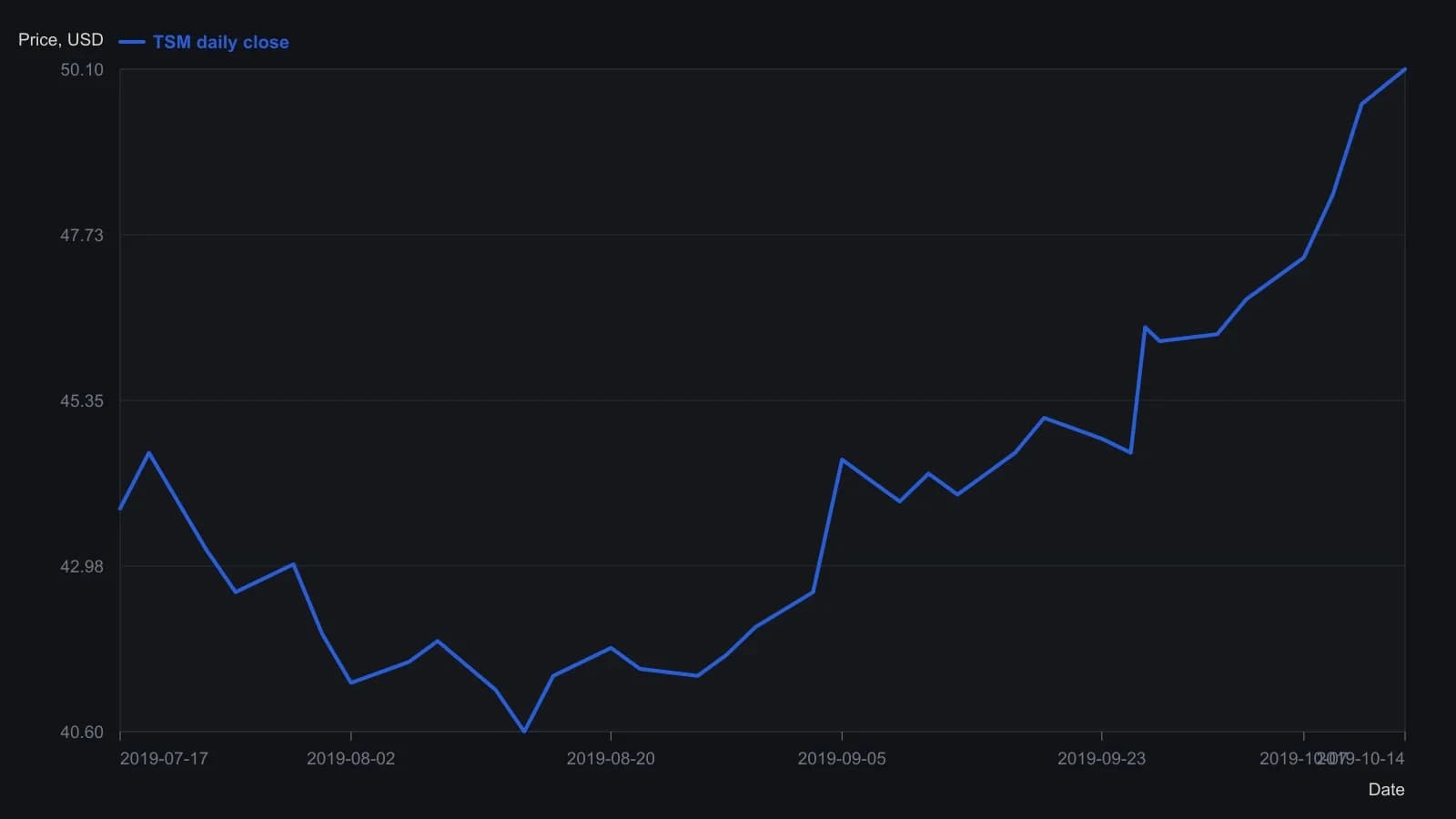
Closes digitized from the printed daily candle chart; wick extremes and volume are not reconstructed. September 26 high of $46.50 and $47 next-session entry are taken from the article text.
Next-session entry in the example
In the illustrated example, a long signal is recorded only after price clears the tall bar's session high of 46.50. The long is specified for the session after the tall bar, 0.50 above that high, which is 47 in the example.
That order is the next-session-entry: a long order placed on the day after the strength bar, a fixed increment above that bar's high.
Swing stop and add-on ladder
After a fill, the swing plan places a 2-point protective stop immediately beneath the entry. That is the swing-stop: a protective exit set a fixed distance under the fill as soon as the position is open.
Because the pattern is described as lacking material pullbacks, the same case allows adding size in roughly two-point increments. That plan is the add-on-ladder: a plan to increase size only while the advance continues without material pullbacks, using a fixed price increment.
When the marks are missing
An editorial reading is that the procedure stands aside when the strength bar, the next-session clearance, or the immediate stop cannot be marked. The archive case itself records a long only after price clears the tall bar's high and, in choppy tape, seeks outlier-type entries rather than ordinary range trades.
All readings on this track · 35 readings
- 2001Swing trading with trailing stops and fixed loss exits
- 2003Linear regression swing alerts and trailing stops
- 2005Range-width gates for swing entries at base edges
- 2006Beyond setups: a six-factor trading process
- 2007Angle of ascent, chart scale, and style-fit
- 2010Stacking a short-horizon oscillator with a moving average and swing hold rules
- 2010A weekly contest long treated as one swing procedure
- 2011Four-color volume-price states for long-only swing actions
- 2012Classify momentum, velocity, or volatility before the swing signal
- 2013Swing rules as a portable entry and exit procedure
- 2013Constructing paired percent-b and stochastic swing oscillators
- 2013Give the fast band line and the slow stochastic complementary jobs
- 2013Smoothed percent-b divergences for numbered swing-wave rules
- 2013Portable swing rules for candle turns and a 1-2-3 wave count
- 2013A three-average swing and breakout case study
- 2013Constructing swing trades with a fifty-day average and a five-bar exponential average
- 2014From aliasing and dilation to a roofed stochastic swing
- 2014Channel width and trend-filter lookback as separate swing-trading choices
- 2016Constructing volume-confirmed multiday breakout swings
- 2017Constructing swing signals from a volume-weighted average cross
- 2017Golden-cross swing entry with a trailing-stop exit
- 2017One swing procedure: group leadership first, then a volume-price leave
- 2017Four-day green-candle breakout entry as one swing procedure
- 2017Swing pivots need a 100-period crossover and a breakout candle
- 2017Supply and demand zones as bounded swing maps
- 2018Three-bar volume-confirmed swing breakout
- 2018Tight stops first on swing breakouts with a range filter
- 2018Constructing trend and swing rules from horizon to crossover
- 2019Decade-level breakouts as one closed swing procedure
- 2019Inverse-pair swing trading with a shared buy-stop
- 2019Week-range next-day breakout on bitcoin pairs
- 2019Ranking strength before confirming a multi-timeframe breakout
- 2019Forty-five-degree multi-week swing breakout as a closed procedure
- 2020A dual pending-stop pair as one bitcoin swing construction
- 2020High-low activator, directional oscillator, and momentum swing agreement