2019issue C0918-19
Inverse-pair swing trading with a shared buy-stop
This archive note applies an inverse-pair idea to swing trading. Long buy-stops on both legs share one prior-day high offset, so a breakout on one member is read together with a pair pivot or continuation on the other.
- The procedure is swing trading that looks for strong-trending inverse pairs and tries to avoid false breakouts.
- It uses high-volatility ETF and ETN pairs that typically move in opposite directions, including LABD with LABU, SQQQ with TQQQ, UGAZ with DGAZ, and UWT with DWT.
- The first step is a visual scan of the listed pair tickers. Only then are long buy-stops placed on both members, 0.30 above the prior-day high.
- One 90-day case shows DUST in a strong downtrend and GDX in a strong uptrend, with a pair pivot on DUST and a breakout continuation on GDX.
A swing reading of an inverse pair
The archive frames the work as swing trading: a multi-session holding procedure that places entries, exits, and abstentions from daily chart structure rather than from an intraday scalp. It seeks strong-trending charts while trying to avoid false breakouts.
The same inverse-pair idea previously described for daytrading is applied here to a swing holding period. Pairs trading, in this setting, reads two listed funds as one market-state hypothesis instead of as unrelated charts. An inverse pair is two listed funds expected to trend in opposite directions over the same lookback.
Where the method is specified
The method is specified for high-volatility ETF and ETN pairs that typically move in opposite directions. Named pair examples include LABD with LABU, SQQQ with TQQQ, UGAZ with DGAZ, and UWT with DWT.
The opening implementation step is a visual scan of the listed pair tickers before any stop is placed.
Shared buy-stops on both legs
Entries are long buy-stops on both pair members. A buy-stop is a long order that becomes active only after price trades through a pre-set trigger above the market.
A breakout is a long trigger that fires only after price clears a stated prior high while the pair remains in the same directional regime. The stated swing trigger is a prior-day high offset of 0.30 above the previous session high.
In the illustrated prices, that offset produces 10.7 from a 10.4 DUST high and 26.70 from a 26.4 GDX high.
One 90-day side-by-side case
One 90-day side-by-side case shows DUST in a strong downtrend and GDX in a strong uptrend. The archive describes those charts as highly correlated inverse charts.
The illustrated entries use a pair pivot on DUST and a breakout continuation on GDX. A pair pivot is a long taken after a turn higher on the declining member of an inverse pair. Both legs still use the same long buy-stop construction.
Daily DUST and GDX prices, April–August 2019
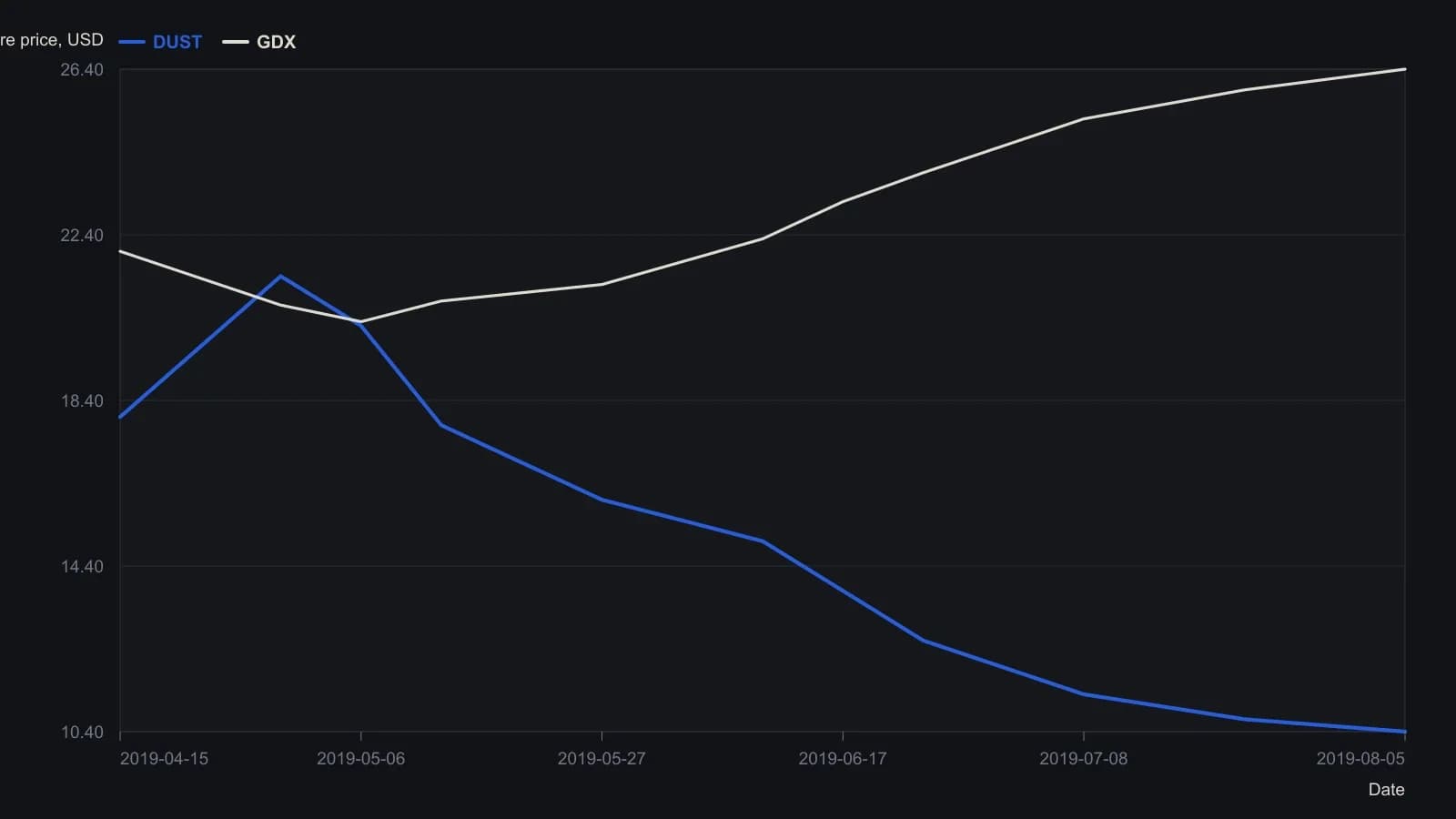
Candles were digitized from a dark eSignal 90-day pane, so path points are approximate to about 0.3–0.5 dollars and are not printed closes. The 10.4 (DUST) and 26.4 (GDX) highs come from the article text; the author’s swing trigger is those highs plus 0.30 and is not drawn as its own series.
All readings on this track · 35 readings
- 2001Swing trading with trailing stops and fixed loss exits
- 2003Linear regression swing alerts and trailing stops
- 2005Range-width gates for swing entries at base edges
- 2006Beyond setups: a six-factor trading process
- 2007Angle of ascent, chart scale, and style-fit
- 2010Stacking a short-horizon oscillator with a moving average and swing hold rules
- 2010A weekly contest long treated as one swing procedure
- 2011Four-color volume-price states for long-only swing actions
- 2012Classify momentum, velocity, or volatility before the swing signal
- 2013Swing rules as a portable entry and exit procedure
- 2013Constructing paired percent-b and stochastic swing oscillators
- 2013Give the fast band line and the slow stochastic complementary jobs
- 2013Smoothed percent-b divergences for numbered swing-wave rules
- 2013Portable swing rules for candle turns and a 1-2-3 wave count
- 2013A three-average swing and breakout case study
- 2013Constructing swing trades with a fifty-day average and a five-bar exponential average
- 2014From aliasing and dilation to a roofed stochastic swing
- 2014Channel width and trend-filter lookback as separate swing-trading choices
- 2016Constructing volume-confirmed multiday breakout swings
- 2017Constructing swing signals from a volume-weighted average cross
- 2017Golden-cross swing entry with a trailing-stop exit
- 2017One swing procedure: group leadership first, then a volume-price leave
- 2017Four-day green-candle breakout entry as one swing procedure
- 2017Swing pivots need a 100-period crossover and a breakout candle
- 2017Supply and demand zones as bounded swing maps
- 2018Three-bar volume-confirmed swing breakout
- 2018Tight stops first on swing breakouts with a range filter
- 2018Constructing trend and swing rules from horizon to crossover
- 2019Decade-level breakouts as one closed swing procedure
- 2019Inverse-pair swing trading with a shared buy-stop
- 2019Week-range next-day breakout on bitcoin pairs
- 2019Ranking strength before confirming a multi-timeframe breakout
- 2019Forty-five-degree multi-week swing breakout as a closed procedure
- 2020A dual pending-stop pair as one bitcoin swing construction
- 2020High-low activator, directional oscillator, and momentum swing agreement