2017issue C1148
Swing pivots need a 100-period crossover and a breakout candle
The documented swing-trading pivot waits for two confirmations before entry: a reclaim of the 100-period simple moving average after a decline toward the 200-period average, and an oversized daily candle on that reclaim day. A buy-stop, a 2-dollar stop, and sitting out stay inside the same rule set.
- A swing pivot waits for at least two confirming technical conditions instead of acting on the first bounce.
- The confirming pair is a reclaim of the 100-period simple moving average after a decline toward the 200-period average, plus an oversized daily candle on the reclaim day.
- The planned long is a buy-stop 0.50 above that oversized candle high, with a 2-dollar initial stop that can also be trailed.
- A 100-period touch or cross made only with an average-size candle is treated as a weaker continuation, so sitting out remains part of the same procedure.
An incomplete bounce until two conditions fire
The documented swing-trading pivot waits for at least two confirming technical conditions before entry instead of acting on the first bounce.
As a TradersWeek editorial drill, treat that first bounce as an incomplete bounce hypothesis. Do not complete the entry until a reclaim of the 100-period simple moving average and an oversized breakout candle fire together.
Chart template and scan
The chart template is a 90-day candlestick view with 50-, 100-, and 200-period simple moving averages. The 100-period SMA is the mid-range simple moving average on that template and the crossing line used for the setup.
The scan looks for shares priced from 20 to 70 that have declined to the 200-period simple moving average and then recover through the 100-period simple moving average.
PPC daily closes versus the 100-day and 200-day averages
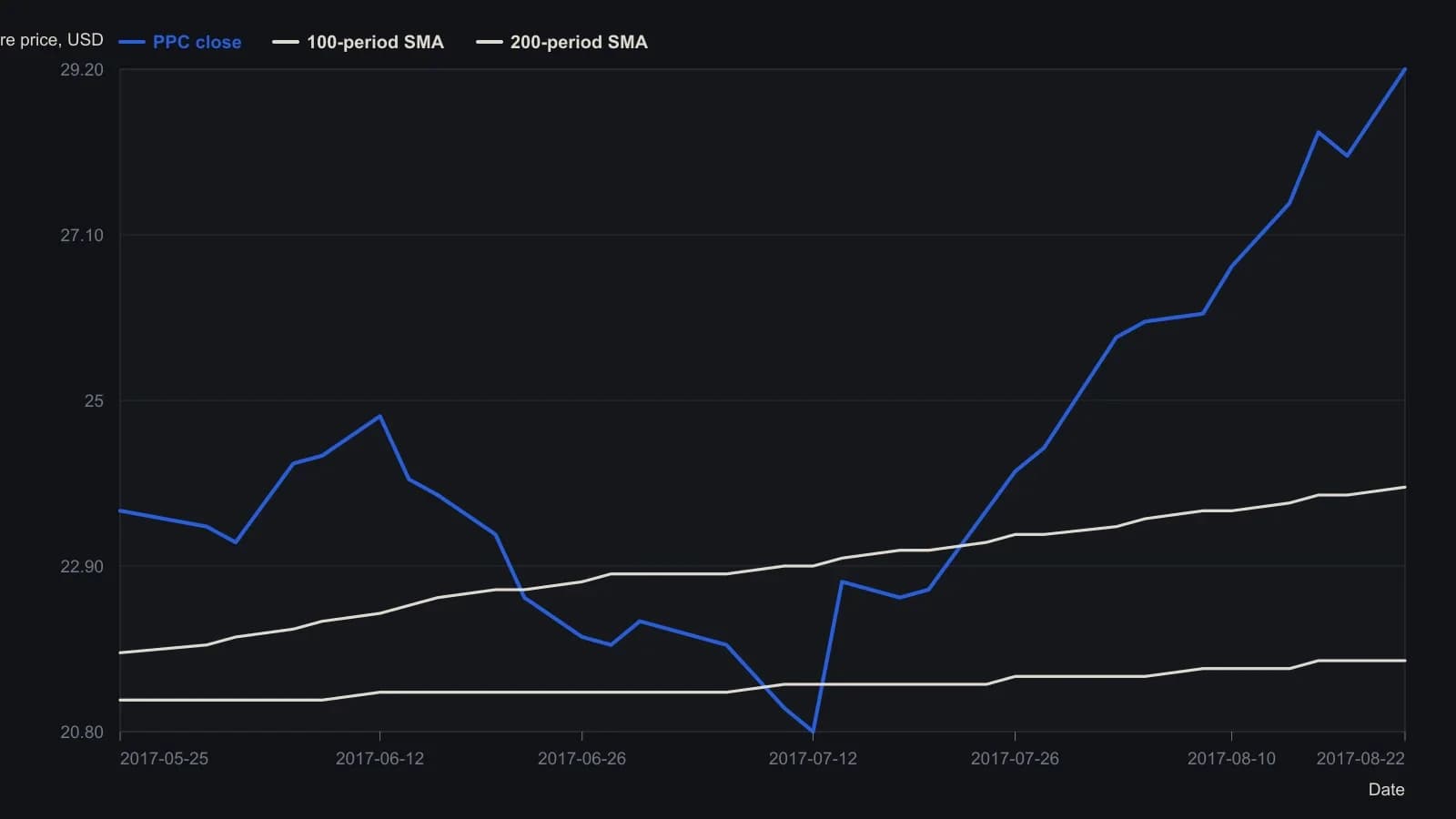
Visual readings from a half-dollar printed grid; dates follow the chart axis. The boxed late-July session is the first close back above the 100-day average.
What counts as the breakout candle
Breakout confirmation on the reclaim day is a daily candle at least twice as tall as candles from the prior week. That oversized candle is required on the day price clears the 100-period average.
A 100-period simple moving average touch or cross made only with an average-size candle is treated as a weaker continuation condition than the oversized-candle version.
Entry, stop, and sitting out
The planned long trigger is a buy-stop 0.50 above that oversized candle high after price has crossed the 100-period simple moving average. The buy-stop is a resting long order placed a fixed increment above the confirming candle high after the 100-period average has been crossed.
The swing-trade risk template uses a 2-dollar initial stop that can also be trailed.
When the 100-period reclaim arrives without the oversized candle, the same procedure withholds the buy-stop. Swing trading here is a multi-day holding procedure that binds scan, entry, stop, and abstention into a single rule set.
Why the crossing line is the 100-period average
The 50-period average is treated as an earlier pivot cue and the 200-period average as a slower one, so the crossing line used for the setup is the 100-period simple moving average.
TradersWeek editorial note: leave the 50-period and 200-period averages on the chart as context. The withheld-entry test still uses the 100-period crossing line plus the oversized candle.
All readings on this track · 35 readings
- 2001Swing trading with trailing stops and fixed loss exits
- 2003Linear regression swing alerts and trailing stops
- 2005Range-width gates for swing entries at base edges
- 2006Beyond setups: a six-factor trading process
- 2007Angle of ascent, chart scale, and style-fit
- 2010Stacking a short-horizon oscillator with a moving average and swing hold rules
- 2010A weekly contest long treated as one swing procedure
- 2011Four-color volume-price states for long-only swing actions
- 2012Classify momentum, velocity, or volatility before the swing signal
- 2013Swing rules as a portable entry and exit procedure
- 2013Constructing paired percent-b and stochastic swing oscillators
- 2013Give the fast band line and the slow stochastic complementary jobs
- 2013Smoothed percent-b divergences for numbered swing-wave rules
- 2013Portable swing rules for candle turns and a 1-2-3 wave count
- 2013A three-average swing and breakout case study
- 2013Constructing swing trades with a fifty-day average and a five-bar exponential average
- 2014From aliasing and dilation to a roofed stochastic swing
- 2014Channel width and trend-filter lookback as separate swing-trading choices
- 2016Constructing volume-confirmed multiday breakout swings
- 2017Constructing swing signals from a volume-weighted average cross
- 2017Golden-cross swing entry with a trailing-stop exit
- 2017One swing procedure: group leadership first, then a volume-price leave
- 2017Four-day green-candle breakout entry as one swing procedure
- 2017Swing pivots need a 100-period crossover and a breakout candle
- 2017Supply and demand zones as bounded swing maps
- 2018Three-bar volume-confirmed swing breakout
- 2018Tight stops first on swing breakouts with a range filter
- 2018Constructing trend and swing rules from horizon to crossover
- 2019Decade-level breakouts as one closed swing procedure
- 2019Inverse-pair swing trading with a shared buy-stop
- 2019Week-range next-day breakout on bitcoin pairs
- 2019Ranking strength before confirming a multi-timeframe breakout
- 2019Forty-five-degree multi-week swing breakout as a closed procedure
- 2020A dual pending-stop pair as one bitcoin swing construction
- 2020High-low activator, directional oscillator, and momentum swing agreement