2003issue C121-3
Linear regression swing alerts and trailing stops
A five-unit least-squares endpoint can be read as a short-horizon forecast. Its reversal map raises long or short alerts that still need a confirming bar, while a trailing stop, not a later map flip, ends the position.
- Keep the least-squares endpoint as a directional forecast of recent closes, not as another average of the same lookback.
- Treat a reversal-map flip as an alert only. The next bar must confirm before a long or short is taken.
- Exit with a trailing stop so the same forecast is not used to both open and close the trade.
- A slower average can hold back countertrend alerts, but the map still changes more often in ranges and minor corrections.
Three jobs on one swing desk
The archive keeps a least-squares line through recent closes as a short-horizon forecast, converts sign changes on that line into long or short alerts, and requires the next bar to confirm before a position is taken. Editorially, those steps are separate jobs on one swing desk: the line forecasts, the reversal map only grants permission to watch, and a trailing stop later ends the trade so the same indicator is not allowed to both open and close it.
The endpoint is a forecast, not an average
A five-unit least-squares regression through recent closes can be used as a directional forecast. Its endpoint is meant to track short-term price shifts with less delay than a moving average of the same length. Relative to averages of that length, the five-unit endpoint is described as turning two bars earlier than a simple moving average and one bar earlier than an exponentially smoothed moving average. The moving endpoint is treated as a forecast rather than as an average of those same closes.
How the reversal map is updated
A reversal map built from the five-unit endpoint records plus one while the endpoint is advancing and minus one after it turns down. The map is updated by comparing the current endpoint with its stored prior value and emitting plus one when the current value is at least as high as that prior value.
An alert is not an entry
In the frequent-trading swing procedure, a move to plus one is only a long alert, with entry if the next bar breaks or closes above the alert-bar high. A move to minus one is only a short alert, with entry if the next bar trades or closes lower. The alert-bar is the bar on which the reversal map changes state. It marks permission to watch for a break, not an automatic entry.
Five-unit linear regression, September 2003 dollar index
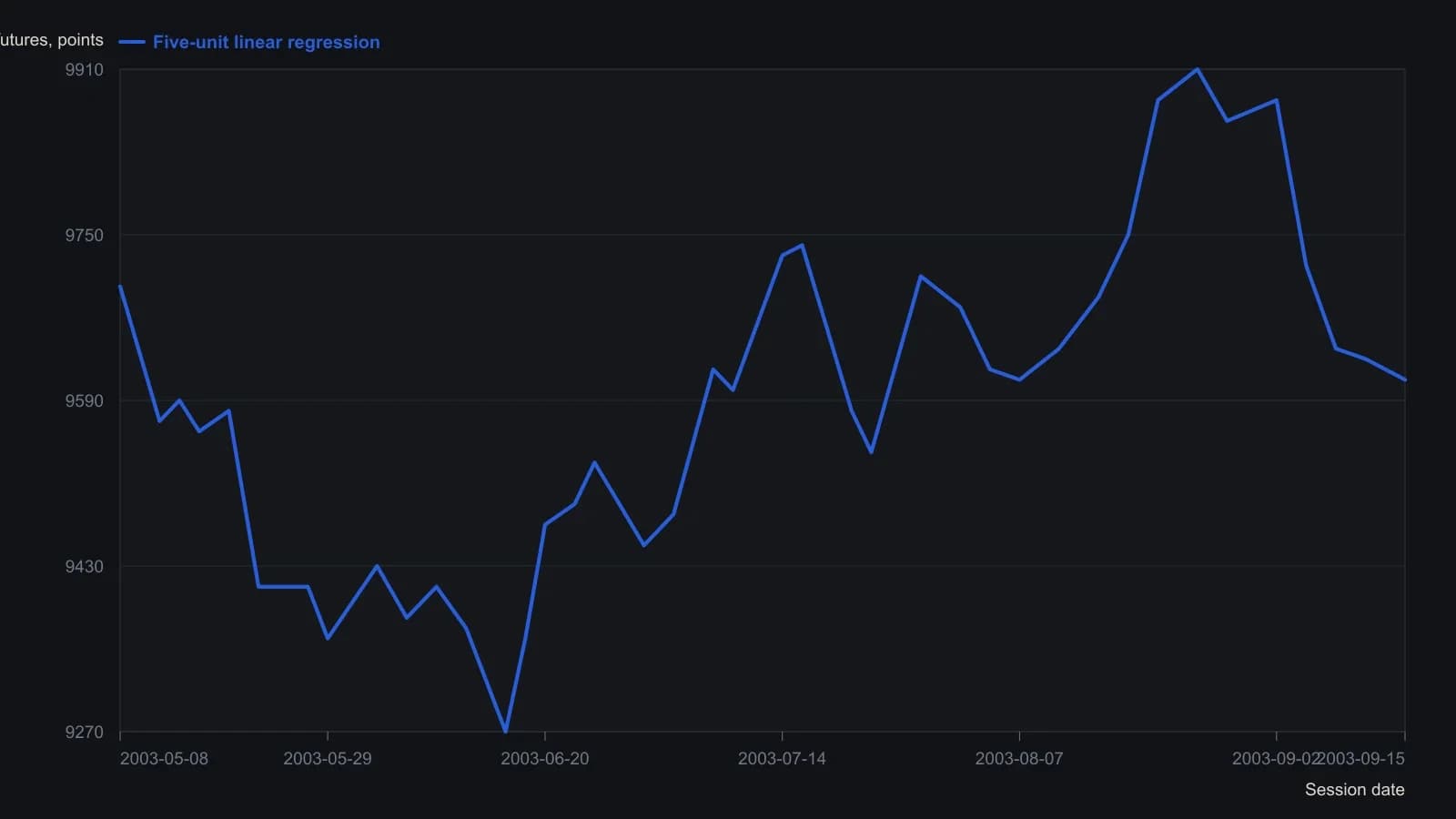
Length is the five-unit setting used in the article. Daily DX U2003. Digitized from the raster, so readings are only good to about 20 index points.
Exit without waiting for a flip
That same procedure exits with a trailing stop instead of waiting for the reversal map to flip the other way. The trailing stop follows the open position and ends it without waiting for the reversal map to change sign.
A slower average as a trend filter
A trend-aligned variation uses a 13-unit simple moving average so that plus-one rallies below the average wait for a return to minus one before a short is considered, while minus-one pullbacks above the average wait for a return to plus one before a long is considered. Editorially, that slower average is a trend-aligned filter: a plus-one rally below it is treated as countertrend, and a minus-one pullback above it is treated as a dip in an advance.
The main short-term limitation
The reversal map is described as changing more often when price is range-bound or in a minor correction, which is presented as its main limitation for short-term swing work.
All readings on this track · 35 readings
- 2001Swing trading with trailing stops and fixed loss exits
- 2003Linear regression swing alerts and trailing stops
- 2005Range-width gates for swing entries at base edges
- 2006Beyond setups: a six-factor trading process
- 2007Angle of ascent, chart scale, and style-fit
- 2010Stacking a short-horizon oscillator with a moving average and swing hold rules
- 2010A weekly contest long treated as one swing procedure
- 2011Four-color volume-price states for long-only swing actions
- 2012Classify momentum, velocity, or volatility before the swing signal
- 2013Swing rules as a portable entry and exit procedure
- 2013Constructing paired percent-b and stochastic swing oscillators
- 2013Give the fast band line and the slow stochastic complementary jobs
- 2013Smoothed percent-b divergences for numbered swing-wave rules
- 2013Portable swing rules for candle turns and a 1-2-3 wave count
- 2013A three-average swing and breakout case study
- 2013Constructing swing trades with a fifty-day average and a five-bar exponential average
- 2014From aliasing and dilation to a roofed stochastic swing
- 2014Channel width and trend-filter lookback as separate swing-trading choices
- 2016Constructing volume-confirmed multiday breakout swings
- 2017Constructing swing signals from a volume-weighted average cross
- 2017Golden-cross swing entry with a trailing-stop exit
- 2017One swing procedure: group leadership first, then a volume-price leave
- 2017Four-day green-candle breakout entry as one swing procedure
- 2017Swing pivots need a 100-period crossover and a breakout candle
- 2017Supply and demand zones as bounded swing maps
- 2018Three-bar volume-confirmed swing breakout
- 2018Tight stops first on swing breakouts with a range filter
- 2018Constructing trend and swing rules from horizon to crossover
- 2019Decade-level breakouts as one closed swing procedure
- 2019Inverse-pair swing trading with a shared buy-stop
- 2019Week-range next-day breakout on bitcoin pairs
- 2019Ranking strength before confirming a multi-timeframe breakout
- 2019Forty-five-degree multi-week swing breakout as a closed procedure
- 2020A dual pending-stop pair as one bitcoin swing construction
- 2020High-low activator, directional oscillator, and momentum swing agreement