1999issue C031-6
Managed-futures construction from trend, leverage, and diversification
This archive case study treats a futures sleeve as a construction problem. A trend-following stance can supply the other side of commercial-hedger demand, leverage-control keeps that stance bounded, and diversification places the sleeve in a portfolio context rather than as a standalone speculation.
- Futures markets exist mainly as a price-risk control mechanism for producers and consumers, not as a capital-raising venue.
- Outside investors balance residual commercial-hedger demand, and commitment-of-traders snapshots show commercial and large-investor net positions as near mirror images.
- Trend-following sets direction from the prevailing price path, while leverage-control bounds equity, volatility, and stop distance so a loss cannot expand without a decision.
- The case-study procedure uses broad continuous diversification, trend-based direction, relatively long holding periods, and strict leverage-control to put one futures trade into a portfolio context.
Futures as a price-risk market
Futures markets exist primarily as a price-risk control mechanism for producers and consumers. They are not a capital-raising venue for companies.
Three participant groups appear in these markets: producers, primary consumers, and outside investors who are not directly involved with the underlying goods.
The other side of commercial-hedger demand
A commercial-hedger is a producer or consumer who uses futures to transfer price risk rather than to express a directional investment view. When producers want to sell more than consumers want to buy, the market needs an external buyer of futures. Outside investors balance that residual commercial demand.
A commitment-of-traders report is a published snapshot of how commercial and large investor groups are net long or short in a futures market. Those published large-trader position reports show commercial and large-investor net positions as near mirror images, with investor exposure generally aligned with or moving toward the price trend.
Investor profits in this framing are compensation for supplying liquidity and risk-transfer services that commercial users need.
Trend-following supplies the stance
Trend-following is a rule that sets position direction from the prevailing price path and stays aligned with that path rather than forecasting a reversal. Most managed-futures programs used some form of this methodology. A managed-futures sleeve is run as a systematic allocation rather than as a single-market speculation.
The case study pairs that trend-based direction with relatively long holding periods.
Leverage-control bounds the sleeve
Leverage-control is a pre-trade and in-trade bound on how much account equity, volatility, and stop distance a futures sleeve may use so a loss cannot expand without a decision.
The case-study index of inherent-return is presented as unleveraged and as omitting trading and management costs. Typical practice applies leverage that magnifies both gains and losses. The bound is set before entry and kept in force throughout the position.
Diversification puts one trade in context
Diversification means spreading continuous exposure across uncorrelated market segments so one trade sits inside a portfolio and regime context instead of standing alone.
The same case study treats broad continuous diversification, trend-based direction, relatively long holding periods, and strict leverage-control as the procedure that puts a single futures trade into a portfolio context.
Weekly Japanese yen futures, November 1993 to December 1998
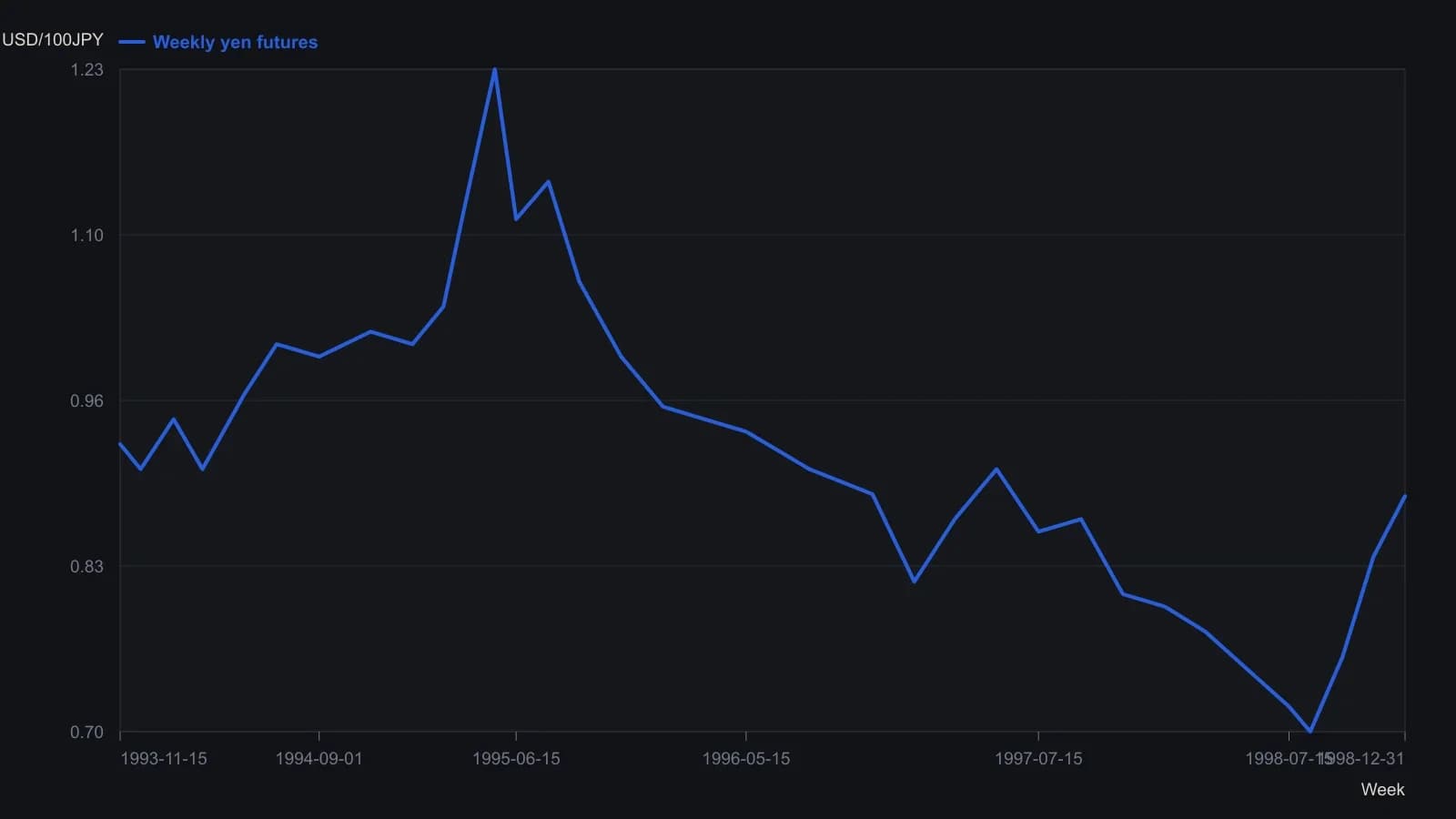
The lower pane plots net commercial and large-speculator positions against an unlabeled center line, so those series cannot be recovered as numbers and are omitted. Digitised weekly prices are approximate to the resolution of the raster.
Inherent-return as an unleveraged idea
Inherent-return is the idea that a diversified, unleveraged, trend-aligned futures stance can earn compensation over time for providing liquidity and risk transfer. The case study presents that idea as an unleveraged index that omits trading and management costs.
TradersWeek editorial interpretation: inherent-return is a construction concept for an unleveraged stance that omits those costs. It is not a claim about a finished, leveraged program, and it does not turn the sleeve into a standalone speculation.
All readings on this track · 13 readings
- 1989Evaluate mechanical systems by peak-to-trough drawdown
- 1991Pairwise return covariance as a construction gate
- 1999Managed-futures construction from trend, leverage, and diversification
- 2000Treat a single name as a node on a correlation tree
- 2002Rising correlation undercuts foreign-listing diversification
- 2003A directional call is not the skill that keeps an account alive
- 2006Risk-adjusted return for cross-market trend systems
- 2010Iron condor range, volatility and diversification
- 2015Reverse diversification when one winner enters a quiet book
- 2016Rebuild the book when correlations and commentary flip
- 2017Idle screens and unused choice across markets
- 2018Professional trader skill as a staged operating system
- 2019Mechanical systems as a critique of discretion