2006issue C091-5
Risk-adjusted return for cross-market trend systems
A mechanical trend book and an unlevered stock index become comparable only after account-size-scaling makes them share the same volatility. This article walks through that risk-adjusted-return workflow and the archive case for reading a single trend-following rule inside a diversified book.
- Risk-adjusted return is the return earned after account-size-scaling so two books share the same measured volatility.
- A one-contract-portfolio is scaled until its volatility matches the stock-index target, then the books are ranked by return.
- Diversification across weakly related markets, and then across systems and horizons, is presented as smoothing the equity path before that comparison.
- Editorial reading: judge a single mechanical trend-following rule only after it sits in a volatility-matched, diversified book.
Comparing books on one risk unit
Two books can be compared by scaling account size until they share the same volatility, then ranking the book with the larger return. An alternative comparison scales account size until both books share the same return, then ranks the book with the smaller risk.
Risk-adjusted return is the first of those two readings: the return earned after account-size-scaling so the books share the same measured volatility. Volatility is the standard deviation of natural-log interval returns and is the common risk unit. Account-size-scaling is the change of capital that makes a one-contract-portfolio or an unlevered book match a target volatility.
Volatility as the shared scale
Yearly DJIA volatility from 1980 to 2003 was about 12.93 percent, defined as the standard deviation of natural-log yearly returns. Under a normal one-standard-deviation reading, that 12.93 percent yearly volatility implies about a 68.27 percent chance the index stays within plus or minus 12.93 percent of the current level over the next year.
How the historical books were built
Four mechanical trend indicators were tested from 2 January 1980 to 30 April 2003 on a 35-market basket, one contract per signal, default 20-day parameters, and 75 dollars subtracted per trade for slippage and commission.
A mechanical-trading-system is a fixed entry, exit, and abstention procedure applied uniformly across markets. Trend-following rules take and hold positions in the direction of a detected price trend. The one-contract-portfolio trades a single futures contract per signal before any risk scaling.
Scaling account size to the index
Portfolio log returns for a chosen account size A are computed as the natural log of one plus yearly profit or loss divided by A, then converted to percent volatility with the sample standard deviation of those returns. Account size is then solved so the diversified one-contract book matches the DJIA volatility of 12.93 percent before risk-adjusted returns are compared.
A diversified book versus a stock basket
The 35-market books span currencies, interest rates, energies, metals, softs, grains, and meats, while the DJIA is a 30-stock basket whose members tend to move together. Diversification means spreading exposure across weakly related markets, systems, or horizons so gains and losses do not arrive together.
Because different markets trend at different times, a diversified 35-market book is presented as smoothing the equity path and lowering drawdown relative to a highly correlated stock index. Further risk reduction is described by stacking different systems on the same market and by mixing long-horizon and short-horizon mechanical rules in one book.
Risk-adjusted annual returns versus the Dow, 1980–2003
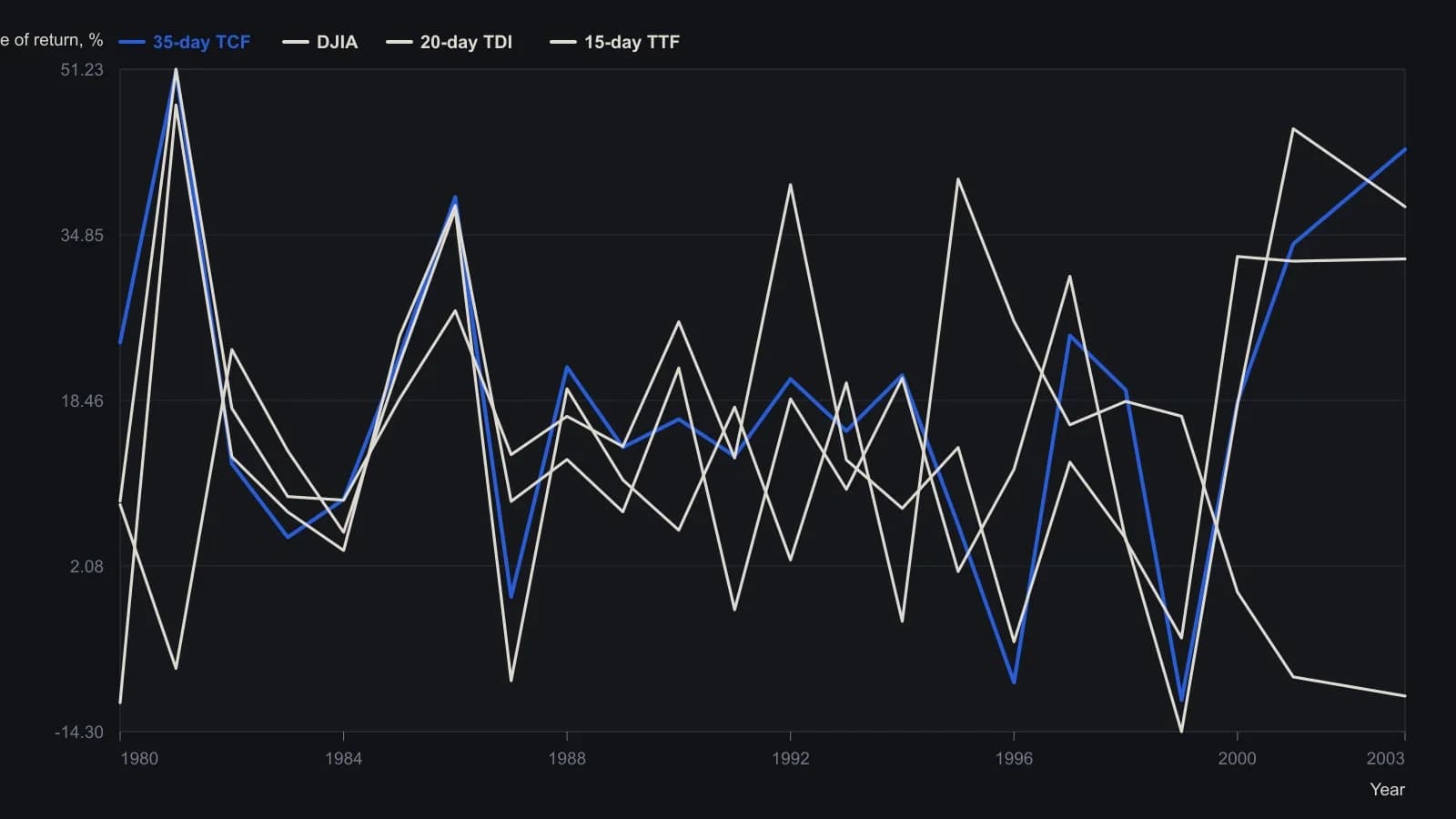
Account size for each futures book was solved so yearly log-return volatility equals the DJIA’s 12.9286669 percent (tau = 1 year). Books trade one contract per signal on 35 markets with $75 subtracted per trade for slippage and commission. Lookbacks are 20-day TDI, 35-day TCF, and 15-day TTF. The last point is January 2002 through April 2003, not a full calendar year. The 35-day PCI book (average 15.94 percent) is omitted because only four series can be drawn.
All readings on this track · 13 readings
- 1989Evaluate mechanical systems by peak-to-trough drawdown
- 1991Pairwise return covariance as a construction gate
- 1999Managed-futures construction from trend, leverage, and diversification
- 2000Treat a single name as a node on a correlation tree
- 2002Rising correlation undercuts foreign-listing diversification
- 2003A directional call is not the skill that keeps an account alive
- 2006Risk-adjusted return for cross-market trend systems
- 2010Iron condor range, volatility and diversification
- 2015Reverse diversification when one winner enters a quiet book
- 2016Rebuild the book when correlations and commentary flip
- 2017Idle screens and unused choice across markets
- 2018Professional trader skill as a staged operating system
- 2019Mechanical systems as a critique of discretion