2015issue C0448-55
Basket construction via rank, correlation, and locked rules
A basket can rank members into a shared score band, group leftover names with a correlation matrix taken from an earlier window, and only then expose lookback and threshold inputs. Entry, exit, and abstention stay written as one procedure.
- Rank-rotation orders candidates by a shared score, such as a five-period relative-strength oscillator, and admits only the top or bottom three ranks until a name leaves that band.
- Correlation-analysis stores pairwise, Pearson-style coefficients from a multi-month window as a matrix so names are grouped before a basket is specified.
- That correlation window is kept earlier than the bars reserved for a later system test, so membership is not chosen on the same sample used to evaluate the rules.
- Once rank, correlation, entry, and exit are one procedure, lookback, rank-cutoff, and correlation-threshold inputs can be exposed for later optimization and backtest review.
Membership first, leftover inputs last
The archive builds a basket as a single procedure. Names must first qualify by rank. They must then pass a correlation grouping measured on an earlier window. Only after those membership rules, and the entry and exit that members will use, are written down can leftover inputs be exposed.
Editorial reading: those are construction gates, not optional extras. If membership is still free to move while inputs are searched, the search can rewrite who sits in the book.
A sample spike-fade inside the book
A range-style series can be defined as the larger of the absolute high-versus-prior-close move and the absolute low-versus-prior-close move, leaving out the same-bar high-low width. That reading is a modified-true-range: a gap-based range that keeps the larger of those two distances.
That series can be averaged and given a standard deviation over a chosen lookback, then scored by how often it meets a user-set distance goal.
One sample procedure treats a reading at least three standard deviations above that average as a spike setup, then fades the close with a next-bar market order. That short-horizon fade is a spike-fade.
The same sample exits with a three-bar trailing channel. A long stops if the low undercuts the three-day lowest low. A short covers if the high exceeds the three-day highest high.
Who ranks into the book
A basket can rank members by a five-period relative-strength oscillator and restrict entries to the top or bottom three ranks, exiting when a name leaves that rank band.
That step is rank-rotation. Candidates are ordered by a shared score and only those that stay inside the rank band are admitted for the system holding period.
Who is too correlated to sit together
Pairwise correlation over a multi-month window, including a Pearson-style coefficient, can be stored as a matrix so candidate names are grouped before a basket is specified.
The window used to measure those correlations is kept earlier than the bars reserved for a later system test, so membership is not chosen on the same sample used to evaluate the rules.
Raw pairs can be sorted by correlation, cut by a threshold in the range from minus one to one, and optionally capped by a maximum number of pairs. The list is then reduced so leftover unlinked clusters become separate candidate baskets.
Those leftover unlinked clusters are correlation-islands: names that correlate strongly with each other but not with other clusters after threshold filtering.
A market-context variant averages how index members correlate with a volatility-futures series and only then allows a channel breakout, using a low-correlation regime as permission to act. That is correlation-analysis used so one trade sits inside a regime-aware basket.
Which leftover inputs may later be optimized
After rank, correlation, entry, and exit steps are written as one procedure, lookback, rank-cutoff, and correlation-threshold inputs can be exposed for later optimization and backtest review.
That last step is system-optimization: vary rule inputs only after entry, exit, and abstention are already written as one testable procedure.
Editorial reading: the exposed inputs may change how strict a rank band or correlation cut is. They should not rebuild the membership list on the same bars used to score the rules.
Strongest S&P 500 pairs after the locked 0.72 correlation filter
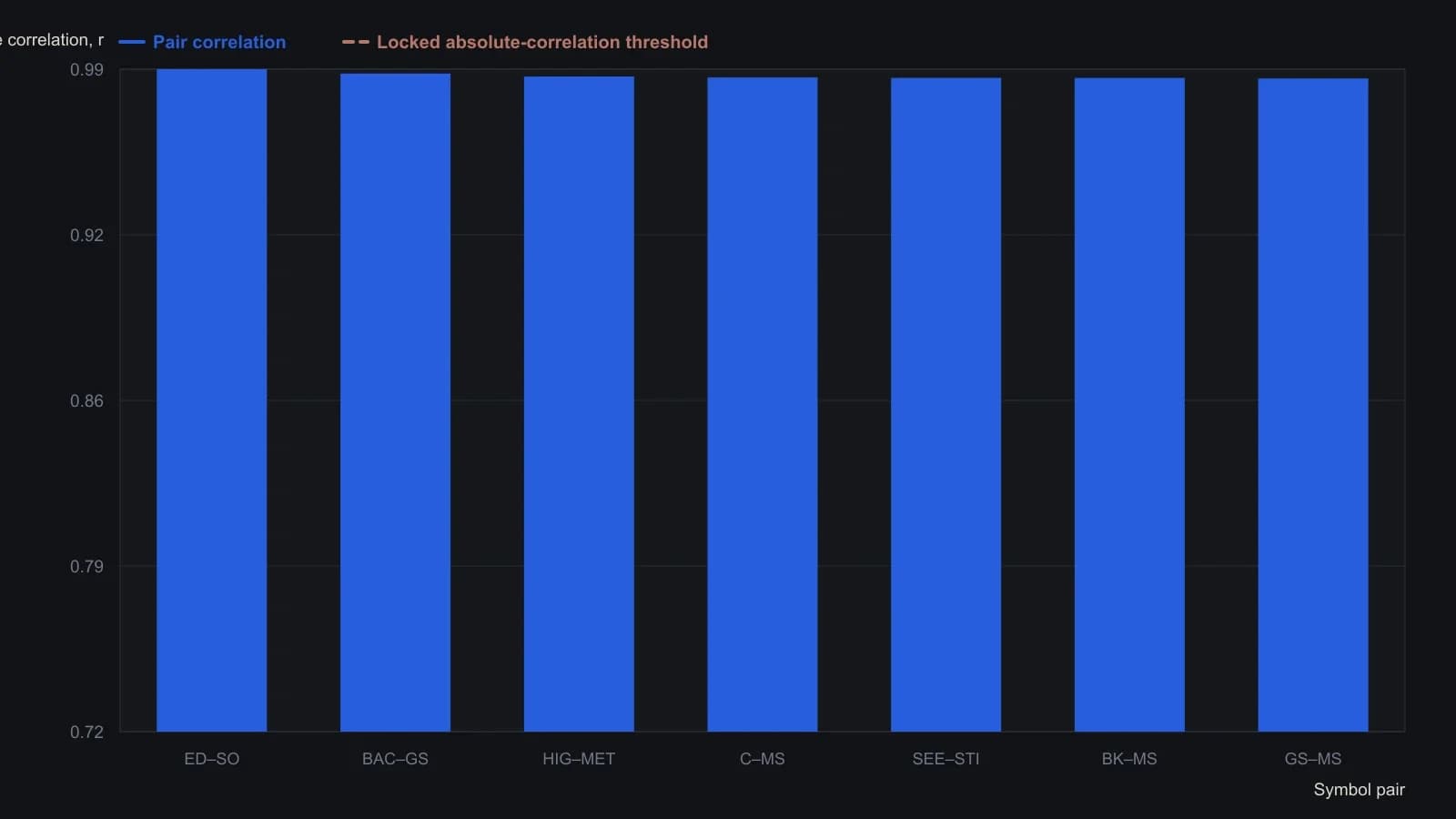
The spreadsheet fixed a 250-bar daily window on S&P 500 constituents, a hard correlation end date of 1 January 2015, an absolute threshold of 0.72, and a max-entries cap of 500. Of 27,131 pairs that cleared the threshold, only the strongest 500 were kept.
All readings on this track · 37 readings
- 1988Constructing a lead-aware correlation coefficient
- 1989A precious-metal price as a changing intermarket equation
- 1990Two clocks for copper: a factor regime, a regression baseline, and leftover moving-average timing
- 1990Earnings yield, rate correlation and regression for equity value
- 1991Name the window, then combine leaders
- 1991Constructing a two-market linear correlation check
- 1991Constructing a commodity-bond correlation regime filter
- 1992Building intermarket context with linear correlation
- 1993Inverse-scale overlays as a gold-equity regime filter
- 1994Constructing seasonal slots from windows, analog years, and implied volatility
- 1995Pin one reference close and roll companion correlations as an overlay
- 1995Rolling correlation windows for shifting intermarket regimes
- 1998Gold as a cross-market regime barometer
- 1999The gold-bond inverse is a regime, not a cause
- 1999A nested lag test of gold leading bond yields
- 1999Constructing spreads from stock and intermarket correlation
- 2000Evaluating headline versus food-and-energy-excluded CPI as bond-yield context
- 2005A late EUR/USD fifth wave tested by the Bund-Treasury gap
- 2006Intermarket dislocation as context for short-horizon momentum
- 2008Map ordinary 12-month outcomes before stacking valuation, rates, and seasonality
- 2008A clean-energy theme inside the oil-and-energy regime
- 2014Quantitative-easing overlays as fragile belief regimes
- 2015Three intermarket checks from the late-2014 crude decline
- 2015Basket construction via rank, correlation, and locked rules
- 2015Construct a CAD-oil pair from percent-of-range Bollinger maps
- 2015CAD/USD and crude: first the correlation, then the band gap
- 2017Correlation regime versus moving-average crossover for S&P 500 exposure
- 2017Updating intermarket systems after correlation shifts
- 2017Constructing a correlation-divergence regime filter for yen and Nikkei context
- 2018Clustered negative troughs in an energy-index pairwise correlation
- 2018Filter pairwise-correlation before reading an intermarket regime
- 2018Moving-average supports in the March 2018 correlation shock
- 2020Bond spreads as an equity regime lens
- 2020Crash-protection folklore as a correlation regime question
- 2020Constructing a bounded correlation-trend-filter
- 2020Constructing a correlation-to-line trend filter
- 2020Bitcoin correlation regimes across equities and gold