2008issue C021-4
A clean-energy theme inside the oil-and-energy regime
Renewable-energy investment was already described at US$100 billion in 2006, and listed products were treated as positively linked to oil. Archive notes offered exchange baskets as a diversified slice of the theme, showed them moving in close step with a traditional-energy sector fund in a February-to-October 2007 window, and flagged most new listings for low volume and potentially wide spreads.
- Intermarket-analysis reads oil, conventional energy equities, and clean-energy baskets together so the theme sits in a weeks-to-months energy-regime instead of a stand-alone story.
- Correlation-analysis tests whether listed clean-energy baskets move with a traditional energy sleeve closely enough that the idea is duplicate energy risk, not a diversifier.
- A liquidity-filter screens theme vehicles by volume and spread so only an executable basket survives before any portfolio weight is assigned.
- Index rules such as a revenue-screen, a generation versus equipment mix, and high index-holding bands describe what a thematic-basket owns. They do not prove the theme is independent of oil.
The theme was already a market
Renewable-energy investment was already described at US$100 billion in 2006, with the industry then growing at 20% to 30% a year.
Listed renewable-energy products were treated as positively linked to oil because higher oil prices were said to improve the relative economics of substitute fuels.
Policy inputs in the case included a US$150 billion ten-year climate-energy program, a US$50 billion strategic energy fund, and a European target to take 20% of energy from alternatives by 2020.
Place the idea in the energy-regime
Intermarket-analysis means reading oil, conventional energy equities, and clean-energy baskets together so one theme is placed in a weeks-to-months market regime rather than treated as a stand-alone story.
The energy-regime is the joint state of oil prices, conventional energy equities, and policy support that decides whether a clean-energy theme behaves as a hedge or as more energy exposure. The archive already treated listed products as moving with oil when substitute-fuel economics improved.
Editorial: those policy figures are regime inputs, not a reason to assign size. The first portfolio question is whether the oil link means the thematic-basket lives inside the same energy-regime as a conventional energy sleeve.
What the thematic-baskets held
Session-tradable exchange baskets were presented as a way to hold a diversified index slice of the theme, with ongoing expenses described as typically lower than those of index mutual funds. A thematic-basket is an exchange-listed collection of index constituents used to hold a clean-energy or transitional-energy idea instead of a single company.
A July 2007 London-listed clean-energy basket held 30 large listed companies, about 35% in generation and 65% in equipment and technology.
A May 2007 US-listed alternative-energy basket tracked a 30-name extra-liquid subset of an 88-name global composite and required more than 50% of revenue from alternative energy, rescreening more than 250 candidates every six months. That revenue-screen is an index rule that keeps only companies earning more than half of sales from alternative energy.
Several US theme funds were described as keeping at least 80% or 90% of assets in their published indexes, whose constituent counts were given as about 42, 47, and 84 names depending on the benchmark.
Editorial: construction rules describe the mix and the purity of the slice. They do not answer whether the slice is a new risk or a second energy bet.
Check for a duplicate energy sleeve
A February-to-October 2007 window was used to show alternative-energy baskets moving in close step with a traditional-energy sector fund, so the theme was treated as highly correlated with an existing energy sleeve.
Correlation-analysis checks whether listed clean-energy baskets move with a traditional energy sleeve closely enough that the theme is a duplicate energy risk, not a diversifier.
Editorial: when baskets already move in close step with a traditional-energy sector fund, adding a thematic-basket does not introduce a separate risk. It adds another expression of the same energy-regime.
Clean-energy baskets versus Energy SPDR, February–October 2007
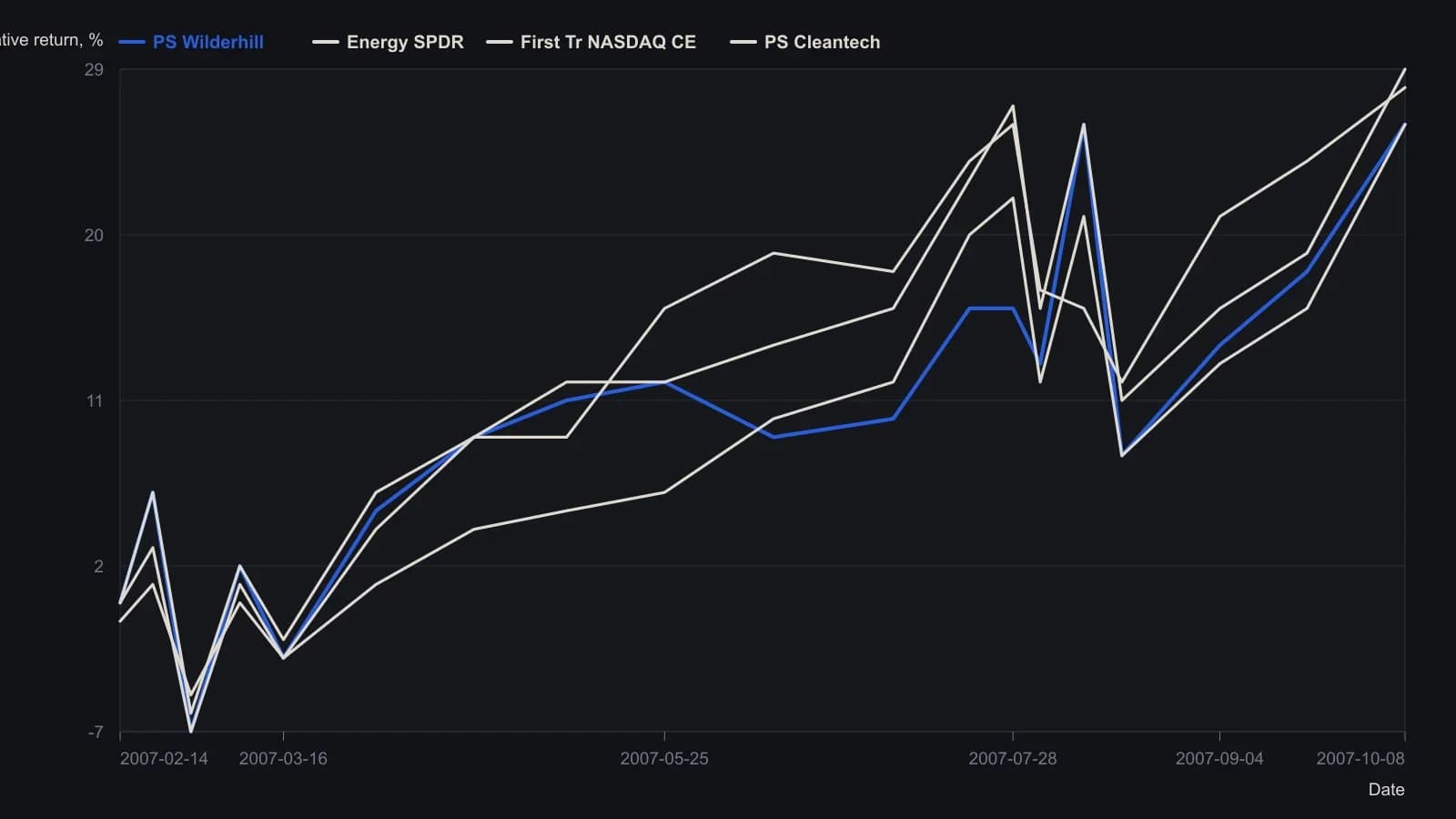
Digitized from the published 14 February–8 October 2007 performance chart. Readings are approximate to about one percentage point.
Screen liquidity before size
Most of the then-new theme baskets were flagged for low volume and potentially wide spreads. Only the March 2005 clean-energy listing was singled out as having good liquidity.
A liquidity-filter screens theme vehicles by volume and spread so only an executable basket survives before any portfolio weight is assigned.
Editorial: an illiquid vehicle should not receive a weight that the theme itself cannot justify. The archive singled out one listing as liquid. The others do not pass the filter on volume and spread.
All readings on this track · 37 readings
- 1988Constructing a lead-aware correlation coefficient
- 1989A precious-metal price as a changing intermarket equation
- 1990Two clocks for copper: a factor regime, a regression baseline, and leftover moving-average timing
- 1990Earnings yield, rate correlation and regression for equity value
- 1991Name the window, then combine leaders
- 1991Constructing a two-market linear correlation check
- 1991Constructing a commodity-bond correlation regime filter
- 1992Building intermarket context with linear correlation
- 1993Inverse-scale overlays as a gold-equity regime filter
- 1994Constructing seasonal slots from windows, analog years, and implied volatility
- 1995Pin one reference close and roll companion correlations as an overlay
- 1995Rolling correlation windows for shifting intermarket regimes
- 1998Gold as a cross-market regime barometer
- 1999The gold-bond inverse is a regime, not a cause
- 1999A nested lag test of gold leading bond yields
- 1999Constructing spreads from stock and intermarket correlation
- 2000Evaluating headline versus food-and-energy-excluded CPI as bond-yield context
- 2005A late EUR/USD fifth wave tested by the Bund-Treasury gap
- 2006Intermarket dislocation as context for short-horizon momentum
- 2008Map ordinary 12-month outcomes before stacking valuation, rates, and seasonality
- 2008A clean-energy theme inside the oil-and-energy regime
- 2014Quantitative-easing overlays as fragile belief regimes
- 2015Three intermarket checks from the late-2014 crude decline
- 2015Basket construction via rank, correlation, and locked rules
- 2015Construct a CAD-oil pair from percent-of-range Bollinger maps
- 2015CAD/USD and crude: first the correlation, then the band gap
- 2017Correlation regime versus moving-average crossover for S&P 500 exposure
- 2017Updating intermarket systems after correlation shifts
- 2017Constructing a correlation-divergence regime filter for yen and Nikkei context
- 2018Clustered negative troughs in an energy-index pairwise correlation
- 2018Filter pairwise-correlation before reading an intermarket regime
- 2018Moving-average supports in the March 2018 correlation shock
- 2020Bond spreads as an equity regime lens
- 2020Crash-protection folklore as a correlation regime question
- 2020Constructing a bounded correlation-trend-filter
- 2020Constructing a correlation-to-line trend filter
- 2020Bitcoin correlation regimes across equities and gold