2017issue C0748-56
Constructing a correlation-divergence regime filter for yen and Nikkei context
This archive article teaches the historical three-market workflow that measures short-horizon returns, fits a rolling association, scales the residual into a bounded oscillator, gates entries with a third-market-screen, and bounds the position with delayed stop-loss exits.
- The construction measures short-horizon percentage returns on the target and two companion series, then estimates a rolling linear association between the target return and the second-market return.
- A predicted target return is subtracted from the observed target return, and that residual is scaled into a bounded divergence-momentum oscillator.
- Long and short setups need a recent oscillator extreme, a turn that stays inside the complementary threshold, a third-market-screen below a fixed ceiling, and matching trend confirmation.
- Open positions are bounded by a delayed initial percentage stop, a later trailing percentage stop, and a fixed-bar time exit.
Why a three-market construction
The historical workflow is a form of intermarket-analysis. It puts a single equity-index trade into a regime-aware context by using related currency and equity-index prices rather than the target market alone.
Correlation-divergence is the residual oscillator that measures how far one market’s short-horizon return has departed from the return predicted by a second market. Correlation-analysis supplies the rolling association that both fits that prediction and later screens a third market.
Returns and the rolling association
The construction measures short-horizon percentage returns on the target series and on two companion series, then estimates a rolling linear association between the target return and the second-market return.
The rolling association used in the fit is a Pearson-style correlation of two series, computed from summed cross-products and variances and then clipped to the interval from minus one to one. Correlation-analysis is that rolling Pearson-style association between two short-horizon return series, used both to fit a linear prediction and to screen a third market.
From residual to divergence-momentum
A predicted target return is formed from that association and subtracted from the observed target return to produce a residual. That residual is then scaled into a bounded divergence-momentum oscillator.
Divergence-momentum is a scaled reading of the prediction residual over a lookback window, mapped into a bounded oscillator that can be compared with fixed upper and lower thresholds.
Daily DXJ regression-divergence oscillator with 75/25 triggers
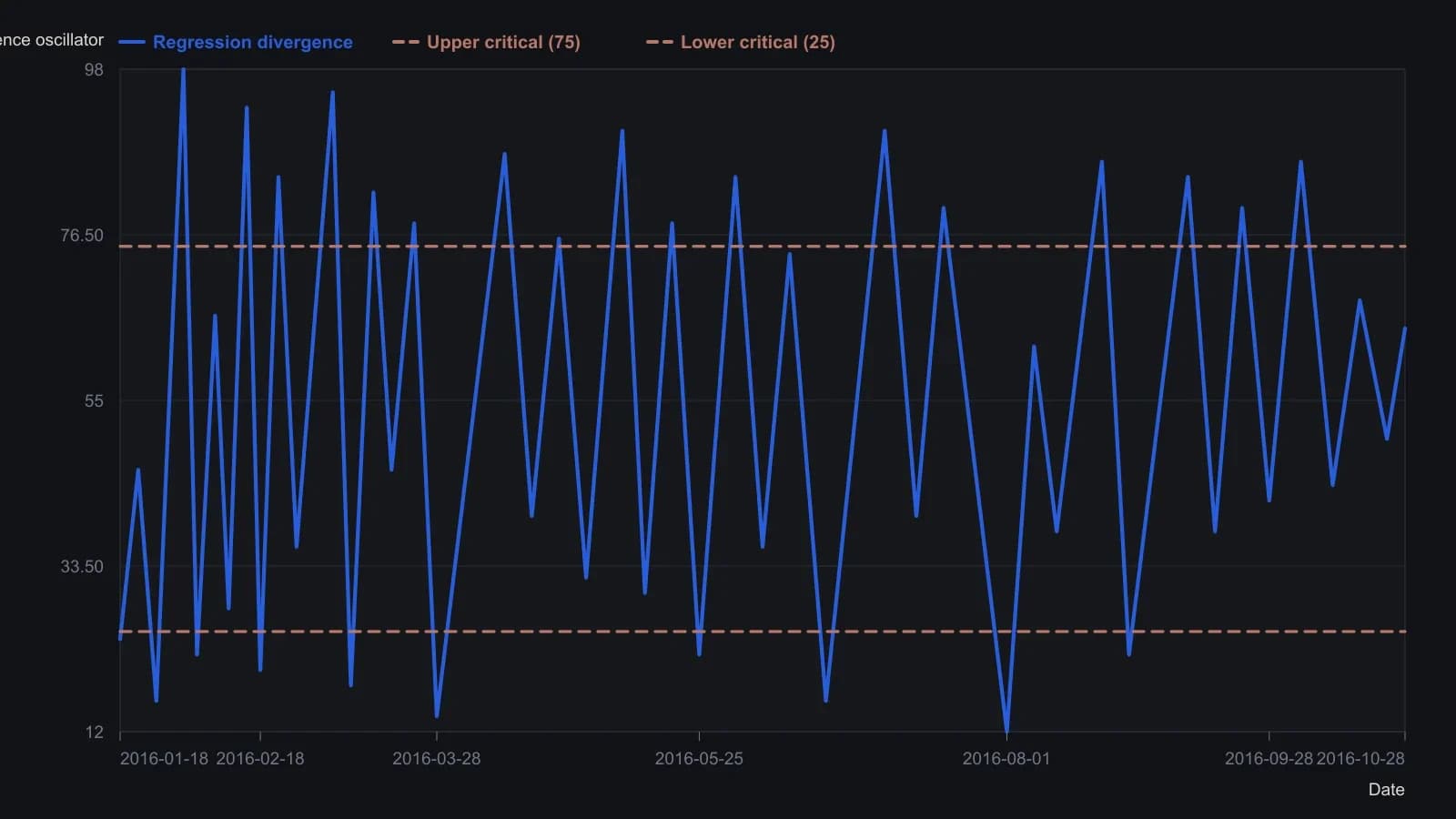
Pane uses the published defaults: 3-day returns, 50-day regression and momentum windows, 3-bar lag. Month labels run Feb–Oct; year 2016 is inferred from DXJ’s last print at 43.38, just before the late-year advance. Intra-month dates are interpolated from those ticks, so only the printed 64.34 is exact.
Long and short setups
A long setup requires the oscillator to have recently been above an upper threshold, then to turn down while remaining above the complementary lower threshold. It also requires the target’s correlation with the third market to stay below a fixed ceiling.
A short setup is the mirror image. The oscillator must have recently been below the lower threshold, then turn up while remaining below the upper threshold, again only if third-market correlation is below the same ceiling.
The third-market-screen is a correlation filter that withholds a two-market divergence signal when the target remains too tightly associated with a third reference market.
Trend confirmation and stop-loss exits
Trend confirmation is required at entry. A long also needs a non-declining linear-regression slope or a close above a moving average. A short needs the opposite pair of conditions.
Open positions are bounded by a delayed initial percentage stop, a later trailing percentage stop, and a fixed-bar time exit that flatten both long and short trades. Stop-loss is a pre-specified exit that bounds loss or open-trade exposure after a minimum holding period, including an initial percentage stop, a later trailing stop, and a time exit.
All readings on this track · 37 readings
- 1988Constructing a lead-aware correlation coefficient
- 1989A precious-metal price as a changing intermarket equation
- 1990Two clocks for copper: a factor regime, a regression baseline, and leftover moving-average timing
- 1990Earnings yield, rate correlation and regression for equity value
- 1991Name the window, then combine leaders
- 1991Constructing a two-market linear correlation check
- 1991Constructing a commodity-bond correlation regime filter
- 1992Building intermarket context with linear correlation
- 1993Inverse-scale overlays as a gold-equity regime filter
- 1994Constructing seasonal slots from windows, analog years, and implied volatility
- 1995Pin one reference close and roll companion correlations as an overlay
- 1995Rolling correlation windows for shifting intermarket regimes
- 1998Gold as a cross-market regime barometer
- 1999The gold-bond inverse is a regime, not a cause
- 1999A nested lag test of gold leading bond yields
- 1999Constructing spreads from stock and intermarket correlation
- 2000Evaluating headline versus food-and-energy-excluded CPI as bond-yield context
- 2005A late EUR/USD fifth wave tested by the Bund-Treasury gap
- 2006Intermarket dislocation as context for short-horizon momentum
- 2008Map ordinary 12-month outcomes before stacking valuation, rates, and seasonality
- 2008A clean-energy theme inside the oil-and-energy regime
- 2014Quantitative-easing overlays as fragile belief regimes
- 2015Three intermarket checks from the late-2014 crude decline
- 2015Basket construction via rank, correlation, and locked rules
- 2015Construct a CAD-oil pair from percent-of-range Bollinger maps
- 2015CAD/USD and crude: first the correlation, then the band gap
- 2017Correlation regime versus moving-average crossover for S&P 500 exposure
- 2017Updating intermarket systems after correlation shifts
- 2017Constructing a correlation-divergence regime filter for yen and Nikkei context
- 2018Clustered negative troughs in an energy-index pairwise correlation
- 2018Filter pairwise-correlation before reading an intermarket regime
- 2018Moving-average supports in the March 2018 correlation shock
- 2020Bond spreads as an equity regime lens
- 2020Crash-protection folklore as a correlation regime question
- 2020Constructing a bounded correlation-trend-filter
- 2020Constructing a correlation-to-line trend filter
- 2020Bitcoin correlation regimes across equities and gold